Ukraine braces for fall of Mariupol, Russian assault on east

1 / 2
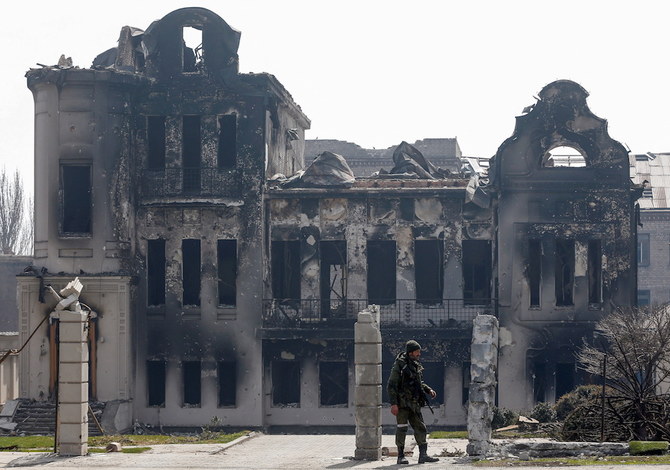
A service members of pro-Russian troops stands near a building burnt during Ukraine-Russia conflict in the southern port city of Mariupol. (Reuters)
2 / 2
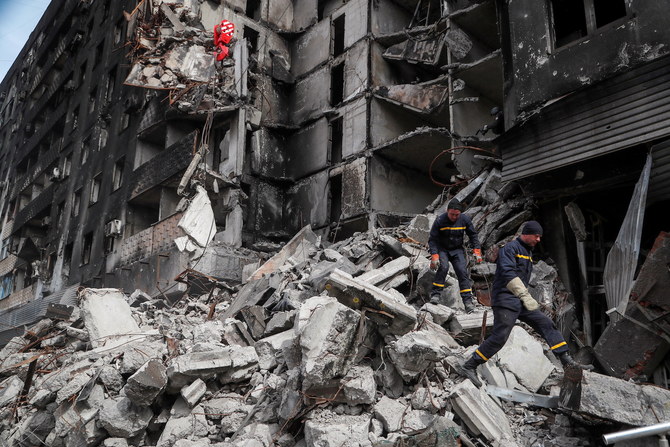
Emergency workers remove debris of a building destroyed in the course of the Ukraine-Russia conflict, in the southern port city of Mariupol, Ukraine April 10, 2022. (Reuters)
Short Url
Updated 11 April 2022
Follow

Ukraine braces for fall of Mariupol, Russian assault on east

  • Austrian leader Karl Nehammer planned to meet Russian President Vladimir Putin in Moscow on Monday
  • Russian forces have abandoned their attempt to capture the capital Kyiv, for now at least, but are redoubling their efforts in Ukraine’s east

KYIV: Ukraine braced Monday for what could be the imminent fall of Mariupol to Russia as President Volodymyr Zelensky said he believed “tens of thousands” of people had died in Moscow’s assault on the strategic port.
With the war grinding toward its seventh week, Ukrainian forces said they were also bolstering their positions in the east ahead of an anticipated massive Russian onslaught.
Austria’s chancellor meanwhile became the first European leader to visit Moscow since the Russian invasion, saying he raised alleged war crimes in devastated areas around Kyiv that had been under Russian occupation.
Ukrainian authorities say over 1,200 bodies have been found in the area so far and that they are weighing cases against “500 suspects,” including President Vladimir Putin and other top Russian officials.
Seven bodies were found Monday under the rubble of two multi-story buildings in Borodianka, Kyiv region, the state emergency service said in Telegram, bringing the total to 19.
French investigators arrived in Ukraine to help probe suspected Russian atrocities in the area, as the European Union earmarked 2.5 million euros ($2.7 million) to the International Criminal Court for future Ukraine cases.
Russia is believed to be trying to connect occupied Crimea and Moscow-backed separatist territories Donetsk and Lugansk in Donbas and has laid siege to Mariupol, once a city of more than 400,000 people.
“Today will probably be the last battle, as the ammunition is running out,” the 36th marine brigade of the Ukrainian armed forces said on Facebook.
“It’s death for some of us, and captivity for the rest,” it added, saying it had been “pushed back” and “surrounded” by the Russian army.
A pro-Russia rebel leader, Denis Pushilin, said separatist forces had already taken control of the city’s port, in comments reported by the RIA Novosti news agency.
Speaking to South Korea’s National Assembly by video link in an appeal for military assistance, Zelensky said Russia had “completely destroyed” the city and “burned it to ashes.”
“At least tens of thousands of Mariupol citizens must have been killed,” he said.
Russian forces are also turning their focus to the Donbas region in the east, where Zelensky said Russian troops were preparing “even larger operations.”
“They can use even more missiles against us... But we are preparing for their actions. We will answer,” Zelensky said.
Lugansk governor Sergiy Gaiday warned that the region could suffer as badly as Mariupol.
Over the weekend, further strikes hampered evacuations in and around Kharkiv in the northeast, killing 11 people including a seven-year-old child, regional governor Oleg Synegubov said.
“The Russian army continues to wage war on civilians due to a lack of victories at the front,” he said on Telegram.
In Dnipro, an industrial city of around one million inhabitants, Russian missiles rained down on the local airport, nearly obliterating the facility, local authorities said.
Gaiday said a missile strike on a railway station in the city of Kramatorsk on Friday, which killed 57 people, had left many afraid to flee.
He again urged people to leave the region, with five humanitarian corridors agreed for Monday.
“You are alive because a Russian shell has not yet hit your house or basement — evacuate, buses are waiting, our military routes are as secure as possible,” he wrote on Telegram.
Russia has denied carrying out the strike.
Over the weekend, nearly 50 wounded and elderly patients were transported from the east in a hospital train by medical charity Doctors Without Borders (MSF), the first such evacuation since the Kramatorsk attack.
Electrician Evhen Perepelytsia was rescued after he lost his leg in shelling in his hometown of Hirske.
“We hope that the worst is over — that after what I’ve been through, it will be better,” said the 30-year-old after arriving in the western city of Lviv.
On the diplomatic front, EU foreign ministers were meeting Monday to discuss a sixth round of sanctions, with concerns that divisions over a ban on Russian gas and oil imports could blunt their impact.
Austrian Chancellor Karl Nehammer said his meeting with Putin was not “a visit of friendship,” adding that he “mentioned the serious war crimes in Bucha and other locations.”
US President Joe Biden meanwhile will hold virtual talks on Monday with Indian Prime Minister Narendra Modi, just weeks after saying New Delhi had been “shaky” in its response to the invasion.
A US spokeswoman said the two leaders would consult on ways to offset the “destabilising impact (of the war) on global food supply and commodity markets.”
Russia was responsible for an escalating global food crisis because of its bombing of wheat stocks and preventing ships from carrying grain abroad, the EU’s top diplomat Josep Borrell said Monday.
The World Bank warned Sunday that Ukraine’s economy would collapse by 45 percent this year — far worse than it predicted even a month ago — while Russia would see an 11-percent decline in GDP.
The World Trade Organization meanwhile cautioned that the war could almost halve global trade growth this year.
Despite Kyiv’s allegations of Russian atrocities, Ukraine’s Foreign Minister Dmytro Kuleba on Sunday told NBC’s “Meet the Press” he was still open to negotiating with Moscow.
“If sitting down with the Russians will help me to prevent at least one massacre like in Bucha, or at least another attack like in Kramatorsk, I have to take that opportunity,” he said.
Bucha — where authorities say hundreds were killed, some with their hands bound — has become a byword for the brutality allegedly inflicted under Russian occupation.
More than 4.5 million Ukrainian refugees have now fled their country, the United Nations refugee agency said — 90 percent of them women and children.
At least 183 children have died and 342 were injured in Ukraine in 46 days of the Russian invasion, the prosecutor general’s office said on Telegram.


Trump takes unconventional approach to communicating to the public about war in Iran

Updated 03 March 2026
Follow

Trump takes unconventional approach to communicating to the public about war in Iran

  • The communications strategy opened Trump to criticism that he hadn’t done enough to explain the rationale and objectives of the war

Typical of an unconventional presidency, the Trump administration waited more than 48 hours to make any live, public communication to the American people about why it had decided to go to war with Iran.
President Donald Trump discussed why he launched the attack prior to a White House ceremony honoring military heroes on Monday but took no questions from reporters. Earlier in the day, Defense Secretary Pete Hegseth and Joint Chiefs of Staff Chairman Dan Caine briefed journalists at the Pentagon.
The two days previous, Trump delivered two pretaped statements that were released on Truth Social, the social media site owned by the president’s media company, and granted telephone interviews to more than a dozen journalists — several of which produced fragmented responses that, to some, clouded as much as they cleared up.
The communications strategy opened Trump to criticism that he hadn’t done enough to explain the rationale and objectives of the war, even as the American military suffered its first casualties. By contrast, Israeli Prime Minister Benjamin Netanyahu, who has teamed with the US against Iran, delivered two statements the day the war began and addressed reporters Monday at the site of a missile attack that killed nine people. The Israeli military has held multiple press briefings each day.
“The American people need a commander in chief, and he has been absent in that role,” Rahm Emanuel, White House chief of staff under President Barack Obama, said on CNN Monday. Emanuel, a Democrat, is contemplating a run for the presidency in 2028.
An unconventional strategy leads to criticism
Peter Baker, chief White House correspondent for The New York Times, wrote on social media that “after Trump launched a new war on Iran, he did not rush back to the White House to make an Oval Office address to rally the nation as other presidents have done. He stayed at Mar-a-Lago to attend a glitzy political fundraiser.”
That post provoked a response from Steven Cheung, White House communications director. “Imagine being a reporter so consumed with Trump Derangement Syndrome that he wants President Trump to mimic the failed policies of the past. The truth is that President Trump spent the majority of his time monitoring the situation in a secure facility, in constant contact with world leaders, and made multiple addresses to the nation that garnered hundreds of millions of views. He also took dozens of calls with reporters.”
The calls included one with Baker’s colleague at The Times, Zolan Kanno-Youngs. Trump’s mobile phone number is known to many of the reporters who cover him, and the president often takes their calls for on-the-spot interviews. Besides The Times, he spoke in the aftermath of the attack to journalists for ABC, CBS, NBC, CNN, CNBC, Fox News Channel, The Atlantic, The Washington Post, Axios, Politico and an Israeli television station.
Most of the calls were brief and marginally illuminating; Politico’s Dasha Burns said Trump answered but said he was too busy to talk. The public couldn’t hear what Trump said in the interviews and was dependent upon what the journalists chose to report on the conversations.
“I spoke to President Trump today and he told me that the operation in Iran is going to go very fast,” Libby Alon, a reporter for Channel 14 News in Israel, wrote about her interview on X. “It’s doing very well, and (will) make the people of Israel very happy, and the people of the world very happy.”
The Times reported that in its six-minute chat, Trump “offered several seemingly contradictory visions of how power might be transferred to a new government — or even whether the existing Iranian power structure would run that government or be overthrown.”
In one of his two conversations with Trump, ABC News’ Jonathan Karl said when he asked about the death of Iranian Ayatollah Ali Khamenei, the president said: “I got him before he got me. They tried twice. Well I got him first.” CNN’s Jake Tapper went on the air minutes after his conversation Monday, saying Trump told him “the big one is coming soon,” an apparent reference to a future attack.
Asked for comment, White House spokeswoman Anna Kelly said: “President Trump is the most transparent and accessible president in American history. The American people have never had a more direct and authentic relationship with a president of the United States than they have with President Trump.”
Hegseth briefing concentrates on friendly reporters
Pentagon reporters learned late Sunday about Hegseth’s briefing. Reporters from The Associated Press, Reuters, ABC, CBS, NBC, CNN, Fox News Channel and Stars & Stripes were permitted into the briefing room, but Hegseth did not call on them. Instead, he took questions from NewsNation and Trump-friendly outlets like the Daily Caller, Daily Wire, One America News and the Christian Broadcasting Network. Most mainstream news outlets left their regular stations at the Pentagon last fall rather than agree to Hegseth’s rules restricting their work.
Hegseth denounced the “foolishness” of people wanting to know details of the operation in advance, such as whether Americans would commit to more than air power, and said the operation would continue as long as it took to achieve objections. He initially ignored NBC News’ Courtney Kube when she called out a question: “President Trump put a four-week time limit on it. Are you saying he’s wrong?”
Later, Hegseth denounced Kube for asking “the typical NBC sort of gotcha-type question. President Trump has all the latitude in the world to talk about how long it might take — four weeks, two weeks, six weeks, it could move up, it could move back. We’re going to execute at his command the objectives he set out to achieve.”
Unlike Pentagon briefings in past administrations, reporters were given assigned seats, with the Trump-friendly outlets seated in front. Jennifer Griffin, Hegseth’s former colleague at Fox News Channel who left the Pentagon with other reporters after not accepting his new rules, was seated in the last row.