

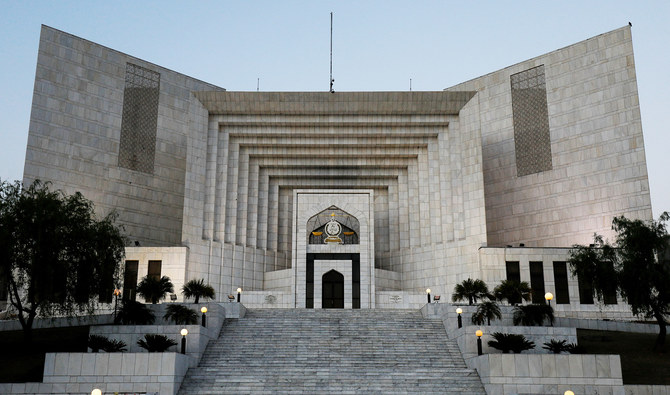

ISLAMABAD: The Pakistani Supreme Court on Thursday said the dissolution of the National Assembly last week by the Prime Minister Imran Khan-led government and a ruling by the deputy speaker not to allow voting on a no-confidence motion against the premier were both “unconstitutional,” ruling that the speaker call a session on Saturday and hold the vote.
The closely-watched verdict solves a constitutional wrangle that has plagued the country since Sunday, when the deputy speaker of the National Assembly, Qasim Suri, disallowed a no-trust vote that would have likely seen Khan booted from office. He used Article 5 of the constitution, which deals with loyalty to the state, to make his case, saying the motion was unconstitutional because it was part of a “foreign conspiracy.”
The president then dissolved the lower house of parliament on Khan’s advice.
But in a unanimous decision, the Supreme Court said the deputy speaker’s Sunday ruling was “contrary to the Constitution and the law and of no legal effect.”

Supporters of Pakistani opposition parties celebrate after Supreme Court decision, in Islamabad, Pakistan, on April 7, 2022. (AP)
The court said the subsequent dissolution of the National Assembly was therefore also unconstitutional.
“The advice tendered by the Prime Minister on or about 03.04.2022 to the President to dissolve the Assembly was contrary to the Constitution and of no legal effect,” the court said in a short order.
“It is declared that the Order of the President issued on or about 03.04.2022 dissolving the Assembly was contrary to the Constitution and of no legal effect, and it is hereby set aside. It is further declared that the Assembly was in existence at all times, and continues to remain and be so.”
The court also ordered National Assembly Speaker Asad Qaiser to summon a session on Saturday, April 9, at 10am, to allow voting on the no-confidence motion.
“If the Resolution is passed by the requisite majority (i.e., the no-confidence resolution is successful), then at any time once a Prime Minister is elected in terms of Article 91 of the Constitution read with Rule 32 of the Rules and enters upon his office,” the court ruled.
The court’s five-member larger bench — headed by Chief Justice Bandial and comprising Justice Muneeb Akhtar, Justice Aijazul Ahsan, Justice Mazhar Alam, and Justice Jamal Khan Mandokhel — ruled unanimously.
Ahead of the no-trust motion being put to vote last Sunday, Khan had lost his parliamentary majority after major coalition partners announced they would side with the opposition in the vote, while over 20 lawmakers belonging to Khan’s own party also defected.
“This is a victory for all of Pakistan, the constitution, democracy,” Maulana Fazal-ur-Rahman, the leader of an opposition alliance against the government, told reporters after the verdict.
The ruling comes as Pakistan’s central bank raised its benchmark policy rate by 250 basis points to 12.25 percent in an emergency meeting on Thursday, saying that a reduction in domestic political uncertainty would be required to ensure Pakistan’s economic recovery from the COVID-19 pandemic.
The rupee also hit a new historic low of Rs188.18 against the US dollar amid the political turbulence, diminishing foreign exchange reserves and a stalled International Monetary Fund (IMF) loan facility.


