ISLAMABAD: Ali Zafar, a lawyer for President Arif Alvi who is a party ally of Prime Minister Imran Khan, told the Supreme Court on Wednesday it should not involve itself in parliamentary procedure as a five-member panel of judges heard a case pertaining to the Khan government’s move last week to block an opposition attempt to oust the premier.
Khan was due last Sunday to face a no-confidence vote tabled by the opposition in the National Assembly. But Qasim Suri, the deputy speaker of parliament, a member of Khan’s Pakistan Tehreek-e-Insaf party, threw out the motion, saying it was part of a foreign conspiracy and thus unconstitutional. He used Article 5 of the constitution, which deals with loyalty to the state, to make his case.
The president then dissolved the lower house of parliament on Khan’s advice.
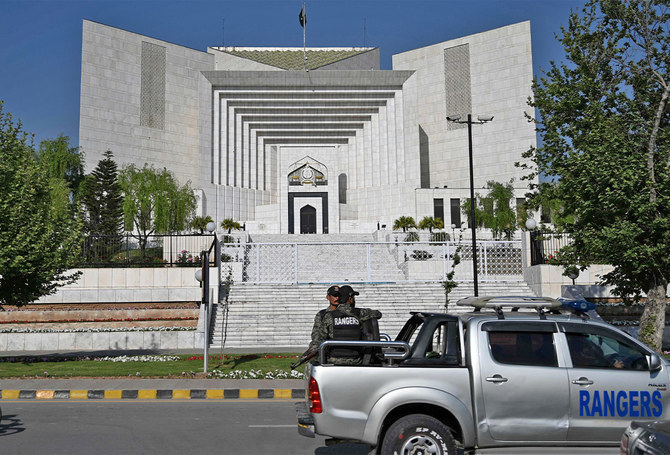
The Supreme Court has since been hearing a case against the government moves filed by the opposition. The panel of five judges has not said when it will give a ruling but it could order parliament to be reconstituted, call for elections or bar Khan from power if he is found to have violated the constitution. The court could also decide that it cannot intervene in parliamentary affairs.
“The court doesn’t have authority to review the speaker’s ruling,” Lawyer Ali Zafar said, adding that parliament could not comment on a case pending before the courts and the courts should likewise not interfere in parliamentary proceedings.
“Any direction from the parliament will be trespassing of the authority [of the court],” he said, adding that any direction to the speaker would mean giving direction to parliament.
He also argued that if the National Assembly was dissolved in the wake of the speaker’s ruling, the court could not review it, adding that the court cannot act as a “monitor” of parliament.
The chief justice remarked that according to the petitioners, the court could review parliamentary proceedings in case there was a violation of the constitution.
“The court fully respects the constitutional distribution of authority among the institutions,” the chief justice said.
“Your point is interesting that even if a ruling of the speaker is wrong, it enjoys a privilege,” he added, saying that what the speaker had done was “unprecedented” apart from the significance of Article 69, which says proceedings in parliament shall not be called in question on the ground of any irregularity of procedure.
“This will have many negative consequences if allowed to happen,” the chief justice said, adding that the no-confidence motion was about to be adopted on the day of voting when the deputy speaker gave his ruling that it was unconstitutional.
Zafar replied: “The court should leave the matter to the public instead of interfering [in parliamentary proceedings].”
The chief justice remarked that the judges would respect the sanctity of the parliament but the Supreme Court could interfere if there was a violation of the constitution.
Earlier, Pakistan Tehreek-e-Insaf (PTI) counsel Babar Awan raised legal points to justify the speaker’s ruling and subsequent dissolution of the National Assembly, saying there was a foreign conspiracy to topple Khan.
“We want to know about the conspiracy before handing down judgment,” the chief justice said. “Apparently the deputy speaker’s ruling contains allegations instead of facts.”
The chief justice questioned if the deputy speaker could give such a ruling without revealing evidence and facts: “This is the constitutional point in which the court has to give its verdict.”
Bandial also asked Awan about the minutes of a March 31 National Security Committee’s meeting that reviewed a “blatant interference” in Pakistan’s domestic affairs by a foreign power.
Pakistan’s military, whose army, navy and air force chiefs were present at the NSC meeting, is facing growing calls by the opposition to clarify its position on the veracity of Khan’s complaints about a foreign conspiracy against him.
Khan has said the plot to dislodge him was being orchestrated by the United States, which the State Department and the White House have denied.
Opposition leader Maryam Nawaz said in a press conference late on Tuesday the military should clarify if it had told the National Security Committee meeting that the US had conspired with the opposition to topple Khan’s government.
“Imran Khan has used the National Security Committee for his political gains,” she told reporters.
Pakistan’s military has not confirmed or denied Khan’s accusation but an official with knowledge of the matter, who declined to be identified, told Reuters on Tuesday security agencies had not found “credible evidence” to confirm Khan’s allegations.
The court will resume hearing tomorrow, Thursday, to record the arguments of the attorney general of Pakistan and PTI counsel Naeem Bokhari.


![]()

Pakistani PM’s defense argues Supreme Court doesn’t have ‘authority to review’ parliamentary procedure
Short Url
https://arab.news/2p2dt
Pakistani PM’s defense argues Supreme Court doesn’t have ‘authority to review’ parliamentary procedure
- Chief justice Umar Ata Bandial says Supreme Court could interfere if there was a violation of constitution
- Court will resume hearing tomorrow to record arguments of the attorney general and Khan’s counsel
Latest updates




Recommended


© 2026 SAUDI RESEARCH & PUBLISHING COMPANY, All Rights Reserved And subject to Terms of Use Agreement.