

Afghans mark Ramadan — first since Taliban seized power

Members of the Taliban break their iftar fast on the first day of the holy month of Ramadan in Kandahar on April 2, 2022. (AFP)
Short Url
Updated 04 April 2022
Follow

Afghans mark Ramadan — first since Taliban seized power

  • Afghans are marking Ramadan while the country is plunged into a deep humanitarian crisis
  • UN says more than half of the country’s 38 million people are facing hunger

KABUL: Afghans across the country are celebrating the holy month of Ramadan in Afghanistan this year — the first since the Taliban seized power last year.
About 300 men, dressed in traditional Afghan shalwar kameez, gathered before sunset at the Wazir Akbar Khan mosque in the capital on Saturday to offer evening prayers on the first day of Ramadan.
“This Ramadan is different than under the previous regime,” worshipper Khairullah, who goes by one name as many Afghans do, told AFP.
“Now we are performing our Islamic duty together... in an Islamic land under an Islamic regime.”
The Wazir Abkar Khan mosque is one of Kabul’s famous places of worship, and was targeted by a bomb attack in June 2020 that killed its imam and some worshippers.
The mosque is situated in central Kabul at the main entrance to the former diplomatic hub known as the Green Zone that housed several foreign embassies including Washington’s mission.
After breaking their fast, the men sat in rows in the mosque’s compound where volunteers served them food.
In the southern province of Kandahar, the de facto power center of the Taliban, several of the fundamentalist movement’s fighters broke their fast at checkpoints and mosques.
Afghans are marking Ramadan at a time when the country is plunged into a deep humanitarian crisis.
The United Nations says more than half of the country’s 38 million people are facing hunger as the winter drags on.
The crisis deepened after donors cut off aid when the Taliban seized power last August.
The international community has so far not recognized the Taliban government.
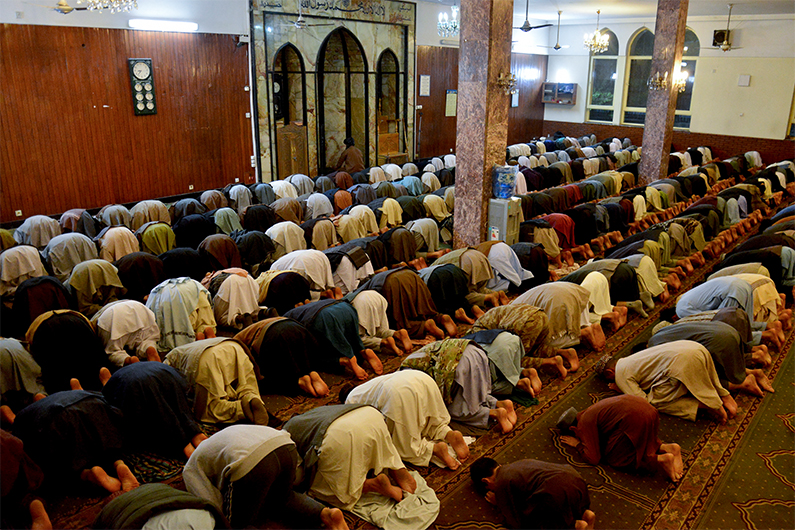


Afghan Muslims offer prayers on the first night of Islam's holy month of Ramadan at the Wazir Akbar Khan mosque in Kabul on April 2, 2022. (AFP)

“The people expected good times under the Islamic emirate but unfortunately that did not happen,” said Shahbuddin, a resident of Kabul, referring to the Taliban regime.
“The world must recognize the Taliban government, otherwise we will see a humanitarian catastrophe.”
Other nations insist the hard-line group respect women’s rights to education and work in order to receive aid.
The Taliban have cracked down on women’s freedoms, including banning them from many government jobs and shutting secondary girls schools.
Meanwhile for Shahbuddin, the rising costs for food have become unbearable.
“For the first time I’m seeing that food prices have risen so much in Ramadan,” he said.
“People were expecting that in an Islamic country prices would drop during Ramadan, but that has not happened.”


Macron to set out how France’s nuclear arms could protect Europe

Updated 3 sec ago
Follow

Macron to set out how France’s nuclear arms could protect Europe

PARIS: France will on Monday unveil how it could use the European Union’s only atomic arsenal to protect the continent in an unstable world, with Russia becoming increasingly aggressive and the United States turning away.
The speech by French President Emmanuel Macron, at France’s Ile Longue nuclear submarine base, comes after the launch of US and Israeli attacks against Iran in a campaign that risks destabilising the Middle East.
“What we are experiencing demonstrates that in the world to come, power and independence will be two indispensable forces for dealing with the proliferation of threats,” said a member of Macron’s team.
Macron is set to update France’s nuclear doctrine as Russia’s war against Ukraine grinds into a fifth year and NATO allies worry about Washington’s wavering commitment to Europe.
“There will undoubtedly be some significant shifts and developments,” a source said of the speech set to be delivered from 1415 GMT Monday.
European nations, which have relied on the US nuclear deterrent throughout the Cold War and in the decades since it ended, are increasingly debating whether to bolster their own atomic arsenals.
Paris has been in talks with countries including Germany and Poland over how France could use its atomic arsenal to help protect the continent.
Last year, Macron said he was ready to discuss possible deployment of French aircraft armed with nuclear weapons in other European countries.
Macron said in February he was considering a doctrine that could include “special cooperation, joint exercises, and shared security interests with certain key countries.
France maintains the world’s fourth-largest nuclear arsenal, estimated at around 290 warheads. Britain, which is no longer a member of the EU, is the only other European nuclear power.
By contrast, the United States and Russia, the world’s two main atomic powers, have thousands of nuclear warheads each.

‘27 buttons’

Reassurances from US officials that Washington’s deterrent would continue to cover Europe under the NATO alliance have done little to quell European fears of fickleness under US President Donald Trump.
“It is clear that we will need to reflect together on how French and British deterrence can fit into a more assertive European defense,” Bernard Rogel, who served as top military adviser to Macron, told AFP.
But how exactly nuclear cooperation would work between the EU’s 27 states is another story.
Rogel insisted that control over the launch decision will remain in French hands.
“I can’t see us having 27 buttons. From a credibility standpoint, that just doesn’t work,” he said.

‘Only a good thing’

Rafael Loss, a policy fellow at the European Council on Foreign Relations, said leaders should find confidence in European support for strengthening nuclear deterrence.
He said people in Denmark, Estonia, Germany, Portugal, Spain and Switzerland now tend to support rather than oppose the idea of developing an alternative European nuclear deterrent.
“If there’s going to be some kind of bigger European investments in France or UK’s nuclear deterrence, that’s only a good thing,” Finland’s defense minister Antti Hakkanen told AFP in February.
Florian Galleri, a historian specializing in nuclear doctrines, warned that Macron would have to tread carefully, pointing to his low approval ratings one year before the end of his presidency.
Macron’s address could also spark a backlash ahead of the 2027 presidential election, in which Marine Le Pen’s euroskeptic far-right is seen as having its best chance yet at winning the top job.
“There is a consensus on possessing nuclear weapons in France, but not on nuclear policy,” Galleri said.
The far-right has already issued a warning.
“If Mr. Macron thinks he can give France’s nuclear weapon to the EU, he will face impeachment proceedings for treason,” Philippe Olivier, an adviser to Le