


Thais eye switch to electric vehicles as petrol prices soar

1 / 2
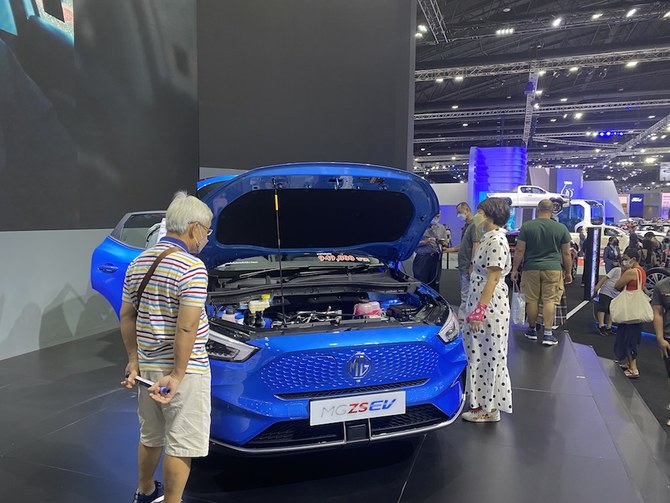
Visitors eye an electric car model from MG Motor at the Bangkok International Motor Show on April 2. (AN Photo/Asia Bureau)
2 / 2
A car model on display at the Great Wall Motors booth at the Bangkok International Motor Show on April 2. (AN Photo/Asia Bureau)
Short Url
Updated 02 April 2022
Follow

Thais eye switch to electric vehicles as petrol prices soar

  • Thailand has issued incentive packages for EV industry amid plans to become a regional production hub
  • One electric car company, MG Motor, took 1,000 pre-orders and said EVs are its top seller

BANGKOK: Soaring fuel prices in Thailand have sparked a sales boom in electric vehicles, or EVs, as the Bangkok International Motor Show revealed before wrapping up on Sunday. 

More than a million people visited the show, with organizers saying there had been a 20 percent increase in orders for electric vehicles compared with last year. 

Much like its regional neighbors, the Southeast Asian country has been slow to embrace electric vehicles, but the Bangkok government has started embracing the alternative to fuel-powered transport and earlier this year announced subsidies for some EVs. 

The turnaround comes at a time when Thai consumers face soaring energy prices, with the government shielding the nation’s low-income groups by freezing retail diesel prices on March 22. Gasoline prices rose above 40 baht ($1.20) per liter on average on Saturday, 50 percent higher than last year. 

Grand Prix International, organizer of the Bangkok motor show, said Thais are turning to EVs due to global changes and increasing fuel prices. 

“Overall, EV is quite a big trend. Not long before the motor show the government announced measures to reduce the tax for affordable-priced EVs,” Anothai Eamlumnao, Grand Prix International chief operating officer, told Arab News. 

“Oil is expensive now and the global trend is changing to electric cars.” 

Eamlumnao said there is a 20 percent increase in electric car orders at the show. The event, which also features other types of vehicles, is expected to translate to about 15 billion baht ($448 million) in total spending. 

Government spokesman Thanakorn Wangboonkongchana said in a statement that Thailand aims to cut carbon dioxide emissions, transform half of its total auto production to EVs by 2030, and become a production base for cleaner vehicles in the region. 

Officials are offering support for more Thais to buy electric cars, and the government in February issued incentive packages that include tax and duty exemption on some EV models. 

MG Motor, one of the companies taking part in the Bangkok motor show, recorded about 1,000 pre-orders and said EVs were its top seller this year. 

But with the trend in its early days in Thailand, interested customers are still testing the waters.

Worrachat Tangfurat, a 41-year-old programmer who visited the motor show on Saturday, said he would wait for Thailand’s EV market to grow before making a purchase. 

“I am interested in an EV because I think it will help save a lot on fuel,” Tangfurat told Arab News. 

“But I am still studying the model and the industry, and want to wait for the market to become bigger because right now I think there are still not enough  charging stations.” 

Sasitorn Panijaren, 29, is also considering making the switch, but will wait for more variety to become available in the country. 

“I am thinking about buying an electric car in maybe the next two or three years because I think it will reduce spending on fuel,” Panijaren told Arab News. 


Trump Maritime Action Plan eyes levies on China goods to resurrect US shipbuilding

Updated 52 min 50 sec ago
Follow

Trump Maritime Action Plan eyes levies on China goods to resurrect US shipbuilding

  • US shipbuilding has shrunk since World War II and now severely lags China and other nations
  • Endorsing the plan, Republican Senator Todd Young said: “It’s time to make American ships again” 

WASHINGTON: The ​Trump administration on Friday released its plan to rebuild US shipbuilding and other maritime businesses, paid for in part by port fees on cargo delivered to the United States on ships made in China — levies the US and China agreed to pause for one year.
The Maritime Action Plan offers a road map for the revival of US shipbuilding, which has shrunk since World War Two and now severely lags China and other nations.
Coming in at ‌more than ‌30 pages, the plan calls for establishing maritime ​prosperity ‌zones ⁠to bolster ​investment, reforming ⁠workforce training and education, expanding the fleet of US-built and US-flagged commercial ships, establishing a dedicated funding stream through a Maritime Security Trust Fund and reducing regulations.
The Trump administration early last year announced plans to levy fees on China-linked ships to loosen the country’s grip on the global maritime industry and help pay for a US shipbuilding renaissance. The so-called Section 301 penalties followed a US probe that ⁠concluded China uses unfair policies and practices to dominate ‌global shipping.
The fees, which sparked intense pushback ‌from the global shipping industry and intensified tensions between ​the world’s two largest economies, hit ‌on October 14 and were expected to generate an estimated $3.2 billion annually ‌from Chinese-built vessels sailing to US ports.
But China retaliated with its own port fees on US-linked ships and the tit-for-tat fees disrupted global shipping. Soon after, the two sides struck a deal to put the levies on hold for 12 months.
On Friday, ‌Shipyard owners, investors and the bipartisan sponsors of the Shipbuilding and Harbor Infrastructure for Prosperity and Security (SHIPS) for America ⁠Act welcomed President Donald ⁠Trump’s maritime plan, which landed months later than hoped.
US Senator Todd Young, a Republican from Indiana, said there is substantial overlap between Trump’s vision and the plan in that proposed law, which he reintroduced last year with Democratic Senator Mark Kelly of Arizona and other lawmakers.
Importantly, the SHIPS Act would establish a Maritime Security Trust Fund to reinvest port fee proceeds into maritime security and infrastructure projects such as shipyard revitalization. It has rare backing from both Democratic and Republican lawmakers in Washington, but has not made swift progress.
“The announcement today should serve as a wake-up call for Congress to act quickly ​on this bill in order ​to provide the legal authorities and resources necessary to make this plan a reality,” Young said. “It’s time to make American ships again.”