Pakistan army chief says Islamabad seeks to ‘broaden and expand’ ties with US 

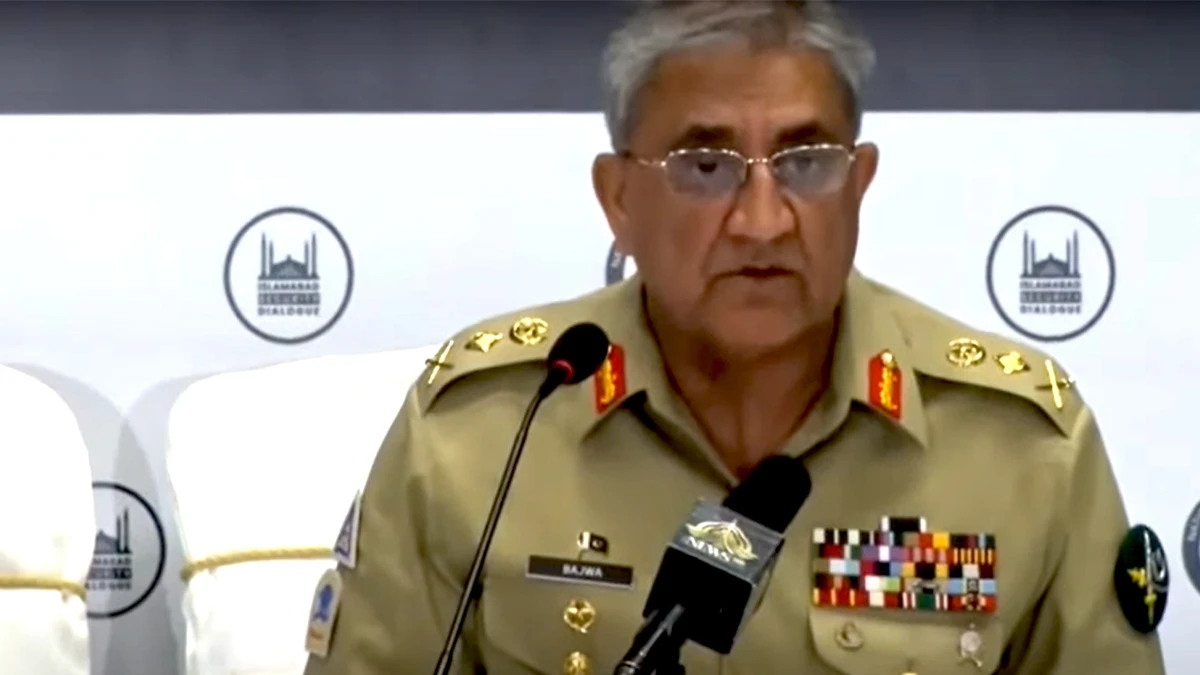
Pakistan's Army Chief Gen. Qamar Javed Bajwa addresses Islamabad Security Dialogue on April 2, 2022. (Screengrab)
Short Url
Updated 02 April 2022
Follow

Pakistan army chief says Islamabad seeks to ‘broaden and expand’ ties with US 

  • Gen Qamar Bajwa’s comments contrast with PM Imran Khan’s accusations against Washington 
  • On Thursday, Khan said Washington was backing a political campaign aimed at ousting him 

ISLAMABAD: Pakistan’s Army Chief General Qamar Javed Bajwa has said the South Asian country seeks to “broaden and expand” its relations with the United States (US), days after Prime Minister Imran Khan accused Washington of meddling in the country’s affairs.
At a rally on Sunday, Khan spoke of a purported letter that contained “threats” to his government, but did not name a country that sent it. Pakistani officials have since said the letter was a cable written by a former Pakistani ambassador to the US, who conveyed threats by a “senior foreign official.”
On Thursday, Khan named the US in his televised address to the nation, accusing it of backing a political campaign aimed at ousting him. He said the move was aimed at hindering his efforts to pursue an independent foreign policy for Pakistan. Washington has denied the allegations.
Gen Bajwa said while Pakistan enjoyed a close strategic relationship with China, it equally shared a long history of excellent strategic relationship with the US, which remained the largest export market for the South Asian nation.
“We seek to broaden and expand our ties with both countries without impacting our relationship with the other,” the army chief said, while addressing attendees at the two-day Islamabad Security Dialogue 2022.
“Similarly, the European Union, United Kingdom, Gulf, South East Asia and Japan are also vital for our national development and progress.”
Gen Bajwa’s comments were in contrast with what was recently said by PM Khan, who faces a no-trust vote in parliament, along with defections by over a dozen of his party’s lawmakers.
The Pakistani army chief expressed alarm over the Russian invasion of Ukraine, describing it as “unfortunate.”
“Sadly, the Russian invasion against Ukraine is very unfortunate as thousands of people have been killed, millions made refugees and a half of Ukraine destroyed.”
“This is a huge tragedy which must be stopped immediately. Despite legitimate security concerns of Russia, its aggression against a smaller country cannot be condoned.”
Pakistan supported a dialogue between all sides to find a lasting solution to the conflict, he said, calling for immediate cessation of hostilities.
After failing to take a major Ukrainian city since it launched the invasion on Feb. 24, Russia has shifted its focus to Ukraine’s southeast, where it has backed separatists since 2014.
Both countries recently agreed to humanitarian corridors during the war to facilitate the evacuation of civilians from cities, but have often traded blame when the evacuations have not been successful.
The conflict has killed thousands, uprooted a quarter of Ukraine’s population and devastated cities such as Mariupol.
Russia denies targeting civilians in what President Vladimir Putin calls a “special military operation” aimed at demilitarizing Ukraine.
Ukraine calls it an unprovoked war of aggression and Western countries have imposed sweeping sanctions in an effort to squeeze Russia’s economy.
Challenges for millions pushed back to Afghanistan from Iran, Pakistan

Updated 01 February 2026
Follow

Challenges for millions pushed back to Afghanistan from Iran, Pakistan

  • Over five million Afghans returned home since September 2023 as Iran, Pakistan ramp up deportations
  • Those who returned face challenges in form of unemployment, lack of housing, shortage of electricity and water

KABUL: After decades hosting Afghans fleeing crises at home, Pakistan and Iran have ramped up deportations and forced millions back across the border to a country struggling to provide for them.

Whether arriving at the frontier surrounded by family or alone, Afghan returnees must establish a new life in a nation beset by poverty and environmental woes.

AFP takes a look at the people arriving in Afghanistan and the challenges they face.

FIVE MILLION

More than five million Afghans have returned home from Iran and Pakistan since September 2023, according to the International Organization for Migration (IOM).

The figure equates to 10 percent of the country’s population, according to the agency’s deputy head in Afghanistan, Mutya Izora Maskun.

Three million returnees crossed the borders just last year, some of whom have spent decades living abroad.

Such a huge influx of people would be hard for any country to manage, Maskun said.

INADEQUATE HOUSING 

Months after arriving in Afghanistan, 80 percent of people had no permanent home, according to an IOM survey of 1,339 migrants who returned between September 2023 and December 2024.

Instead, they had to live in temporary housing made from materials such as stone or mud.

More recently, the UN refugee agency (UNHCR) spoke to Afghans who arrived back between January and August last year about their living arrangements.

Three-quarters of tenants said they could not afford their rent, while the majority of families were sharing rooms with up to four people, according to the survey of 1,658 returnees.

DESPERATE SEARCH FOR WORK 

Just 11 percent of adults pushed back from Pakistan and Iran were fully employed, the IOM survey found.

For those who returned in the first few months of last year, the average monthly income was between $22 and $147, according to the UNHCR.

WATER, ELECTRICITY SHORTAGES

More than half the returnee households lack a stable electricity supply, according to the IOM.
The agency said that households headed by women faced “significantly higher vulnerabilities,” with around half of them struggling to access safe drinking water.

SPEEDING UP LAND DISTRIBUTION

More than 3,000 plots of land have been distributed to returnees nationwide, Hamdullah Fitrat, the Afghan government’s deputy spokesman, said in mid-January.

The process “was accelerated,” he said while recounting a special meeting with supreme leader Hibatullah Akhundzada.

On their arrival in Afghanistan, returnees usually receive help with transport, a SIM card and a small amount of money.