

Ramadan rituals’ welcome return in Makkah and Madinah after two years

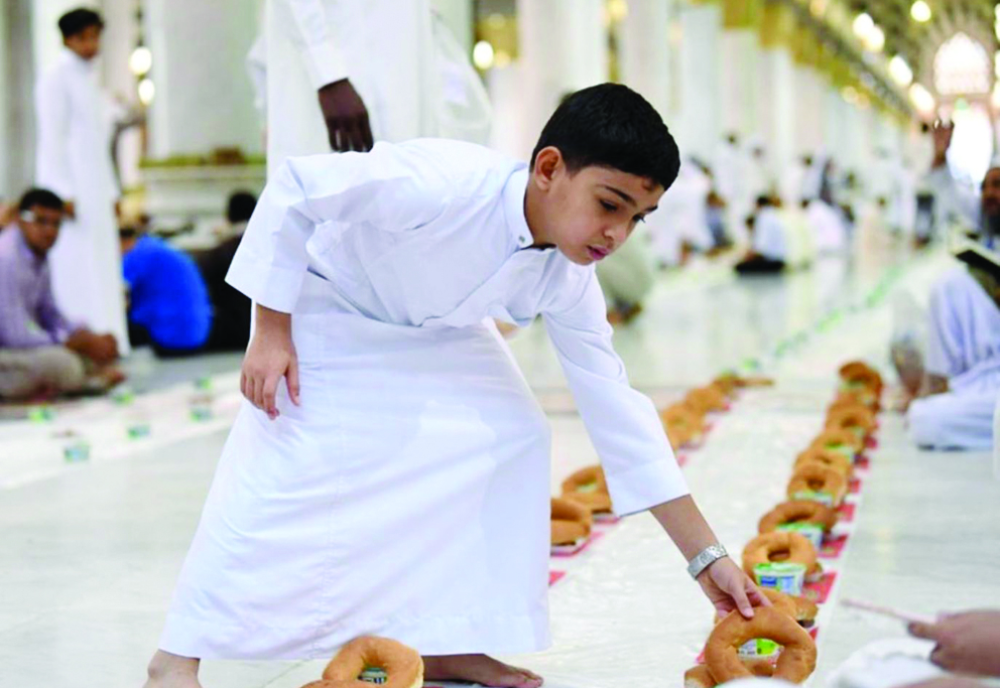
In Ramadan this year, worshippers will again enjoy being part of communal iftar sufras at the two Grand Mosques in Makkah and Madinah. (Supplied)
Short Url
Updated 02 April 2022
Follow

Ramadan rituals’ welcome return in Makkah and Madinah after two years

  • Communal itikaf and iftar allow secluded prayers and meals for breaking the fast
  • 2,000 permits have been issued to those wanting to donate food for worshipers

JEDDAH: After two years of COVID-19 restrictions, the two holy mosques in Makkah and Madinah will again allow customary communal Ramadan rituals including itikaf or secluded devotion, and iftar suppers — a return to normalcy welcomed by citizens and residents.

The decision was announced on March 22 by Sheikh Abdulrahman Al-Sudais, head of the General Presidency for the Affairs of the Two Holy Mosques, on Twitter @ReasahAlharmain: “We are glad to announce the return of Itikaf in Haramain (two sanctuaries). It will be applied according to specific criteria, and permits will be available through the official website of the presidency soon.”

Itikaf takes place over the last 10 days of Ramadan when worshippers go into seclusion and devote their time to prayer and reading the Qur’an. It starts from the sunset of the 20th day of Ramadan and ends when the Eid moon is sighted. In itikaf, worshipers live and sleep in the mosques and only leave for ablutions.

HIGHLIGHTS

• For some Saudi families, providing iftar meals at the same spot in the precincts of the mosques, have been passed down through the generations.

• The distribution of iftar meals was allowed last year in Ramadan but this year on Jan. 13, Sheikh Abdulrahman Al-Sudais announced the return of communal iftar sufras at the two mosques.

• Those families, who received their permits, said that they start preparing for iftar two weeks prior to Ramadan, which is part of the enjoyment.

Layla Nagadi, a 59-year-old Jeddah resident, has been observing itikaf for over 15 years. “Nothing equals itikaf in Makkah, where you can dedicate the last 10 days of Ramadan for worship only.”
“I was very happy when Al-Sudais announced the return of itikaf this year, I will be among the first people to apply.”

Before COVID-19, worshipers were welcomed at the two holy mosques for iftar by philanthropists who provide iftar sufras or meals at specific locations. The distribution of iftar meals was allowed last year in Ramadan but this year on Jan. 13, Al-Sudais announced the return of communal iftar sufras at the two mosques.

Two thousand permits have been issued to those interested in this form of charity. For some Saudi families, providing iftar meals at the same spot in the precincts of the mosques, have been passed down through the generations.

Shatha Jaylan, 30, from Madinah, told Arab News that she and her family have provided iftar for years near the Al-Rawda door. “We have been serving iftar meals in (the) Madinah haram for nine years in the ladies’ section. It is a collaboration between my father and my aunty as they both really appreciate the spirituality of (the) haram during the holy month of Ramadan.”

Those families, who received their permits, said that they start preparing for iftar two weeks prior to Ramadan, which is part of the enjoyment. “We provide yoghurt, shouraik bread, duggah (Madini mixture of condiments), different types of dates such as rutab and sukkary, Zamzam water bottles, Saudi coffee, and tea.”

“I (personally) used to serve iftar for visitors for three years in a row every Ramadan season; we used to prepare everything in the morning so we could bring (it all to the) haram by Asr prayer to avoid the peak hour,” Jaylan said. “It is really important to get everything set up so visitors can enjoy their meals.”

Jaylan said that like other people providing meals, she also hires workers to help with the preparation and serving, usually unemployed people seeking work. However, this year Jaylan said her family would not organize any meals so that others could be given a chance to do so.

“Once we heard the announcement of the return of iftar meals we were extremely happy, however, we did not renew our membership this year as there were new rules and regulations that were a bit different,” she said. “Providing iftar, gaining hasanat, going to (the) haram every day might sound nice and fun, but it is a huge responsibility.”

“My aunt, cousins, and I used to stay in (the) haram from (the) afternoon till (the) evening every day for one month. It is not easy as once the visitors leave, we (had) to collect the plastic mats, leftovers, and disposable utensils. It is a big effort, but one honest dua from visitors wipes all the tiredness away,” she added.

Meanwhile, the general presidency is set to launch several programs to provide services for worshipers during Ramadan. Over 12,000 workers will be serving in Makkah’s grand mosque, with the third expansion used at full capacity.

Crowd control measures have been instituted, with prayer areas designated for people with disabilities and the elderly.


Aloula partners with Saudi Music Hub to amplify young voices

Updated 4 sec ago
Follow

Aloula partners with Saudi Music Hub to amplify young voices

  • 2-month vocal program places children in spotlight
  • Program culminates in performance of Saudi national anthem

JEDDAH: A new choral initiative launched by Aloula, in partnership with the Saudi Music Hub, has brought youngsters aged 9-18 into a structured vocal training program that will culminate in a performance of the Saudi national anthem.

The two-month initiative, which was launched in November, is one of the first children’s choral programs led by a nonprofit organization in Saudi Arabia.

In the rehearsal room, 75 children are learning how to sing the Saudi national anthem “Aash Al-Maleek,” and “Watani Al Habib” in a full choral arrangement.

Among the singers is 14-year-old Nawaf Al-Qahtani,  who said the experience had helped him grow as a performer. (Supplied)

Participants attend vocal training sessions three times a week, from Monday to Wednesday, focusing on technique, listening skills, and ensemble performance.

Speaking to Arab News, Abir Abusulayman, the CEO of Aloula, said the project was designed to include children more directly in the Kingdom’s cultural transformation.

She said: “The Kingdom is living a beautiful cultural moment right now, and we didn’t want our children to watch it from the sidelines; we wanted them to be part of it.

HIGHLIGHTS

• The two-month initiative, launched by Aloula in partnership with the Saudi Music Hub, is one of the first children’s choral programs in Saudi Arabia.

• Abeer Ibrahim, a vocal and singing instructor at the Saudi Music Hub, is among the educators working closely with the group.

“It felt like the perfect way to bring them together, build their confidence, and let them experience something joyful and memorable.”

Founded in 1962, Aloula works with children and families through early-intervention programs to strengthen academic, creative, and social skills. The initiative reflects the organization’s broader focus on confidence-building and participation through creative experience. 

Aloula children rehearsing the Saudi national anthem with instructor Abeer at the Saudi Music Hub. (Supplied)

Abusulayman said music offered lessons that extended beyond performance, and added: “Music opens something special inside a child. It teaches them to listen, to express themselves, to work as a team, and to trust their own voice. These creative experiences help children feel seen and give them skills that stay with them far beyond the classroom.”

Abusulayman said the benefits of the venture extended well beyond the final performance.

She said: “Academically, music helps with focus and memory. Socially, it teaches them to work together and support one another. And on a personal level, it gives them a moment in their lives where they feel proud, capable, and celebrated. Many of these children have never been on a stage before; this can be the spark that pushes them to dream bigger.”

The Saudi Music Hub, an education and training institution affiliated with the Music Commission under the Ministry of Culture, was established in 2022. (Supplied)

Abeer Ibrahim, a vocal and singing instructor at the Saudi Music Hub, is among the educators working closely with the group. A graduate of the Egyptian Conservatory, Ibrahim specializes in vocal training and music theory for young singers. 

“This experience gave me very beautiful feelings and emotions while working with children,”  Ibrahim told Arab News.

“From the very beginning they showed clear enthusiasm and joy, and I discovered wonderful talents and voices despite their young age. That small voice gave me a very powerful feeling, and I am extremely happy with it. We will present even better work in the future.”

Ibrahim also noted the significance of working with the national anthem, and she said: “Performing the Saudi national anthem instills in children a deep sense of belonging and pride in their country and culture,” adding that it helped young participants understand their role within the larger community. 

Among the singers is 14-year-old Nawaf Al-Qahtani,  who said the experience had helped him grow as a performer.

He described the experience as transformative, and said: “What I liked most was the interaction with the instructor, and we learned many things that will benefit us in the future.”

He added: “I learned how to control my vocal range, how to sing properly, how to face an audience, and I learned about the vocal ranges of the national anthem.”

Ibrahim described Al-Qahtani as one of the program’s strongest voices, noting that the anthem’s arrangement was adapted to suit his vocal range. 

The initiative is part of Aloula’s wider portfolio of educational and creative programs. These include a robotics program, in which children design interactive projects, as well as community exploration activities that introduce participants to major cultural and sporting events in Jeddah.

The Saudi Music Hub, an education and training institution affiliated with the Music Commission under the Ministry of Culture, was established in 2022. 

With headquarters in Riyadh and branches in Jeddah and Alkhobar, the hub provides musical instrument instruction, choir training, and performance workshops, with a focus on developing local talent.

For Abusulayman, the partnership reflects the value of collaboration between cultural and social organizations. 

“When we combine our strengths, we create opportunities that our children may not otherwise have,” she said. “I truly believe this kind of collaboration can open new doors for the whole nonprofit sector.”