

King Abdullah University, Saudi environment ministry to build pilot algae food plant

1 / 3
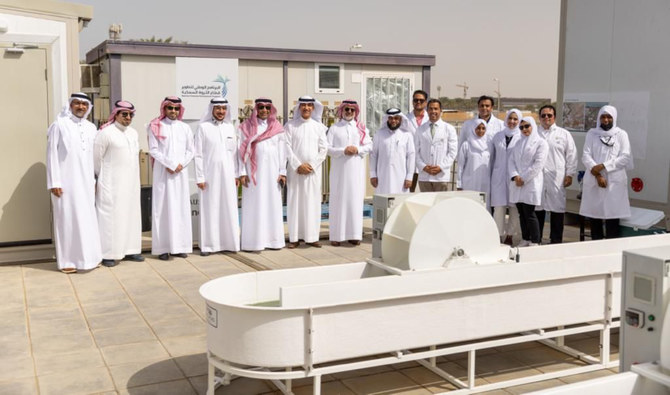
The project, DABKSA, aims to develop technologies that encourage the production of animal feed for agriculture in the the Kingdom. (Supplied)
2 / 3
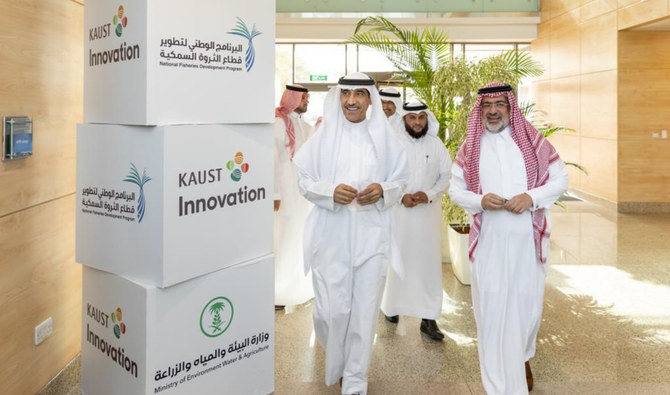
(Supplied)
3 / 3
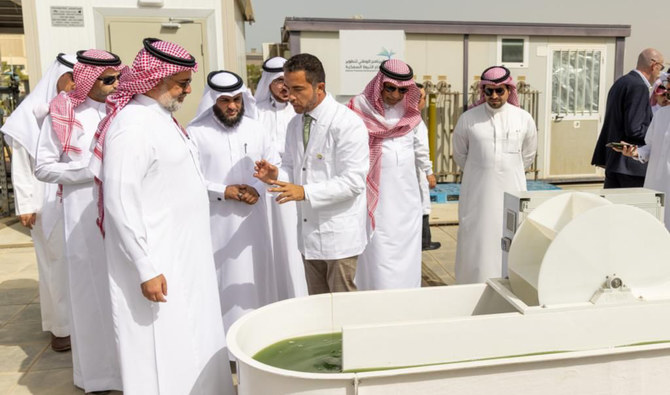
(Supplied)
Short Url
Updated 29 March 2022
Follow

King Abdullah University, Saudi environment ministry to build pilot algae food plant

RIYADH: King Abdullah University of Science and Technology (KAUST) announced on Tuesday a collaboration with the Ministry of Environment, Water, and Agriculture to develop algae biotechnology in the Kingdom.

The project, DABKSA, aims to develop technologies that encourage the production of animal feed for agriculture in the the Kingdom. The project — overseen by MEWA’s National Fisheries Development Program and located on the KAUST campus — is set to establish a sustainable feed industry in Saudi Arabia while opening new economic ventures for the aquaculture industry.

Finite resources such as land, water and energy are used to rear animals.

According to KAUST, animal feed is vital to the process, and a significant amount of global greenhouse gas emissions are related to feed production and processing.

New innovation and technology in sustainable feed solutions can lower environmental impacts. One such solution is the development and promotion of aquaculture and the use of plentiful seaweed. With Saudi Arabia’s Red Sea and Arabian Gulf coastlines measuring about 3,400 kilometers, there is ample opportunity for innovation.

DABKSA will see the design, build and operation of a proof of concept algae plant at KAUST. This strategic project aligns with Vision 2030 and the Saudi Green Initiative’s focus on food security. Producing local raw material for animal feed will enable the Kingdom to be less reliant on importing raw materials.

“We’re extremely proud to announce the partnership between MEWA and KAUST that targets the localization of algae production in the Kingdom. This collaboration will result in major progress in this field, further delivering Saudi Arabia’s food security and sustainable future for generations to come,” said Dr. Kevin Cullen, vice president of KAUST Innovation.

Phase one of the project is now under development, and includes the building and commissioning of 870 square meters of microalgae facilities.

During the first phase, microalgae biomass will be produced and incorporated as raw material to feed animals such as fish and poultry.

The pilot-scale facilities will provide documented data of algae productivity during an entire year of operation. These production numbers will allow for a realistic life cycle and economics assessment while proving its use towards sustainability.

CEO of the National Fisheries Development Program Dr. Ali Al-Shaiki said: “This project is an extension of the concerted efforts undertaken by the ministry in this field; starting with the algae road map developed by several local and international experts. The ministry aligned with the major players in this field and financial resources were allocated to this project — a real turning point in algae production in Saudi Arabia.”


Makkah’s urban shift enhances the city’s quality of life

Updated 08 February 2026
Follow

Makkah’s urban shift enhances the city’s quality of life

  • By harmonizing its religious heritage with modern urban development, Makkah is proving that a city can honor its past while vigorously embracing the future

MAKKAH: Islam’s holiest city is currently witnessing a qualitative urban shift, one that seamlessly blends its profound spiritual sanctity with a modern, vibrant lifestyle. By integrating cultural, educational, and entertainment initiatives, Makkah is redefining the visitor experience and significantly enhancing the quality of life for its residents, directly supporting the goals of Saudi Vision 2030.

The city’s transformation was recently highlighted by the success of the Makkah winter season. The event attracted approximately 400,000 visitors — over 60% of whom were locals — demonstrating a strong domestic demand for high-quality public spaces.

The season revitalized community interaction, driving a 35% increase in visits to recreational sites and creating more than 1,200 temporary jobs for the local workforce.

Central to this urban renaissance is the Hira Cultural District. Since opening its doors in January 2023 near the historic Mount Hira, the district has become a definitive landmark that bridges Islamic history with contemporary identity.

Makkah’s Hira Cultural District has become a definitive landmark that bridges Islamic history with contemporary identity. (SPA photo)

Far from being a static monument, the district has cultivated a thriving creative economy. Its craftsmanship program, which features over 100 artisans, has generated up to SAR 3 million in sales and attracted 130,000 visitors to live workshops. These interactive spaces allow visitors to engage directly with the region’s heritage, moving beyond passive observation to active participation.

A living legacy 

The shift extends to Makkah’s broader ecosystem of museums and cultural sites, which are now positioned as key pillars of cultural tourism. Facilities like the Revelation Exhibition use cutting-edge technology and multilingual content to narrate the story of the Holy Quran’s revelation, offering an immersive experience that complements the spiritual journey of pilgrims.

These efforts align with the “Makkah: A Living Legacy” campaign, which seeks to document the city’s historical narrative and preserve its collective memory. Recent months have seen a surge in educational workshops for university students and tour guides, ensuring that the human element of Makkah’s history is conveyed with accuracy and depth.

City’s transformation recently highlighted by the success of the Makkah winter season. (SPA photo)
 

Economic and social impact 

The results of this integrated approach are tangible. Specialized museums and restored historic sites now attract up to 1.6 million annual visitors. Crucially, this cultural enrichment is encouraging pilgrims to linger longer, increasing the average duration of stay by 18%.

By harmonizing its religious heritage with modern urban development, Makkah is proving that a city can honor its past while vigorously embracing the future, offering a holistic experience that nourishes both the soul and the community.