

Jordan’s King Abdullah reiterates two-state Palestinian solution in talks with Israel’s Gantz

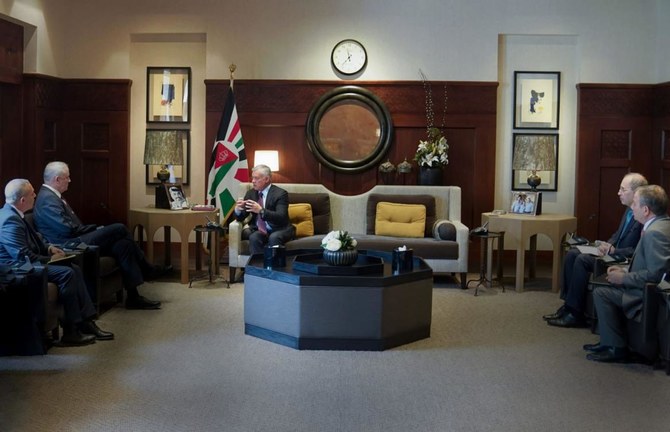
Jordan's King Abdullah II meets with the Israeli Defence Minister Benny Gantz in Amman, Jordan March 29, 2022. (Reuters)
Short Url
Updated 29 March 2022
Follow

Jordan’s King Abdullah reiterates two-state Palestinian solution in talks with Israel’s Gantz

  • Meeting part of King Abdullah’s efforts to create a new horizon to achieve just and comprehensive peace on the basis of the two-state solution
  • King reiterated need to respect and preserve the historic and legal status quo of Jerusalem

AMMAN: Jordan’s King Abdullah on Tuesday met with Israeli Defence Minister Benny Gantz in Amman, just one day following the Jordanian monarch’s meeting with Palestinian President Mahmoud Abbas in Ramallah.

The meeting was part of King Abdullah’s efforts to create a new horizon to achieve just and comprehensive peace on the basis of the two-state solution, according to a Jordanian Royal Court statement.

The King reiterated the need to respect and preserve the historic and legal status quo of Jerusalem and to remove all obstacles hindering the freedom of worship in the old city ahead of the holy month of Ramadan, the statement said.

Jordan has been the custodian of Jerusalem’s Islamic and Christian holy sites since the 1920s. The Jordanian custodianship was reaffirmed in the peace deal with Israel in 1994.   

The Israeli media quoted a statement from Gantz’s office saying that the defense minister discussed with the king the steps that Israel intends to take ahead of Ramadan in order to preserve freedom of worship in Jerusalem and the West Bank. Gantz also discussed security coordination during the holy days as well as additional steps that could be taken to improve the lives of Palestinians.

King Abdullah and Gantz also met in Amman in January this year, marking the first high-profile Jordanian-Israeli meeting in years. The meeting followed the strained Amman-Tel Aviv relationship during Benjamin Netanyahu’s premiership.

The king’s meeting with Gantz also came just one day following an official visit of the Jordanian monarch to Ramallah for a meeting with Abbas, the first since 2017. He stressed the need to maintain calm in the occupied West Bank and to respect the rights of Muslims to worship at Al-Aqsa Mosque without provocation or interference, the Royal Court said.

A well-informed Jordanian source told Arab News on Tuesday that the Israeli President Isaac Herzog will visit Jordan on Wednesday for a meeting with King Abdullah.

The Israeli media also unveiled a meeting last week in Amman between Israel’s Public Security Minister Omer Bar-Lev and Jordan’s Foreign Minister Ayman Safadi to discuss security arrangements ahead of Ramadan.

In remarks to Arab News, political analyst Amer Sabaileh said that Jordan has recently intensified its coordination with the Israelis and Palestinians in a bid to cool rising tension in Jerusalem and the occupied West Bank ahead of Ramadan.

Sabaileh explained that Jordan seeks to avoid tension in the occupied territories during the holy month that could trigger another escalation similar to events of May last year which culminated in Israel launching a large-scale military operation on Gaza.

Tensions erupted last Ramadan when Israel tried to expel Palestinian families from the East Jerusalem’s Sheikh Jarrah neighbourhood.

The security escalation in the West Bank and Gaza triggered massive rallies and protests in Amman near the Israeli embassy and elsewhere across the kingdom.

According to Sabaileh, the Amman-Tel Aviv relationship has enjoyed a “noticeable” improvement since Israeli Prime Minister Naftali Bennett came to office.

He explained that Jordan is seeking to capitalize on this improved relationship with Israel to push for new peace talks between the Palestinians and Israelis.


Palestinians attempt to use Gaza’s Rafah Border crossing amidst delays

Updated 08 February 2026
Follow

Palestinians attempt to use Gaza’s Rafah Border crossing amidst delays

  • The Rafah Crossing opened to a few Palestinians in each direction last week, after Israel retrieved the body of the last hostage held in Gaza and several American officials visited Israel to press for the opening

CAIRO: Palestinians on both sides of the crossing between Gaza and Egypt, which opened last week for the first time since 2024, were making their way to the border on Sunday in hopes of crossing, one of the main requirements for the US-backed ceasefire. The opening comes as Prime Minister Benjamin Netanyahu is expected to travel to Washington this week, though the major subject of discussion will be Iran, his office said.
The Rafah Crossing opened to a few Palestinians in each direction last week, after Israel retrieved the body of the last hostage held in Gaza and several American officials visited Israel to press for the opening. Over the first four days of the crossing’s opening, just 36 Palestinians requiring medical care were allowed to leave for Egypt, plus 62 companions, according to United Nations data.
Palestinian officials say nearly 20,000 people in Gaza are seeking to leave for medical care that they say is not available in the war-shattered territory. The few who have succeeded in crossing described delays and allegations of mistreatment by Israeli forces and other groups involved in the crossing, including and an Israeli-backed Palestinian armed group, Abu Shabab.
A group of Palestinian patients and wounded gathered Sunday morning in the courtyard of a Red Crescent hospital in Gaza’s southern city of Khan Younis, before making their way to the Rafah crossing with Egypt for treatment abroad, family members told The Associated Press.
Amjad Abu Jedian, who was injured in the war, was scheduled to leave Gaza for medical treatment on the first day of the crossing’s reopening, but only five patients were allowed to travel that day, his mother, Raja Abu Jedian, said. Abu Jedian was shot by an Israeli sniper while he was building traditional bathrooms in the central Bureij refugee camp in July 2024, she said.
On Saturday, his family received a call from the World Health Organization notifying them that he is included in the group that will travel on Sunday, she said.
“We want them to take care of the patients (during their evacuation),” she said. “We want the Israeli military not to burden them.”
The Israeli defense branch that oversees the operation of the crossing did not immediately confirm the opening.
A group of Palestinians also arrived Sunday morning at the Egyptian side of the Rafah crossing border to return to the Gaza Strip, Egypt’s state-run Al-Qahera News satellite television reported.
Palestinians who returned to Gaza in the first few days of the crossing’s operation described hours of delays and invasive searches by Israeli authorities and an Israeli-backed Palestinian armed group, Abu Shabab. A European Union mission and Palestinian officials run the border crossing, and Israel has its screening facility some distance away.
The crossing was reopened on Feb. 2 as part of a fragile ceasefire deal that stopped the war between Israel and Hamas. Amid confusion around the reopening, the Rafah crossing was closed Friday and Saturday.
The Rafah crossing, an essential lifeline for Palestinians in Gaza, was the only crossing not controlled by Israel prior to the war. Israel seized the Palestinian side of Rafah in May 2024, though traffic through the crossing was heavily restricted even before that.
Restrictions negotiated by Israeli, Egyptian, Palestinian and international officials meant that only 50 people would be allowed to return to Gaza each day and 50 medical patients — along with two companions for each — would be allowed to leave, but far fewer people than expected have crossed in both directions.