

Saudi Arabia brings curtain down on Dubai Expo pavilion — with eye on Expo 2030 in Riyadh

A dazzling closing ceremony brought the curtain down on the Saudi pavilion at Dubai Expo 2020 as KSA launched an ambitious bid to host Expo 2030. (Supplied)
Short Url
Updated 05 April 2022
Follow

Saudi Arabia brings curtain down on Dubai Expo pavilion — with eye on Expo 2030 in Riyadh

  • The Saudi Pavilion was the most visited at Expo 2020 Dubai, hosting more than 4.8 million visitors
  • At Monday night’s closing ceremony, the Kingdom reinforced its desire and readiness to host Expo 2030

DUBAI: Saudi Arabia lowered the curtain on its Expo 2020 Dubai pavilion on Monday, and looked to raise another one — by hosting Expo 2030 in Riyadh.

On an evening of spectacle, as Saudi dancers performed traditional and contemporary routines in front of the pavilion’s striking architectural façade, the Kingdom reinforced its desire and readiness to bring the global event home.
Crown Prince Mohammed bin Salman announced the Saudi bid in October 2021, and the formal application was submitted to the Bureau International des Expositions in December.

FASTFACT

Crown Prince Mohammed bin Salman announced the Saudi bid for Expo 2030 in October 2021, and the formal application was submitted to the Bureau International des Expositions in December.

“As we continue our expo journey toward Expo 2030, we will grow the expo team from 300 to 34 million people as our whole nation mobilizes behind our efforts,” Fahd Abdulmohsen Al-Rasheed, chief executive of the Royal Commission for Riyadh City, said at the closing ceremony in Dubai on Monday.
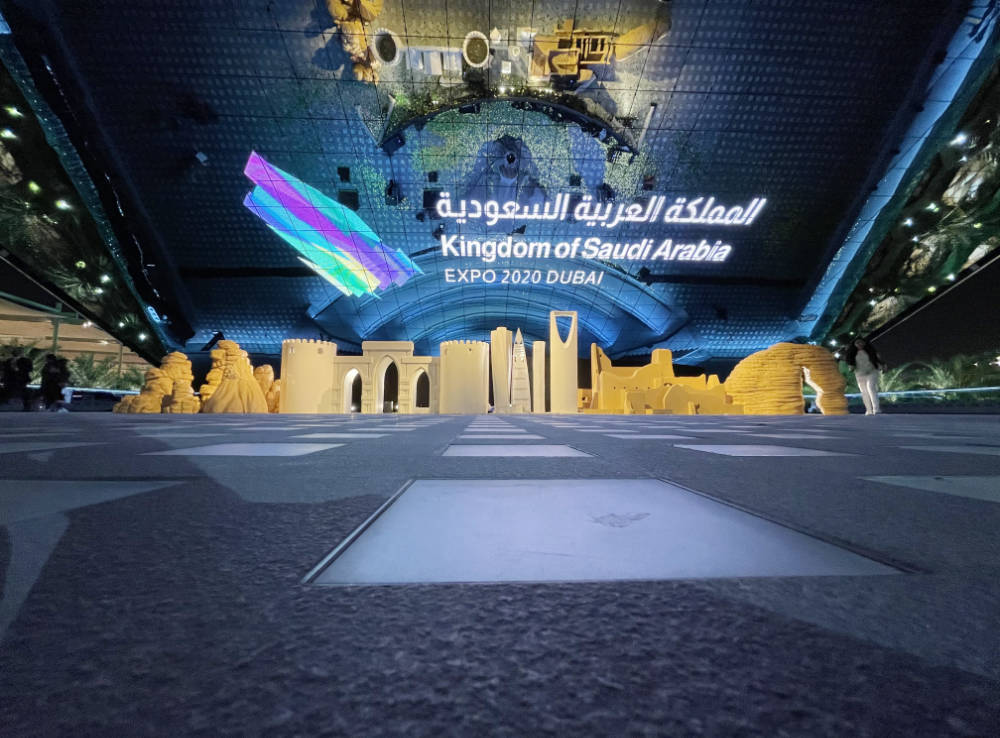
The event, attended by dignitaries and VIPs, celebrated the success of the pavilion over the past six months. “What a pavilion and what an experience it was,” Al-Rasheed said. “It was the colors, the landscapes, the diversity, the authenticity, the heritage, the modernity — I could see under one roof everything that we are all as a nation working toward.”

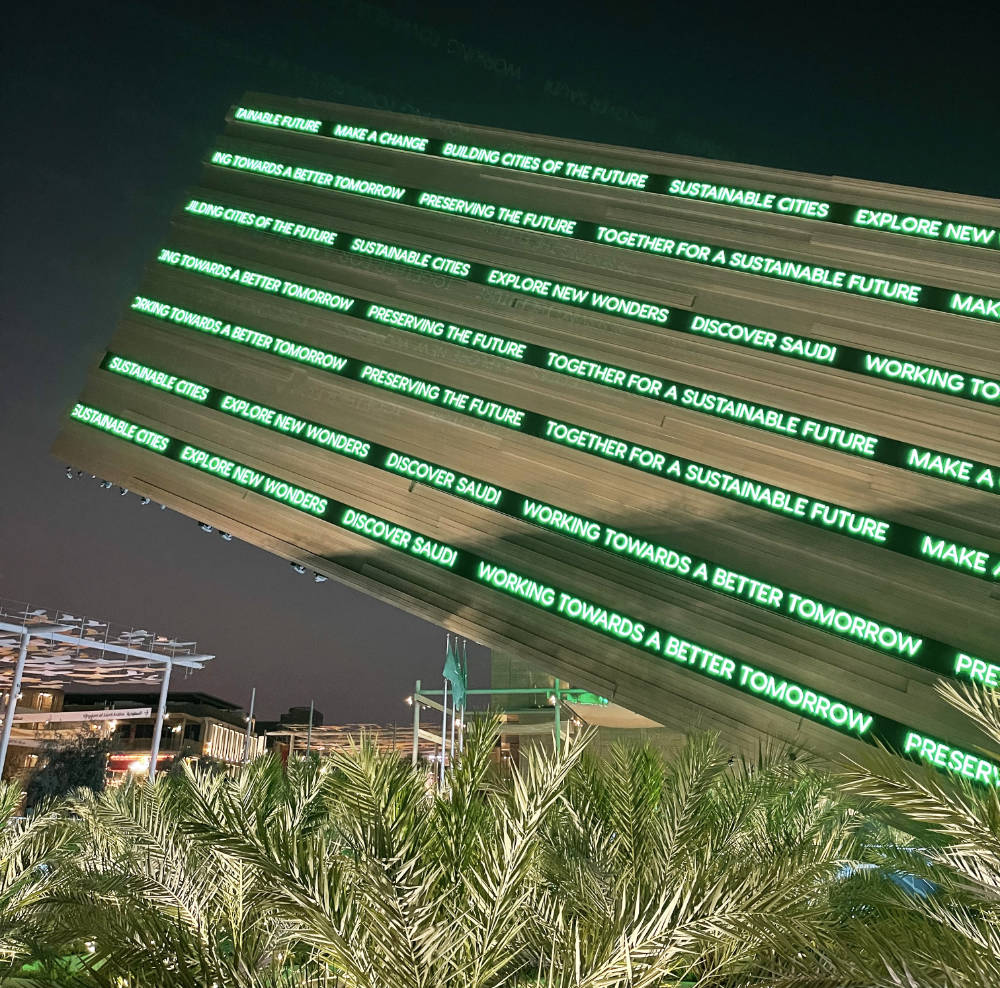
The pavilion’s dramatic sloping structure features a façade representing the idea of a large window open to the future. “It has become a recognizable landmark with a strong foundation rooted in heritage rising toward the sky,” said Hussain Hanbazaza, the pavilion’s commissioner general.

The pavilion was the most visited at Expo 2020, with more than 4.8 million people passing through its doors. Its architecture and design, and its programming over the past six months, aimed to represent the social, cultural and economic change that is taking place in the Kingdom as a result of the Vision 2030 reform agenda.
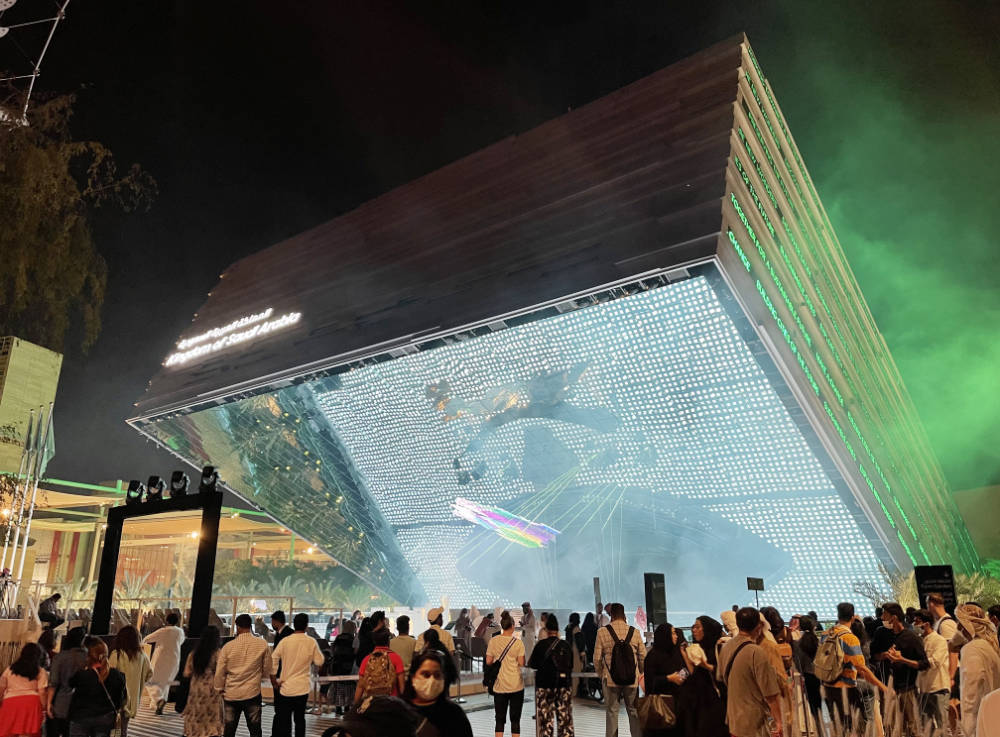
“This is a statement about our readiness to open our hearts and doors to the rest of the world, and to the limitless potential of the Kingdom of Saudi Arabia,” Hanbazaza said.

Al-Rasheed said Riyadh was a global capital, and two thirds of its people were under the age of 30. “Its streets, corners, offices and parks are bustling with youthful energy,” he told guests at the closing ceremony.

“We know that the world of 2030 will be different, we know that it will be better. Our capital Riyadh is preparing to host you and the world. But to get there, we need to work together.”


Playing to win: Qiddiya City begins to welcome the world

Updated 7 sec ago
Follow

Playing to win: Qiddiya City begins to welcome the world

  • A Six Flags theme park, the first completed attraction at the massive new entertainment, sports and cultural destination focused on “play,” opened for business on New Year’s Eve
  • The development near Riyadh will eventually include 70 major attractions, including a water park, a Dragon Ball theme park, world-class sports facilities and esports arenas

RIYADH: Qiddiya City, the massive entertainment, sports and cultural destination under construction near Riyadh, is scaling up quickly as it aims to add SR44 billion ($11.7 billion) to gross domestic product and create 85,000 jobs by 2030.

The Qiddiya Investment Company’s ambitious inaugural project, a global destination built from the ground up focused on the concept of “play,” is starting to roll out its entertainment attractions, sports venues and the infrastructure to support them. The hype really began to build when the Six Flags Qiddiya City theme park, the first of 70 major attractions, opened on New Year’s Eve.

Spanning an area of more than 360 sq. km, Qiddiya City is located at the heart of the Tuwaiq Mountains, about 40 minutes from the Saudi capital. The development’s economic model is rooted in experiential tourism, a growing segment in this market.

Its goal is to support Saudi Arabia’s economic diversification and development; this year alone, as its attractions begin to open, the project is expected to contribute SR2.5 billion to national GDP and provide 7,000 jobs. But the vision and the dream are bigger and wider than that

Abdullah Nasser Al-Dawood, the managing director of Qiddiya Investment Company, set out the strategic importance of the development and its aggressive growth trajectory during a recent appearance on the “Fi Al Soura” television program. He described Qiddiya City as a long-term national development initiative driven by extensive market research and directives from Crown Prince Mohammed bin Salman, the chairman of its board of directors.

“Qiddiya was created in response to people’s needs,” Al-Dawood said. “His Royal Highness further directed us to not merely meet these needs but to import the best global practices, infuse them with a unique Saudi touch and create a Saudi landmark for the world.”

The Qiddiya team talked to more than 20,000 people to better understand their needs, he added, discussions that revealed an overwhelming desire for high-quality recreational options and family activities.

The integrated design of Qiddiya City means that its entertainment, hospitality, sports, culture and infrastructure will work together in a synergistic fashion, its designers say, to help elevate the competitive global standing of the Kingdom.

The opening of Six Flags Qiddiya City will soon be followed by Aquarabia, a Saudi-designed water park featuring record-breaking rides. It will have women-only days with strict privacy protocols, reflecting a culturally sensitive approach to local needs.

Qiddiya City will also have the only theme park in the world based entirely around the Japanese media franchise Dragon Ball, targeting more than 2 billion anime and manga fans locally and worldwide.

Two out of three people in Saudi Arabia identify as gamers, and Qiddiya City will cater to them with dedicated esports arenas. In addition it will host regional headquarters for gaming companies, and accommodation tailored to the international gaming community, with the aim of capturing a significant share of the $250 billion global gaming market.

A multi-faceted motor sports center, in partnership with Mercedes-AMG, will include a globally unique “Speed Park Track” that includes a 70-meter climb to an elevated a first corner, and can host more than 16 established international events, including Formula One and Formula E.

In addition to providing venues for numerous international sporting events, Qiddiya City is also developing world-class headquarters for Saudi Pro League football teams Al-Nassr and Al-Hilal, which developers say will rival top international facilities and be backed by strategic 20-year sponsorship deals.

Other sports facilities will include a National Tennis Center, an Equestrian Zone that will host the Saudi Cup, and the innovative Prince Mohammed bin Salman Stadium, expected to open in 2029.

Qiddiya City also aims to become a premier golf destination through a global partnership with the Faldo Series, described as the leading development pathway for young golfers, and by hosting international events. British golfer Nick Faldo has designed an 18-hole championship course that is set to open this year, and a state-of-the-art clubhouse, golf academy and practice facilities will follow in 2028.

Qiddiya City’s “Park of Parks” zone will feature 10 public parks and 29 hotels as part of a largely car-free environment offering a diverse range of public-transportation options, including monorails and even gondolas.

The city has been designed to accommodate 500,000 residents in 150,000 residential units to support the 300,000 people expected to work at Qiddiya City upon completion.

The development of the city has been structured in three main waves, with new attractions opening every three months until it is fully operational in 2034, when the Kingdom will host the FIFA World Cup.

Acknowledging the importance of seamless access to the city and its attractions, Al-Dawood highlighted the ongoing infrastructure enhancements that are being carried out by the Royal Commission for Riyadh City, including road expansions, a new Metro line serving eight stations in Qiddiya City, and proposals for a high-speed train link, which he said will significantly improve connectivity.

Developers say they are also committed to social responsibility, and have pledged to donate 1 percent of revenues to community and charitable organizations to “open the door to play for everyone.”

Safety and security are described as a “red line” for the development; Six Flags underwent rigorous certification by specialized German companies and its rides completed 4,500 test runs prior to opening.

“It is an immense privilege to serve my country and its leadership, contributing to Vision 2030 through a magnificent project like Qiddiya,” said Al-Dawood.

“We are not just building a city; we are creating a national landmark that will inspire and uplift for generations to come, fostering opportunities and experiences unparalleled anywhere in the world.”