

Houthis hit ‘backbone of the global economy’ in Jeddah oil depot strike

1 / 3
A view of a fire at Saudi Aramco's petroleum storage facility, after an attack, in Jeddah, Saudi Arabia March 25, 2022. (Reuters)
2 / 3
The Coalition to Restore Legitimacy in Yemen said a “hostile” operation by Yemen’s Iran-backed Houthi militia targeted an Aramco oil facility in Jeddah. (AN Photo)
3 / 3
Saudi Arabia’s air defense forces destroyed seven drones and a missile launched by the Houthi militia targeting the southern part of the Kingdom, the Coalition said on Friday. (SPA)
Short Url
Updated 26 March 2022
Follow

Houthis hit ‘backbone of the global economy’ in Jeddah oil depot strike

  • Huge blaze and plumes of smoke over city
  • Militia aims to undermine world energy security, coalition says

JEDDAH: The Iran-backed militia in Yemen were accused on Friday of threatening global energy security with a wave of drone and missile attacks on oil facilities in the Kingdom.

A huge fire erupted at an Aramco oil storage facility in Jeddah after one attack.

Plumes of black smoke rose over the city and were visible to drivers practicing for the Formula 1 Grand Prix motor race at the Jeddah Corniche circuit.
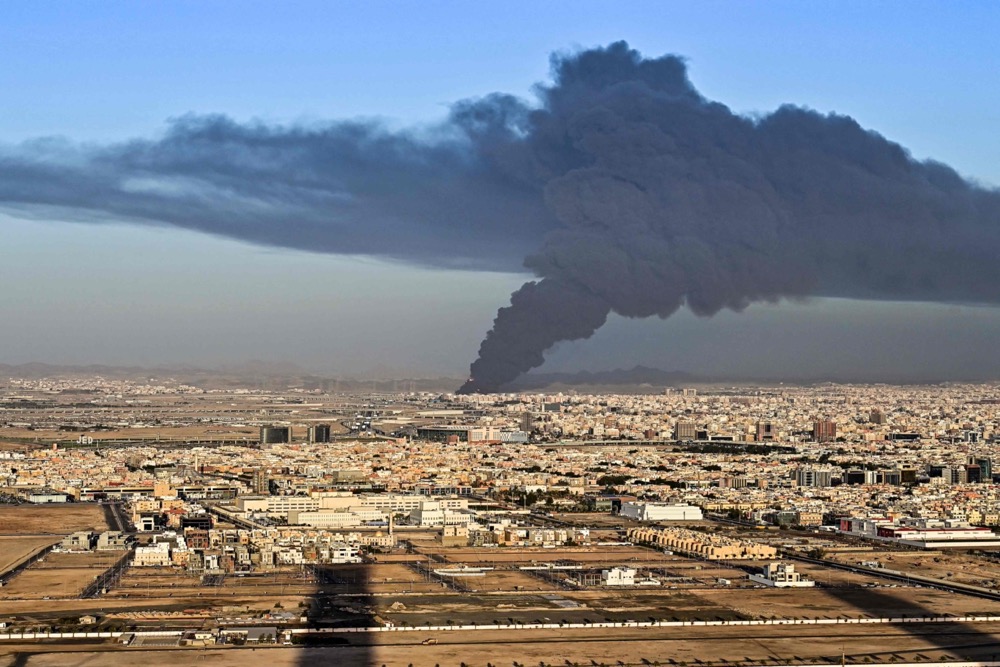


Smoke from the site could be seen across the city on Friday. (AFP)

F1 authorities said the race would go ahead on Sunday as planned.

The Coalition to Restore Legitimacy in Yemen said the fire in two tanks at the North Jeddah oil facility had been brought under control, and there were no casualties.

Coalition spokesman Brig. Gen. Turki Al-Malki said: “This hostile escalation targets oil facilities and aims to undermine energy security and the backbone of the global economy. These hostile attacks had no impact or repercussions in any way, shape or form on public life in Jeddah.”

The US State Department condemned the Houthi attacks as “unacceptable.”

British Prime Minister Boris Johnson also slammed the attacks. “These strikes put civilian lives at risk and must stop,” he said.

Earlier, Saudi air defenses forces destroyed seven drones and a missile launched by the Houthis targeting the southern part of the Kingdom.  The attacks deliberately targeted civilian areas and energy installations, the coalition said, and threatened both regional and international security.

Last weekend a Houthi assault on the Kingdom caused a temporary drop in output at a refinery and a fire at a petroleum products distribution terminal. On March 11, the group targeted a refinery in Riyadh, causing a small fire.

Saudi Arabia said after those attacks that it would bear no responsibility for any shortage of global oil supplies caused by Houthi attacks, and the Saudi Energy Ministry restated that view on Friday.

The North Jeddah plant stores diesel, gasoline and jet fuel for use in the city. It accounts for over a quarter of Saudi Arabia’s supplies and also provides fuel for a desalination plant.

The Houthis have twice targeted the plant with cruise missiles, once in November 2020 and most recently last Sunday. A UN panel of experts on the war in Yemen described it as a “civilian target.”
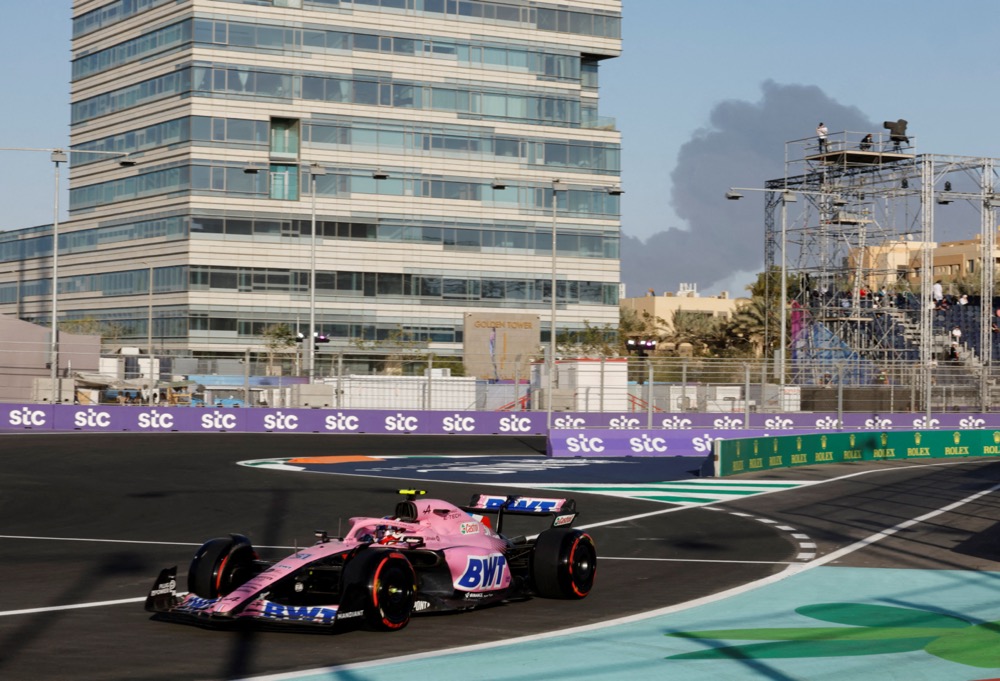


Plumes of smoke were visible to drivers practicing for the Formula 1 Grand Prix motor race at the Jeddah Corniche circuit. (Reuters)

“While the facility also supplies the Saudi military with petroleum products, it is mostly supplying civilian customers,” the panel said.

“If it had been out of service for a significant period, the impact on the Kingdom’s economy and the welfare of the residents of the western region would probably have been significant.”


Saudi Arabia launches key projects at World Defense Show in Riyadh

Updated 09 February 2026
Follow

Saudi Arabia launches key projects at World Defense Show in Riyadh

  • Defense Minister Prince Khalid bin Salman unveils initiatives
  • New firms set up and deals inked at event running to Feb. 12  

RIYADH: Defense Minister Prince Khalid bin Salman unveiled new initiatives and signed several agreements on the opening of the third World Defense Show in Riyadh on Sunday.

Prince Khalid opened the show on behalf of Crown Prince Mohammed bin Salman, the Saudi Press Agency reported.

Organized by the General Authority for Military Industries, the five-day event will run until Feb. 12, showcasing the Kingdom’s rapid strides toward strategic independence and technological leadership in the defense sector.

The 2026 edition features a purpose-built venue with a 2,700-meter runway for live air and land demonstrations, underscoring the show’s status as a premier global defense event.

The GAMI’s Gov. Ahmad Al-Ohali said the show reflects Saudi Arabia’s commitment to localizing over 50 percent of military spending in line with Vision 2030, and fostering an integrated ecosystem where government bodies and international partners collaborate on innovation.


The event brings together official delegations, government entities, and leading international companies specializing in the defense and security sectors. (SPA)

Strategic agreements and major launches

At the Saudi Arabian Military Industries Group pavilion, Prince Khalid launched several key initiatives.

  • New entities: The inauguration of the SAMI Land Co., SAMI Autonomous Co., and the SAMI Land Industrial Complex.
  • Supply chain: The unveiling of the SAMI Local Content Program and the HEET Program.
  • International cooperation: A memorandum of understanding was signed between the Saudi General Authority for Defense Development and the Korean Agency for Defense Development on advanced military research.
  • Defense deals: The minister signed cooperation agreements with Slovakia, Malaysia, and Somalia.
Defense Minister Prince Khalid signed cooperation agreements with Slovakia, Malaysia, and Somalia. (SPA)


Technological debuts and innovations

The show is also serving as a launchpad for cutting-edge security technologies across various government sectors.

  • AI-Powered Lucid Gravity: Public Security debuted its advanced Lucid Gravity electric security vehicle at the Ministry of Interior’s pavilion.

The vehicle integrates state-of-the-art artificial intelligence and specialized security equipment designed to accelerate emergency response times and support field operations.

Public Security’s advanced Lucid Gravity electric security vehicle is displayed at the Ministry of Interior’s pavilion. (SPA)

By leveraging predictive intelligence and advanced command-and-control systems, the Lucid Gravity exemplifies the ministry’s commitment to protecting the Kingdom.

  • Smart helmet: Also at the Ministry of Interior’s pavilion, the General Directorate of Civil Defense unveiled its smart helmet.

Designed to revolutionize public safety and emergency response, the helmet features day-and-night cameras and specialized sensors to detect hazardous materials in hard-to-reach locations.

The device serves as a mobile command node, delivering live video feeds directly to command-and-control centers. By enabling real-time data analysis and faster decision-making, the helmet reduces response times and enhances personnel safety in high-risk environments.


The smart helmet features day-and-night cameras and specialized sensors to detect hazardous materials in hard-to-reach locations. (SPA)


  • Border security: The General Directorate of the Border Guard showcased an integrated security system featuring radar and thermal cameras capable of detecting drones and classifying moving targets to protect critical infrastructure.

It also functions as an early warning system for critical facilities and border areas and is fully integrated with command-and-control systems.


Border Guard's ntegrated security system features radar and thermal cameras capable of detecting drones and classifying moving targets to protect critical infrastructure. (SPA)
  • Counter-terrorism: The Islamic Military Counter Terrorism Coalition presented a comprehensive framework integrating intellectual, media, and military domains to combat extremism and terror financing.

    Visitors were briefed on specialized programs designed to raise the readiness of national personnel and foster sustainable institutional cooperation among member states to combat extremism.

    On the event’s opening day, the pavilion hosted high-level delegations, including ministers, military leaders, and ambassadors who reviewed and praised the coalition’s pivotal role in coordinating local and international security efforts.

    A view of the Islamic Military Counter Terrorism Coalition pavilion. (SPA)
  • Meteorology: The National Center for Meteorology displayed advanced weather systems essential for ensuring the safety of the event’s air shows and military operations.

    At its dedicated pavilion, the NCM is showcasing its latest advanced meteorological technologies and systems. These solutions serve both the military and civilian sectors, providing accurate data to support beneficiary entities’ operational processes.

World Defense Show CEO Andrew Pearcey said that participation is expected to surpass previous records, reflecting the event’s growing importance on the international stage.

NCM's latest meteorological technologies and systems serve both the military and civilian sectors