

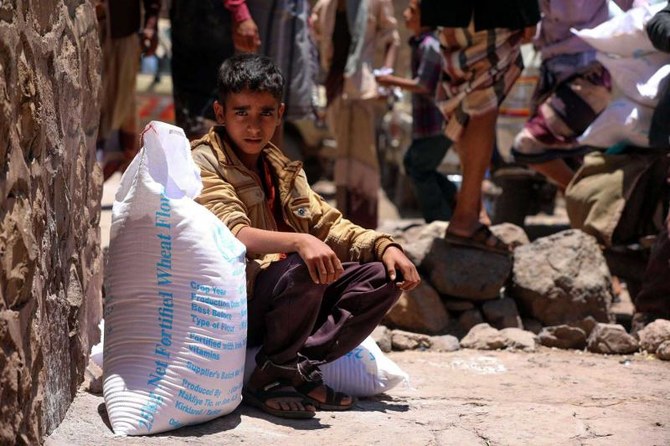

LONDON: Millions of people around the world, many of them in Yemen, are facing catastrophe as the conflict in Ukraine threatens to drastically increase the price of food, the UN has warned.
Officials from the UN’s World Food Programme (WFP) previously warned that up to 44 million people across 36 countries were on the edge of famine before the conflict in Ukraine began.
Between them, Russia and Ukraine produce 30 percent of the world’s wheat — and the war in Ukraine is poised to push prices of the essential commodity up.
This has already forced the WFP to reduce by up to 50 percent what it feeds to children in the Yemen conflict.
Martin Penner, the WFP’s deputy head of global communications, told The Independent: “When the Ukraine conflict happened, the world was already facing unprecedented challenges all over the place, with hunger numbers and emergencies just getting bigger by the day.
“Then along comes the war in Ukraine. Ukraine, together with Russia, is the breadbasket of the world. Ukraine by itself produces enough food every year for about 400 million people. A lot of that is exported.”
He added: “It’s like another disaster happening on top of something that was already a catastrophe.”
About half of Yemen’s population of 30 million is in poverty, and the WFP feeds 13 million people a month.
But now, with Ukrainian ports closed and Russian grain deals nixed because of sanctions, that crisis could be about to get much worse.
Roughly 13.5 million tons of wheat and 16 million tons of maize are currently frozen in Russia and Ukraine.
“We’re really in a unique situation,” Dr Michael Puma, director of the Center for Climate Systems Research at Columbia University, New York told The Independent.
“What is also concerning is not just the disruption to production, but disruption to transport, and logistics in and moving out of the country. And also, Russia (is) becoming more of a pariah state, where companies, including transport and logistics companies, are hesitant to be involved.”
As well as Yemen, impoverished Syria and Taliban-run Afghanistan both face food crises, as do many African nations. Around half of Africa’s wheat imports come from Ukraine and Russia.
David Beasly, executive director of the WFP, said the body is facing a $9 billion shortfall and that countries that are not facing famine could yet feel the consequences of millions being plunged into hunger.
He told Politico: “We’re billions short. Failure to provide this year a few extra billion dollars means you’re going to have famine, destabilization and mass migration.”
“If you think we’ve got hell on earth now, you just get ready. If we neglect northern Africa, northern Africa’s coming to Europe. If we neglect the Middle East, (the) Middle East is coming to Europe.”


