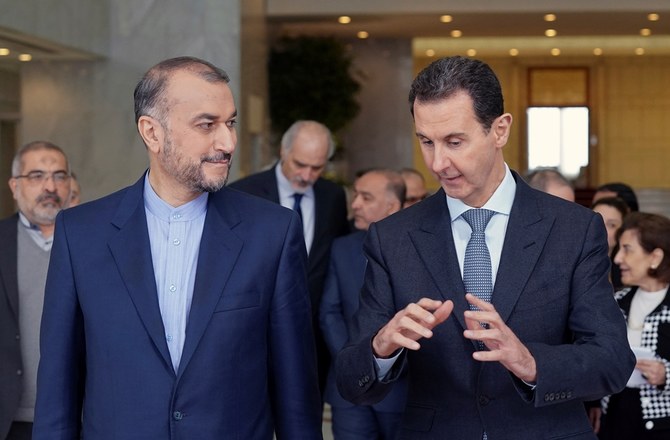
DAMASCUS: The foreign ministers of Iran and Syria, two allies of Russia, discussed the war in Ukraine and other developments during a meeting in Damascus on Wednesday. Syria’s top diplomat said Moscow is defending its people.
Faisal Mekdad spoke to reporters in Damascus after his Iranian counterpart, Hossein Amir-Abdollahian, held talks with President Bashar Assad, Mekdad and top security official Maj. Gen. Ali Mamlouk.
Amir-Abdollahian welcomed the reconciliation approach by the United Arab Emirates toward Syria. He added that Tehran is close to reaching an agreement on its nuclear program with world powers.
Iran is a strong ally of Assad and has sent thousands of Iran-backed fighters from around the region to bolster Syrian government forces against opponents in the 11-year Syrian conflict. Russia has also supported Assad militarily, turning the tide of the war in his favor. The Syria war has killed nearly half a million people and displaced half the country’s pre-war population of 23 million.
Speaking about Russia’s invasion of Ukraine, Mekdad said “Russia is defending its right in protecting its people (by pushing) away the NATO presence on its direct border.”
“Russia is defending us all and is defending its sovereignty,” Mekdad added.
State news agency SANA said that during Assad’s meeting with Amir-Abdollahian they discussed the conflict in Ukraine and they both agreed that “international balance should not be subjected to dangerous shocks through which Western countries threaten international peace and security.”
During his visit, Amir-Abdollahian discussed the latest developments in Iran’s negotiations to restore Tehran’s nuclear deal with world powers. He also discussed Assad’s visit to the United Arab Emirates last week, which marked his first to an Arab country since the Syria war broke out, and meetings of the constitutional committee in Geneva between the Syrian government and opposition.
“We welcome and we are satisfied with what some Arab countries are doing by normalizing relations with Syria,” Amir-Abdollahian said.
Amir-Abdollahian said in Farsi that strategic relations between Iran and Syria are at their best. He later made a rare comment in Arabic, saying: “We are in the same trench, and we support Syria’s leadership, government and people.”
Like Iran, Russia is a strong ally of Syria and joined the war in 2015, which helped Assad’s forces regain control of much of the country. Russia has hundreds of troops deployed in Syria and an air base on the Mediterranean coast.
Nuclear negotiations nearly reached completion earlier this month before Moscow demanded that its trade with Iran be exempted from Western sanctions over Ukraine, throwing the process into disarray. Negotiators have yet to reconvene in the Austrian capital, and it’s unclear exactly what hurdles lie ahead.
The Iranian official said he believes that Tehran is close to reaching an agreement over its nuclear program and put the blame for delays on the American side, which he said should take “a realistic stance.” He did not elaborate.
Amir-Abdollahian’s visit comes two weeks after two members of Iran’s Revolutionary Guard were killed in an Israeli strike near the capital Damascus.
Days later Iran claimed responsibility for a missile barrage that struck near a sprawling US consulate complex in northern Iraq, saying it was retaliation for repeated Israeli strikes in Syria. The Revolutionary Guard said it fired off 12 cruise missiles at what it described as a “strategic center” of the Israeli spy agency Mossad, a claim denied by Iraqi officials.


Iran welcomes Syria ties with Arabs, says nuclear deal close
https://arab.news/mnccn
Iran welcomes Syria ties with Arabs, says nuclear deal close

- Amir-Abdollahian welcomed the reconciliation approach by the UAE toward Syria
- “Russia is defending us all and is defending its sovereignty,” Mekdad added


Hundreds flee to government-held areas in north Syria ahead of possible offensive
- Many of the civilians who fled used side roads to reach government-held areas
- Men, women and children arrived in cars and pickup trucks that were packed with bags of clothes
DEIR HAFER, Syria: Scores of people carrying their belongings arrived in government-held areas in northern Syria on Friday ahead a possible attack by Syrian troops on territory held by Kurdish-led fighters east of the city of Aleppo.
Many of the civilians who fled used side roads to reach government-held areas because the main highway was blocked with barriers at a checkpoint that previously was controlled by the Kurdish-led and US-backed Syrian Democratic Forces, Associated Press journalists observed.
The Syrian army said late Wednesday that civilians would be able to evacuate through the “humanitarian corridor” from 9 a.m. to 5 p.m. Thursday. The announcement appeared to signal plans for an offensive against the SDF in the area east of Aleppo.
There were limited exchanges of fire between the two sides.
Men, women and children arrived in cars and pickup trucks that were packed with bags of clothes, mattresses and other belongings. They were met by local officials who directed them to shelters.
In other areas, people crossed canals on small boats and crossed a heavily damaged pedestrian bridge to reach the side held by government forces.
The SDF closed the main highway but about 4,000 people were still able to reach government-held areas on other roads, Syrian state TV reported.
A US military convoy arrived in Deir Hafer in the early afternoon but it was not immediately clear whether those personnel will remain. The US has good relations with both sides and has urged calm.
Inside Deir Hafer, many shops were closed and people stayed home.
“When I saw people leaving I came here,” said Umm Talal, who arrived in the government-held area with her husband and children. She added that the road appeared safe and her husband plans to return to their home.
Abu Mohammed said he came from the town of Maskana after hearing the government had opened a safe corridor, “only to be surprised when we arrived at Deir Hafer and found it closed.”
SDF fighters were preventing people from crossing through Syria’s main east-west highway and forcing them to take a side road, he said.
The tensions in the Deir Hafer area come after several days of intense clashes last week in Aleppo, previously Syria’s largest city and commercial center, that ended with the evacuation of Kurdish fighters from three neighborhoods north of the city that were then taken over by government forces.
The fighting broke out as negotiations stalled between Damascus and the SDF over an agreement reached in March to integrate their forces and for the central government to take control of institutions including border crossings and oil fields in the northeast.
The US special envoy to Syria, Tom Barrack, posted on X Friday that Washington remains in close contact with all parties in Syria, “working around the clock to lower the temperature, prevent escalation, and return to integration talks between the Syrian government and the SDF.”
The SDF for years has been the main US partner in Syria in fighting against the Daesh group, but Turkiye considers the SDF a terrorist organization because of its association with Kurdish separatist insurgents in Turkiye.


