

Pakistan among eight nations with two-thirds of global tuberculosis cases

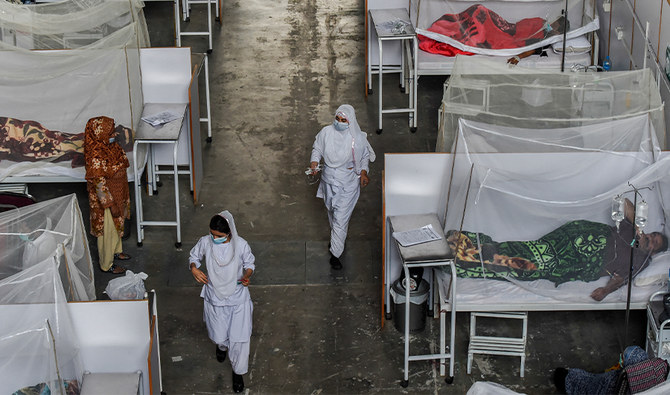
Patients take rest on beds arranged inside a makeshift ward in a hospital in Lahore on October 17, 2021. (AFP/FILE)
Short Url
Updated 23 March 2022
Follow

Pakistan among eight nations with two-thirds of global tuberculosis cases

  • World TB Day marked each year on March 24, anniversary of announcement of discovery of bacillus in 1882
  • TB was world's second-deadliest infectious disease after Covid-19 in 2020, accounting for 1.5 million deaths

Paris: Tuberculosis (TB) may have been overtaken by Covid-19 as the world's deadliest infectious disease, but it continues to defy vaccines and antibiotics to wreak a grim global toll, with two-thirds of cases concentrated in eight countries: Bangladesh, China, India, Indonesia, Nigeria, Pakistan, the Philippines and South Africa.

Here are five things to know about an infection that has scourged the world for tens of thousands of years, ahead of World Tuberculosis Day on Thursday.

TB first emerged around 40,000 years ago, according to genetic studies.

For a long time, scientists believed that tuberculosis in humans came from TB in cattle, and that it had been transmitted when livestock farming started in the Neolithic Age.

But recent studies paint a different picture, showing that TB already existed in humans before they started to raise cattle. Traces of the illness have been discovered in human remains that are around 11,000 years old.

World TB Day is marked each year on March 24, the anniversary of the announcement of the discovery of the bacillus in 1882 by Nobel laureate Robert Koch of Germany.

It was, however, only in 1921 that France's legendary Pasteur Institute developed the Bacillus Calmette-Guerin (BCG) vaccine, which became one of the world's oldest and most trusted jabs.

A century on, the vaccine is still in use and is particularly effective in preventing tuberculosis in children, but results are variable in adults.

In the 1940s and 1950s, the discovery of streptomycin and other antibiotics made it possible to treat pulmonary TB, the most common form of the disease amongst adults and teens.

But drug-resistant strains of tuberculosis emerged, forcing doctors to use antibiotic cocktails to efficiently muzzle the bacteria and to apply their treatment over several months.

Some strains are resistant to several TB drugs, forcing the use of alternative treatments for many months and leading in some cases to therapeutic failures.

TB was the world's second-deadliest infectious disease after Covid-19 in 2020 (the latest year for which figures are available), accounting for 1.5 million deaths, according to the World Health Organization (WHO).

Covid killed more than 1.8 million people that year, according to an AFP count based on official figures.
Before Covid emerged, TB had occupied the top spot, claiming more lives than HIV/AIDS, which cost 680,000 lives in 2020 according to UNAIDS.

TB is also a major cause of death amongst people living with HIV.

Disruptions in access to healthcare because of the Covid pandemic have erased years of progress toward tackling the curable disease.

As a result TB is on the rise again globally, with the number of deaths rising by seven percent in 2020.

TB is present on all five continents, but developing countries are disproportionately affected.

In 2020, two regions accounted for the biggest number of new cases: southeast Asia recorded 43 percent of the new cases and Africa 25 percent, according to the WHO.


Pakistan says responding to Afghan ‘offensive operations’ after border fire as tensions escalate

Updated 26 February 2026
Follow

Pakistan says responding to Afghan ‘offensive operations’ after border fire as tensions escalate

  • Afghan Taliban spokesperson says “large-scale offensive operations” launched against Pakistani military bases
  • Pakistan says Afghan forces opened “unprovoked” fire across multiple sectors along shared border

ISLAMABAD: Afghanistan’s Taliban authorities said on Thursday they had launched “large-scale offensive operations” against Pakistani military bases and installations, prompting Pakistan to say its forces were responding to what it described as unprovoked fire along the shared border.

The escalation follows Islamabad’s weekend airstrikes targeting what it said were Tehreek-e-Taliban Pakistan (TTP) and Daesh militant camps inside Afghanistan in response to a wave of recent bombings and attacks in Pakistan. Islamabad said the strikes killed over 100 militants, while Kabul said dozens of civilians were killed and condemned the attacks as a violation of its sovereignty.

In a post on social media platform X, Afghan government spokesperson Zabihullah Mujahid said Afghanistan had launched “large-scale offensive operations” in response to repeated violations by the Pakistani military.


Pakistan’s Ministry of Information said Afghan forces had initiated hostilities along multiple points of the frontier.

“Afghan Taliban regime unprovoked action along the Pakistan–Afghanistan border given an immediate, and effective response,” the ministry said in a statement.

The statement said Pakistani forces were targeting Taliban positions in the Chitral, Khyber, Mohmand, Kurram and Bajaur sectors, claiming heavy Afghan casualties and the destruction of multiple posts and equipment. It added that Pakistan would take all necessary measures to safeguard its territorial integrity and the security of its citizens.


Separately, security officials said Pakistani forces had carried out counterattacks in several border sectors.

“Pakistan’s security forces are giving a befitting reply to the unprovoked Afghan aggression with full force,” a security official said, declining to be named. 

“The Pakistani security forces’ counter-attack destroyed Taliban’s hideouts and the Khawarij fled,” they added, referring to TTP militants. 

The claims from both sides could not be independently verified.

Cross-border violence has intensified in recent weeks, with Pakistan blaming a surge in suicide bombings and militant attacks on militants it says are based in Afghanistan. Kabul denies providing safe havens to anti-Pakistan militant groups.

The clashes mark the third major escalation between the neighbors in less than a year. Similar Pakistani strikes last year triggered weeklong clashes before Qatar, Türkiye and other regional actors mediated a ceasefire in October.

The 2,600-kilometer (1,600-mile) frontier, a key trade and transit corridor linking Pakistan to landlocked Afghanistan and onward to Central Asia, has faced repeated closures amid tensions, disrupting commerce and humanitarian movement. Trade between the two nations has remained closed since October 2025.