

Pakistan PM urges OIC states to mediate ceasefire between Russia and Ukraine

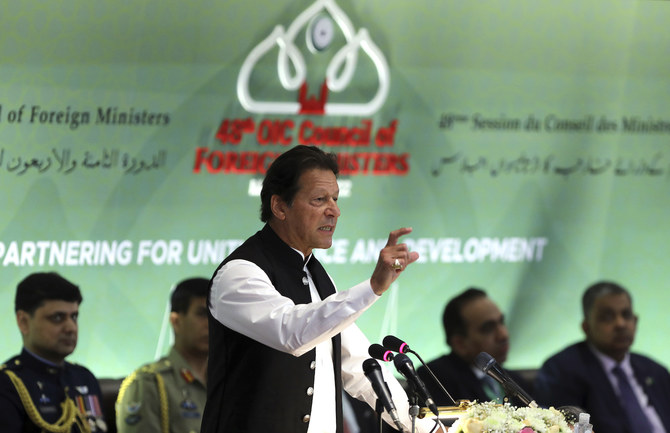
Pakistan's PM Imran Khan speaks at the start of a two-day gathering of the OIC at the Parliament House in Islamabad, Pakistan, Tuesday, March 22, 2022. (AP)
Short Url
Updated 22 March 2022
Follow

Pakistan PM urges OIC states to mediate ceasefire between Russia and Ukraine

  • Imran Khan says continued conflict “will have great consequences for the world”
  • PM spoke during conference of OIC foreign ministers hosted by Islamabad

ISLAMABAD: Pakistan Prime Minister Imran Khan on Tuesday urged member states of the Organization of Islamic Cooperation to mediate and help “bring about a ceasefire” between Russia and Ukraine.

More than 600 delegates from 56 OIC member states and observer countries are participating in the body’s 48th Council of Foreign Ministers session being held in Islamabad from March 22 to 23. The theme of this year’s conference is “Partnering for Unity, Justice, and Development.”

Though Russian troops have failed to capture any major Ukrainian city more than four weeks into their invasion, they are increasingly now resorting to causing massive destruction to residential areas using air strikes, long-range missiles and artillery.

“We, like everyone else in the world, are all worried about what’s happening there (in Ukraine),” Khan said. “May I suggest that the OIC, during its discussions, the foreign ministers, we should think how we represent 1.5 billion people, how we can mediate, how we can bring about a ceasefire, how can we bring about an end to the conflict.”

On Feb. 24, Russia launched a full-scale invasion of Ukraine, drawing widespread condemnation from countries around the world and triggering a wave of international sanctions against Moscow. Pakistan remains one of the few countries in the world that has refrained from condemning Russia directly, though it has called for the use of diplomacy to deescalate the crisis. 

During Tuesday’s address, Khan said he would hold a meeting with Chinese Foreign Minister Wang Yi during the OIC summit to discuss how Beijing, together with the OIC, could help resolve the conflict.

“This conflict will have great consequences for the world,” he warned, adding that Pakistan was already suffering as oil, wheat and gas prices had shot up in the country in the wake of the Russian invasion.

Khan also spoke about a humanitarian crisis in Afghanistan.

Following the Taliban takeover of Afghanistan in mid-August last year, the aid-dependent country was cut off from billions of dollars in international assistance and financial institutions, while nearly $10 billion of its assets were frozen by the US, triggering a banking crisis.

Khan said Afghanistan was reeling from sanctions and called on the international community to engage with Afghans to save them from a humanitarian catastrophe.

Khan also said “we (OIC) have failed both the Palestinians and the people of Kashmir.”

“I am sad to say that we have been able to make no impact at all,” he said, adding that Muslim countries were “a divided house.”

In his opening remarks as chair of the conference, Pakistan Foreign Minister Shah Mahmood Qureshi warned about the “threat of genocide” faced by the Muslims of Indian-administered Kashmir.

“The threat of genocide is most imminent,” he said.

Kashmiri territory has long been a flashpoint between India and Pakistan. Both claim all of the region but rule only in part.

Qureshi said the government of Indian Prime Minister Narendra Modi had “unleashed a reign of terror” since August 2019 when it withdrew Kashmir’s autonomy in order to tighten the central government’s grip over the region, provoking outrage in Pakistan and the downgrading of diplomatic ties and suspension of bilateral trade.

He called on the OIC member states to partner with the international community and take “concrete and tangible” steps for the resolution of the conflicts in Kashmir, as well as Palestine.

After Qureshi’s speech, Saudi Foreign Minister Prince Faisal bin Farhan delivered his opening statement, announcing “support to the people of Jammu and Kashmir.”

“We also support the efforts made by the international community to reach a just solution for the Jammu and Kashmir issue,” he said.

Prince Faisal also condemned the aggression of the Houthi rebels in Yemen and called on Muslim nations to apply more pressure on the group.

“In line (with) international resolutions, Saudi Arabia calls (for measures) to neutralize (the) Houthi groups and wants to stop the importing of arms in Yemen,” he said. “We reiterate the importance of the role of brothers to (apply) more pressure on (the) Houthis so that they can be stopped from jeopardizing the security of the Kingdom.”


Pakistan rules out talks with Afghanistan, says more than 330 Afghan fighters killed in operations

Updated 56 min 31 sec ago
Follow

Pakistan rules out talks with Afghanistan, says more than 330 Afghan fighters killed in operations

  • Pakistan is a major non-NATO ally of Washington, while the US considers the Afghan Taliban a “terrorist” group

ISLAMABAD: Pakistan has ruled out talks with Afghanistan until there is an end to “terrorism” emanating from Afghan soil, officials said on Friday. The statement follows the killing of more than 330 Afghan fighters in cross-border skirmishes this week.

The latest clashes between the neighbors erupted after Pakistani airstrikes on Afghan territory last weekend triggered retaliatory attacks along the border on Thursday, escalating long‑simmering tensions over Pakistan’s claim that Afghanistan shelters Pakistani Taliban militants. Afghanistan denies this, saying Pakistan is deflecting blame for its own security failures.

Pakistani Information Minister Attaullah Tarar said his country had killed 331 Afghan fighters, destroyed over 100 posts and targeted 37 military locations across Afghanistan. Afghan officials have said more than 50 Pakistani soldiers have been killed and several Pakistan posts captured. Neither casualty figures nor battlefield claims by either side could be independently verified.

Meanwhile, Mosharraf Zaidi, Prime Minister Shehbaz Sharif’s spokesperson for foreign media, ruled out any talks with Afghanistan until Kabul addresses the issue, while the US expressed support for what it called Pakistan’s “right to defend itself” against attacks from Afghanistan’s Taliban rulers.

“There won’t be any talks, there is nothing to talk about ... Terrorism from Afghanistan has to end,” Zaidi told state-run Pakistan TV Digital, saying Islamabad would continue to target militant havens inside Afghanistan.

“Pakistan’s responsibility is to protect its citizens. If we know that there is a terrorist in point A and we know that there is a terrorist enabler at point A, we will find a weapon to land at point A and eliminate the threat.”

Zaidi said he did not expect Pakistan to deviate from this position: “We have clearly articulated what we are doing and what we plan on continuing to do and what it will take for us to stop doing what we are doing.”

He added: “And we will expect that both the international community and the regime in question, the Afghan Taliban, will come to their senses and will help reduce instability and disorder in this region.”

Pakistan is a major non-NATO ally of Washington, while the US considers the Afghan Taliban a “terrorist” group.

“The United States supports Pakistan’s right to defend itself against attacks from the Taliban, a Specially Designated Global Terrorist group,” Reuters quoted a State Department spokesperson as saying.

US diplomat Allison Hooker said on X she had spoken with Pakistan Foreign Secretary Amna Baloch on Friday.

The State Department spokesperson said Washington was aware of the escalation in tensions and “outbreak of fighting between Pakistan and the Afghan Taliban,” adding the US was “saddened by the loss of life.”

“The Taliban have consistently failed to uphold their counterterrorism commitments,” it said. “Terrorist groups use Afghanistan as a launching pad for their heinous attacks.”

Meanwhile, Afghan Taliban spokesperson Zabihullah Mujahid called for talks to resolve the crisis.

“We have always emphasized peaceful resolution, and now too we want the issue to be resolved through dialogue,” he said on Friday afternoon.

Asked what Pakistan desired, Tarar said: “Neutralizing the threat and ensuring that Pakistan is safe. Because for us, we’ve been good neighbors, we’ve been very friendly neighbors, we’ve been very, very generous neighbors. Our generosity, unfortunately, has often been seen as our weakness. So the objective, aim is to neutralize the threat and make Pakistan safe.”

He added it was too early to comment on a ceasefire as it was an evolving situation.