

Government files presidential reference in Supreme Court for interpretation of Article 63-A

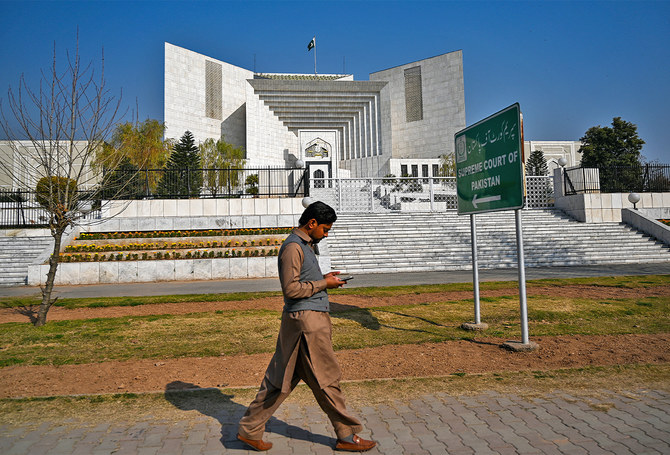
A man walks past the Supreme Court building in Islamabad, Pakistan, on January 29, 2021. (AFP/File)
Short Url
Updated 21 March 2022
Follow

Government files presidential reference in Supreme Court for interpretation of Article 63-A

  • The constitutional provision deals with the issue of disqualification of parliamentarians on grounds of defection
  • The government wants to know if dissident lawmakers can be disqualified for life and stopped from voting in parliament

ISLAMABAD: Pakistan's attorney general Khalid Javed Khan on Monday submitted a reference in the country's top court on behalf of President Arif Alvi to seek detailed interpretation of Article 63-A of the constitution which deals with the disqualification of parliamentarians on grounds of defection.

The development took place in the context of a no-confidence motion against Prime Minister Imran Khan which was filed by an alliance of opposition parties earlier this month.

The government's coalition partners and several lawmakers of the ruling Pakistan Tehreek-e-Insaf (PTI) party have publicly criticized the prime minister and his administration in recent weeks.

The ruling party also issued show-cause notices to its 14 lawmakers, saying their interviews with media outlets had created a perception that they had abandoned the party. The lawmakers were also given a week to present themselves before the prime minister who is also the PTI party chief.

The presidential reference on Monday described floor-crossing as "constitutionally prohibited and morally reprehensible conduct," asking the Supreme Court how the government should ensure "purification of the electoral process and democratic accountability" by dealing with dissident parliamentarians.

Should Article 63-A be interpreted, it asked, in a way that suggests that "defections warrant no preemptive action save de-seating the member as per the prescribed procedure with no further restriction or curbs from seeking election afresh?"

It also mentioned "a robust, purpose oriented and meaningful interpretation of Article 63A" as an alternative that "visualizes this provision as prophylactic enshrining the constitutional goal of purifying the democratic process, inter alia, by rooting out the mischief of defection by creating deterrence, inter alia, by neutralizing the effects of vitiated vote followed by lifelong disqualification for the member found involved in such constitutionally prohibited and morally reprehensible conduct."

The government has previously accused opposition parties of using money to buy the loyalties of its lawmakers.

However, the dissident PTI members maintain they want to vote during the no-confidence session according to their conscience.

Some of them have also pointed out that their party leaders have been trying to prevent them from participating in the no-trust session.

The presidential reference also requested the court to clarify if a member engaging in "constitutionally prohibited and morally reprehensible act of defection can ... nevertheless claim a vested right to have his vote counted and given equal weightage."


Pakistan to begin first phase of Hajj 2026 trainings from today

Updated 31 December 2025
Follow

Pakistan to begin first phase of Hajj 2026 trainings from today

  • Training programs to be held in phases across Pakistan till February, says religion ministry
  • Saudi Arabia allocated Pakistan a total quota of 179,210 pilgrims for Hajj 2026

ISLAMABAD: Pakistan’s religious affairs ministry has said that it will begin the first phase of mandatory Hajj 2026 training for pilgrims intending to perform the pilgrimage from today, Thursday.

The one-day Hajj training programs will be held in phases across the country at the tehsil level until February. The ministry directed intending pilgrims to bring their original identity cards and the computerized receipt of their Hajj application to attend the training sessions.

“Pilgrims should attend the one-day training program according to their scheduled date,” Pakistan’s Ministry of Religious Affairs (MoRA) said in a statement.

The ministry said training schedules are being shared through the government’s Pak Hajj 2026 mobile application as well as via SMS. It added that details of the schedule are also available on its website.

According to the ministry, training programs will be held in Abbottabad on Jan. 2; Ghotki, Thatta and Kotli on Jan. 3; and Tando Muhammad Khan and Khairpur on Jan. 4.

Hajj training sessions will be held in Rawalakot, Badin and Naushahro Feroze on Jan. 5, while pilgrims in Fateh Jang, Dadu and Tharparkar will receive the training on Jan. 6.

The ministry said training programs will be conducted in Umerkot and Larkana on Jan. 7, followed by sessions in Mirpurkhas, Shahdadkot and Mansehra on Jan. 8.

Pakistan’s religious affairs ministry has previously said these trainings will be conducted by experienced trainers and scholars using multimedia.

It said the training has been made mandatory to ensure that intending pilgrims are fully aware of Hajj rituals and administrative procedures.

Saudi Arabia has allocated Pakistan a quota of 179,210 pilgrims for Hajj 2026, of which around 118,000 seats have been reserved under the government scheme, while the remainder will be allocated to private tour operators.

Under Pakistan’s Hajj scheme, the estimated cost of the government package ranges from Rs1,150,000 to Rs1,250,000 ($4,049.93 to $4,236), subject to final agreements with service providers.