

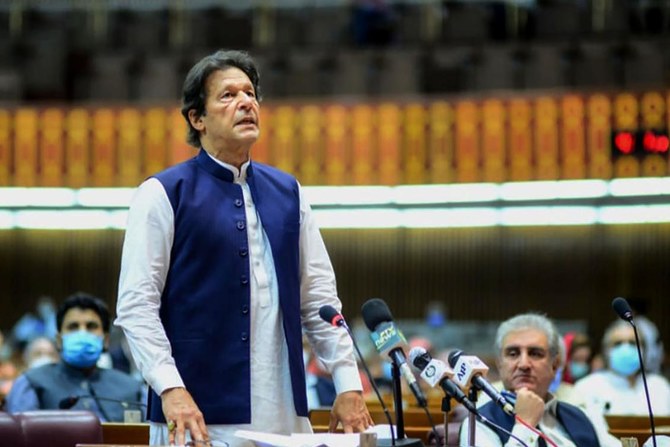

ISLAMABAD: The Supreme Court of Pakistan on Saturday observed that the no-trust motion against Prime Minister Imran Khan was a political matter and the constitutional process should be followed in this regard, local media reported.
The remarks by Chief Justice Umar Ata Bandial came during the hearing of a petition filed by the Supreme Court Bar Association (SCBA), seeking the court's intervention to prevent unrest in Islamabad ahead of the no-trust vote as both the government and the opposition have promised to gather hundreds of thousands of supporters in the federal capital.
The opposition filed the no-confidence motion against the prime minister on March 8, accusing him of mismanaging the economy, foreign policy and poor governance. Voting on the motion is scheduled to be held later this month.
In its petition, the SCBA said a possible confrontation between the government and the opposition could trigger an "anarchic situation" in the country. It sought the court's directions for state functionaries "to act strictly in accordance with the constitution," the Dawn news website reported.
A two-judge bench, comprising Chief Justice Bandial and Justice Munib Akhtar, heard the petition, urging the court to direct state functionaries as well as political stakeholders to allow peaceful execution of proceedings for the no-confidence vote in the National Assembly.
"The apex court said it would not interfere in political matters, but legal matters would have to be looked into," the report read.
"The court directed the process of no-confidence vote should continue under Article 95."
Chief Justice Bandial said the SCBA wanted public order and implementation of Article 95 of the constitution, which relates to the no-confidence vote.
"What would you say on the freedom of expression and the right to protest? What would you say on yesterday's incident?" he inquired Attorney General of Pakistan (AGP) Khalid Jawed Khan, referring to the storming of Sindh House in Islamabad.
Sindh House is an official building in Islamabad dedicated to the government of Pakistan’s southern Sindh province, ruled by the Pakistan Peoples Party (PPP), which is in opposition in the center.
Angry supporters of the ruling PTI on Friday stormed the Sindh House building in Islamabad, sloganeering against dissident party lawmakers who have made public their intentions to vote against PM Khan. PTI supporters were seen carrying ‘lotas’ — round water pots used to refer to turncoats — in video clips shared online.
The chief justice said the incident went against the freedom of speech. To this, the AGP agreed, saying there was no justification for it.
Khan said 13 protesters were arrested for attacking Sindh House and a case was registered against them in the Secretariat police station.
"We are not concerned with what is happening," the chief justice was quoted as saying. "We are here for the constitution's implementation."
Chief Justice Bandial asked whether attacking public property was a bailable offence.
"Public property and national institutions were threatened. Members [of the National Assembly] and institutions should be protected in accordance with the constitution," he was quoted as saying further.
The chief justice directed the Islamabad inspector-general to submit a report on the incident by Monday.
"Sindh House was damaged. All political parties will act in accordance with the law. They should not take any action that is against the law," the top judge observed.
The court issued notices to the ruling Pakistan Tehreek-e-Insaf (PTI), Pakistan Peoples Party (PPP), Pakistan Muslim League-Nawaz (PML-N) and the Jamiat Ulema-e-Islam-Fazl (JUI-F) in this regard.
The hearing was adjourned till 1pm on Monday.


