

Amid political turmoil, Pakistan and IMF resolve to continue talks for 7th review of $6bln loan program

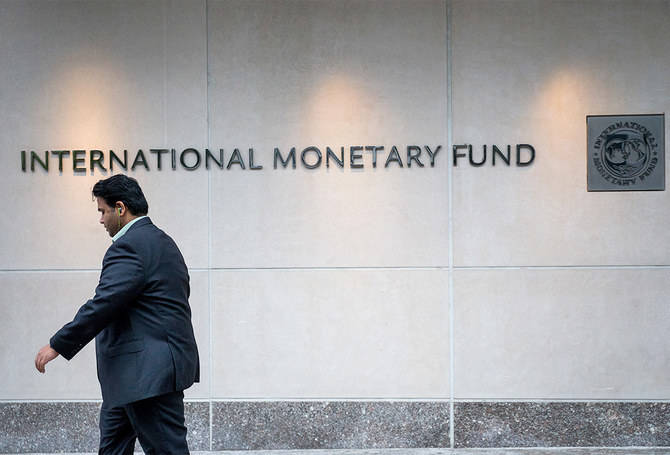
A man walks past the IMF Headquarters in Washington, US, on September 30, 2016. (AFP/File)
Short Url
Updated 18 March 2022
Follow

Amid political turmoil, Pakistan and IMF resolve to continue talks for 7th review of $6bln loan program

  • IMF’s country representative says will continue discussions to promote macroeconomic stability in Pakistan
  • Pakistani officials say have submitted response on PM’s economic relief package, should not be objected to

KARACHI: Despite an uncertain political situation in Pakistan, finance ministry officials and the International Monetary Fund (IMF) have expressed their resolve to continue discussions for the completion of seventh review of the country’s $6 billion loan program. 
The development comes as Pakistan’s opposition alliance seeks to oust Prime Minister Imran Khan and is gearing up to gather hundreds of thousands of people in Islamabad later this month. Opposition parties, including the Pakistan Muslim League-Nawaz (PML-N) and the Pakistan People’s Party (PPP) of former prime ministers Nawaz Sharif and Benazir Bhutto, have submitted a resolution in the National Assembly, demanding a vote of no-confidence against PM Khan. 
Historically, no Pakistani prime minister has ever completed his term in the office. Voting on the motion is expected by the end of this month, with political temperature going up with each passing day and amid talks between the IMF and Pakistani authorities for the completion of seventh review of the Extended Fund Facility (EFF) the South Asian nation secured in 2019 to shore up its economy. 
“The authorities and the IMF will continue to discuss recent developments and other measures to promote macroeconomic stability in Pakistan,” Esther Perez Ruiz, the IMF’s resident representative for Pakistan, told Arab News on Thursday. 
The IMF executive board approved $1 billion disbursement to Pakistan on February 2, after completing a sixth review of the country’s reforms under its $6 billion loan program secured in 2019. 
The global lender revived the program after the government met its several conditions, including parliamentary backing to central bank’s full autonomy, uniform implementation of sales tax and energy tariff hikes. 

Pakistan will receive about $1 billion under the EFF after the completion of the seventh review. The country has successfully completed six reviews and received a little over $3 billion from the IMF since 2019.
Pakistani officials are confident they will sail through the ongoing seventh review of the program, despite political uncertainty and deviation from the program’s objectives by announcing a $1.5 billion economic relief package that included subsidies on energy prices and a moratorium on increase in prices of petroleum products. 
“Apparently, there should be no impact of the political situation on the talks with IMF because the program is already approved there is no option of discontinuing the program. Once approved, the governments have to honor the program,” Muzzamil Aslam, a spokesman for the Pakistani finance ministry, told Arab News on Friday. 
“I don’t feel there would be any political repercussions unless there is a major objection and if they don’t agree with what we have done (announcement of relief package). And so far, no such things are in sight. We have given them our response and they have said that they will get back with their feedback.” 
The finance ministry spokesman said the authorities had achieved all targets set for December 2021. 
“The important things in the review are the targets whether you have accomplished the targets or not. We have accomplished all December 2021 targets,” Aslam said. 
“We have made changes in the policy for which in principle there should be no objection though the IMF can say that it is not sustainable and suggest to drop it.” 
IMF officials have expressed satisfaction over talks with Pakistani authorities, saying the South Asian country has achieved key objectives. 
Ongoing discussions had been “constructive” in terms of ensuring Pakistan met its key objectives of “fiscal prudence, external sector viability, due protection of vulnerable groups from high international energy and food prices,” Reuters quoted IMF spokesman Gerry Rice as saying. 
Pakistani analysts, however, say the completion of the seventh review may take longer than expected, mainly due to the political situation and the government’s deviation from the program through the relief package. 
“The ongoing seventh review of the IMF program may take substantial time to complete,” Dr. Vaqar Ahmed, joint executive director at Sustainable Development Policy Institute (SDPI), told Arab News on Friday. 
“The program may be delayed due to the current political situation and the government’s deviation from the promises made with the fund by cutting electricity tariff and freezing fuel prices, which was contrary to the program’s objectives,” Ahmed said. “The response from the IMF would be very critical which they have not released yet”. 
Ahmed informed that two major long-term investors had postponed their Pakistan visit due to the political turmoil. 
“High-profile investors from China and the United Arab Emirates have deferred their visits,” he said. “They are institutional investors and are waiting for the political dust to settle down because they want political stability.” 
Khurram Schehzad, the CEO of Alpha Beta Core investment advisory firm, said: “In all of this political impasse, we are forgetting the economy, which is turning into a gigantic risk to handle, creating extreme uncertainty for investors and putting life of the poor at risk.” 
The ongoing talks with the IMF and the political instability are also negatively impacting Pakistan’s currency, which is trading at an all-time low of Rs180.57 against the US dollar in the interbank market. 


New PIA owner says airline will take time to make profits post-privatization

Updated 10 sec ago
Follow

New PIA owner says airline will take time to make profits post-privatization

  • Arif Habib says his group may consider buying the government’s remaining 25% stake and offer part of it to a foreign airline
  • New management is also in talks with the US Federal Aviation Administration about resumption of PIA flights to US, he adds

KARACHI: The recently privatized Pakistan International Airlines (PIA) will continue to face financial losses for another few years before start making profits, its new owner said on Monday, promising to do all it takes to revive the Pakistani carrier.

A Pakistani consortium, led by Arif Habib Group, on Dec. 23 secured a 75% stake in PIA for Rs135 billion ($482 million) after several rounds of bidding, valuing the airline at Rs180 billion ($643 million).

The sale marked Pakistan’s most aggressive attempt in decades to reform the debt-ridden airline, which had accumulated more than $2.8 billion in financial losses. The government said it would end decades of state-funded bailouts and help revive the airline.

Arif Habib, CEO of Arif Habib Group, said the airline will take time to start giving “reasonable” returns to its investors, including AKD Group Holdings, Fatima Fertilizer Company, City Schools, Lake City Holdings and Fauji Fertilizer Company, a publicly listed firm owned by Pakistan’s military.

“It may take about one to two years’ time because in initial period of one to two years, we may see some losses but into medium term, I think, that would be turned around,” Habib said in an exclusive interview with Arab News.

“In a longer period of time, if we say about 10 years’ time, this business is expected to give a reasonable return to the investors.”

Once considered among Asia’s leading carriers, PIA struggled with chronic mismanagement, political interference, overstaffing, mounting debt and operational issues that led to a 2020 ban on flights to the European Union, United Kingdom and the United States (US) after a pilot licensing scandal. The EU and the UK lifted the bans, providing fresh momentum to the carrier that still remains barred from flying to the US.

PIA currently has around Rs9 billion ($32 million) liabilities on its balance sheet and the injection of “a reasonable capital” will keep the airline afloat, according to Habib.

“It will take care of initial period losses and will also take care of the development capital expenditure,” he said.

RENOVATION PLANS

Habib plans to renovate PIA planes, improve maintenance and flight schedule, and bring in new aircraft to revive the carrier.

“We will renovate the check-in counters and the cabins. We will replace the seats and put the entertainment equipment into it,” he said.

“We will also ensure the punctuality of flights. That will bring market confidence, and with that there will be a culture change.”

Bound by his agreement with the government that he will not change PIA’s logo and name, Habib did not rule out the new management could change the uniform of the airline staff.

“It’s too early, but I definitely will consider all options whereby we improve the brand,” he said.

The privatization of PIA as well as other loss-making, state-run enterprises is a key requirement of the International Monetary Fund (IMF) under its $7 billion loan program.

Pakistan’s equity investors welcomed the airline’s sell-off, with PIA Holding Company (PIAHC) being one of the most-traded scrips on Monday, according to the Pakistan Stock Exchange (PSX) data.

Habib, whose conglomerate is involved in businesses ranging from stock brokerage services to real-estate projects, plans to invest about $400 million in PIA to sustain its initial losses as well as fund its overhauling that he aims to complete in the next seven years.

He said he would invest two-thirds of the planned investment in the airline upon taking it over in April, while another one-third would be injected in one year afterwards.

“Since we are putting in a large sum, about $400 million, into the company, that $400 million will be available to the company for all these improvements,” he said.

Habib’s consortium has engaged global advisory firm, Seabury Aviation Partners, to help find “viable” markets for the carrier, and targets more than 70 million Pakistani travelers to expand its local and international footprint.

If PIA is able to improve its services and improve its cabin and aircraft, I think there is a huge market waiting for PIA,” he said.

‘STRATEGIC INVESTOR’

The consortium may look to buy the government’s remaining 25% stake and offer part of it to a “strategic investor,’ preferably a foreign airline, to make PIA more competitive.

“The government has given [us] an option of acquiring 25 percent and that option we have to exercise in 90 days,” Habib said. “We are thinking of bringing in some foreign airline as our partner who would be the technical partner for [our] airline.”

The consortium does not intend to lay off any of the airline’s 7,000 employees, unless someone fails to perform, according to Habib.

The existing members of the consortium will hold 75 percent shares of the airline for the next three-year mandatory period and may expand the group afterwards.

“We may consider getting this company listed on the stock exchange and also bring in some partners if additional capital is required,” he added.

Presently, the airline’s parent company, PIAHC, is listed on the PSX, but not the newly privatized PIA.
Habib said the listing would happen once the company starts showing some profits.

“Then there would be a case for going into the market. That would be around a three-year time period,” the businessman said.

“As far as the 25% option is concerned, there we have the ability to attract more investors, more qualified investors, and preferably airlines,” he said, referring to the government’s remaining share in the airline.

FLEET AND ROUTE EXPANSION

PIA’s new management plans to more than triple its fleet to 64 aircraft from 19 at present in up to eight years. In the first phase, the airline would induct 38 four- to seven-year-old, narrow and wide body aircraft which would go up to 64 in the second phase.

“There are routes where there is incremental demand there, but because of the limited aircraft available with PIA, they are not able to serve the whole market,” Habib said, adding the delivery scheduled for new aircraft was very tight and buying old passenger jets would be easier for the group.

“Those are very suitable for the business of PIA as well.”

PIA’s new owners see the region comprising the United Kingdom (UK), the US and Canada as a “lucrative market” for their business.

“There we can increase the frequency of the flight,” he said. “We will also try to run flights to Canada from Karachi, Lahore, and I think it’s already in Islamabad.”

Habib said the PIA management was in talks with the US Federal Aviation Administration about the resumption of its flights to the US.

“We will try to comply with whatever the requirements are,” he said. “Definitely, we would like to be approved worldwide.”