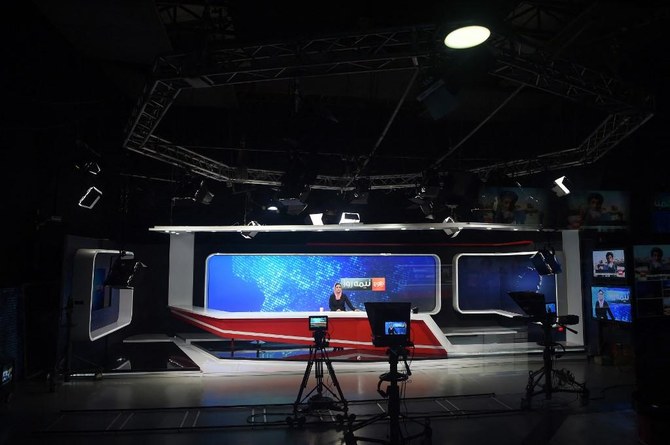
KABUL: Taliban intelligence men came in the night to arrest three staff of TOLO TV, one of Afghanistan’s largest television stations, a channel executive said Friday.
The country’s new rulers apparently didn’t like a story the broadcaster aired on their decision to ban foreign drama series from local television, said Khpalwak Sapai, head of TOLONews, who was among the three arrested.
Sapai, and Nafay Khaleeq, the station’s legal adviser, were released within hours, but the station presenter, Bahram Aman was still in custody Friday, Sapai told The Associated Press.
The intelligence officials from the Taliban’s General Directorate of Intelligence (GDI) came shortly after 8 p.m. Thursday to arrest the three. Sapai said the station was still seeking the release of Aman.
Moby Group, the media company that owns TOLO TV, said the detentions were “for publishing Tolo news about banning of the foreign drama series,” a decision made by the Taliban’s Ministry for the Propagation of Virtue and Prevention of Vice.
The Afghan-owned media company has interests in South and Central Asia as well as the Middle East and Africa.
The arrests were met with international outcry, including broader demands from the UN and the Committee to Protect Journalists (CPJ) for the country’s rulers to stop harassing local journalists and stifling free expression through threats, arrests and intimidation.
“The Taliban must immediately release journalist Bahram Aman, a news presenter at independent broadcaster TOLOnews, and stop detaining and intimidating members of the Afghanistan press corps, ” a statement from the US-based CPJ said.
The United Nations Assistance Mission in Afghanistan (UNAMA) urged the same.
“UNAMA expresses its deep concern about the detentions of journalists and the ever increasing restrictions being placed on media in Afghanistan,” it said on Twitter. “Time for the Taliban to stop gagging & banning. Time for a constructive dialogue with the Afghan media community.”
Neither the Taliban’s information and culture ministry nor its intelligence agency responded to requests from the AP for comment.
The CPJ statement said the Taliban’s intelligence service denied the arrests.
Since sweeping back to power last August, the Taliban have sent erratic signals about what the media landscape will look like under their rule, with international journalists sometimes welcomed and Afghan media often attacked.
The ranks of journalists in Afghanistan thinned dramatically during the chaotic days of the US withdrawal last August when tens of thousands of Afghans fled or were evacuated by foreign governments and organizations. Many who stayed, and even those who have not had run-ins with the new Taliban rulers, say they are afraid of what tomorrow might bring.
The majority of TOLONews reporters and producers are women because Sapai, who was briefly detained, said he made a special effort to recruit and train Afghan women journalists.
In December Reporters Without Borders and the Afghan Independent Journalist Association found that 231 out of 543 media outlets had closed, while more than 6,400 journalists lost their jobs after the Taliban takeover. The outlets closed for lack of funds or because journalists had left the country, according to the report.


Taliban detain journalists over report on TV show censoring
https://arab.news/vwmsu
Taliban detain journalists over report on TV show censoring

- Afghan-owned media company has interests in South and Central Asia as well as the Middle East and Africa


Israeli court overturns conviction of officer who assaulted Palestinian journalist, citing ‘Oct. 7 PTSD’
- Judge sentenced Yitzhak Sofer to 300 hours of community service, saying officer “devoted his life to Israel’s security” and conviction was “disproportionate to severity of his actions”
- Footage shows Sofer throwing photojournalist Mustafa Alkharouf to the ground, and repeatedly beating and kicking him while he covered Palestinian gatherings near Al-Aqsa Mosque
LONDON: An Israeli court overturned the conviction of a border police officer who assaulted a Palestinian journalist, ruling his actions were influenced by post-traumatic stress disorder from serving during the Oct. 7 2023 attacks.
On Tuesday, the Jerusalem Magistrate’s Court sentenced officer Yitzhak Sofer to 300 hours of community service for assaulting Anadolu Agency photojournalist Mustafa Alkharouf in occupied East Jerusalem in December 2023.
Footage shows Sofer and other officers drawing weapons, throwing Alkharouf to the ground, and repeatedly beating and kicking him while he covered Palestinian gatherings near Al-Aqsa Mosque amid heavy restrictions.
Alkharouf was hospitalized with facial and body injuries. His cameraman, Faiz Abu Ramila, was also attacked.
Anadolu photojournalist Mustafa Alkharouf violently attacked by Israeli army in occupied East Jerusalem while covering Palestinian prayers near Al-Aqsa Mosque
— Anadolu English (@anadoluagency) December 15, 2023
Incident highlights ongoing restrictions on Friday prayers and press freedom in region https://t.co/exT6XqjEaA pic.twitter.com/pqugK9HnOt
Sofer had been convicted in September 2024 of assault causing bodily harm (acquitted of threats) and initially faced six months’ community service, as recommended by Mahash, the Justice Ministry’s police misconduct unit.
Judge Amir Shaked accepted the defense request to cancel the conviction, replacing it with community service.
He cited Sofer’s PTSD from responding to the Oct. 7 Hamas-led attack, noting the officer had “no prior criminal record” and had “devoted his life to Israel’s security.”
“The court cannot ignore this when considering whether the defendant’s conviction should stand,” he said, adding that while the incident is “serious and does cross the criminal threshold,” the conviction in place could cause Sofer harm “disproportionate to the severity of his actions.”
The ruling comes amid surging attacks on journalists in the West Bank, East Jerusalem and Gaza since Israel’s war on Gaza began.
The Committee to Protect Journalists reported Israel responsible for two-thirds of the 129 media workers killed worldwide in 2025, the deadliest year on record, citing a “persistent culture of impunity” and lack of transparent probes.
Reporters Without Borders called the Israeli army the “worst enemy of journalists” in its 2025 report, with nearly half of global reporter deaths in Gaza.
Foreign journalists face raids, arrests and intimidation. In late January 2026, Israel’s Supreme Court granted a delay on ruling a ban on foreign media access to Gaza.


