Saudi Arabia, Bangladesh hold first political consultation talks

1 / 2
Saudi delegates led by Foreign Minister Prince Faisal bin Farhan meet Bangladeshi officials for political consultation talks in Dhaka on March 16, 2022. (Saudi Ministry of Foreign Affairs)
2 / 2
Saudi Foreign Minister Prince Faisal bin Farhan shakes hands with his Bangladeshi counterpart, A.K. Abdul Momen, during talks in Dhaka on March 16, 2022. (Saudi Ministry of Foreign Affairs)
Short Url
Updated 16 March 2022
Follow

Saudi Arabia, Bangladesh hold first political consultation talks

  • Dhaka vows support for potential Saudi investors in Bangladesh
  • Bangladesh requests to join Saudi Arabia’s green initiatives

DHAKA: Saudi Arabia and Bangladesh on Wednesday held their first ever political consultation talks during Saudi Foreign Minister Prince Faisal bin Farhan’s visit to Dhaka.

The prince flew into the Bangladeshi capital on Tuesday afternoon and was received by his counterpart A.K. Abdul Momen.

On Wednesday, he met the country’s Prime Minister Sheikh Hasina and led the Saudi delegation in talks with Bangladeshi officials at Dhaka’s Pan Pacific Sonargaon hotel.

“This is a very historic event because this is the first time Bangladesh and Saudi Arabia have had a high-level political consultation,” Momen said in a joint press conference with Prince Faisal after the meeting.

“We discussed solid cooperation,” he added. “In different international forums we will support each other.” 
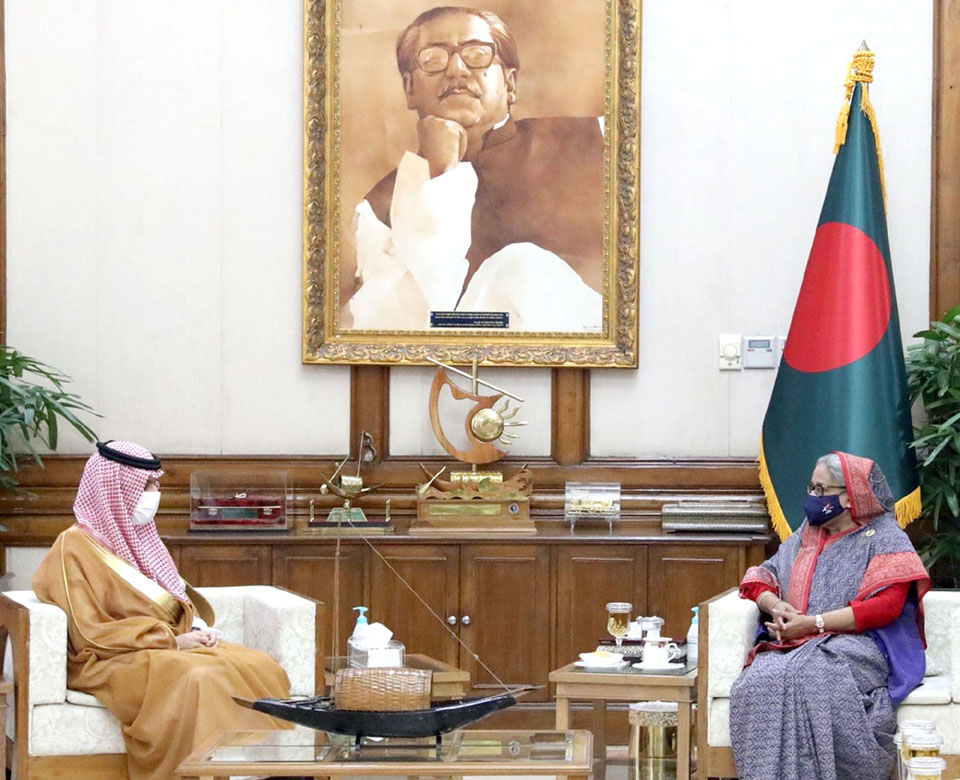


Saudi Foreign Minister Prince Faisal bin Farhan meets Bangladeshi Prime Minister Sheikh Hasina in Dhaka on March 16, 2022. (Saudi Ministry of Foreign Affairs)

Prince Faisal said they had an “excellent round of political consultation.”

He added: “We discussed many areas, and I think the most important thing to say is that we are fully aligned in our vision for the future. We believe very much in working together to contribute to the security and stability of our respective regions.”

The prince pointed out that with 2.5 million Bangladeshi expats living and working in the Kingdom, and contributing to its development, the two countries had already been working closely together.

“There are Saudi companies already present here in Bangladesh with several billion dollars’ worth of direct investment. And we are committed to building on this strong foundation to a much, much broader partnership and much broader relationship,” he said.

Momen pledged Dhaka’s support for Saudi entities interested in investing in the country, which was preparing more than 100 special economic zones for potential investors.

“We will provide all support to the Saudi investors if they want to invest in our economic zones. Already 20 Saudi companies have shown interest in this regard,” he said.

According to the Bangladesh Investment Development Authority, most of the planned Saudi investment projects were in the public sector and related to oil refineries, gas transmission, fertilizer production, aviation, port management, construction, and hospitality.

Bangladesh has also requested to join Saudi Arabia’s green initiatives announced last year to reduce carbon emissions and combat pollution and land degradation by planting billions of trees.

“Saudi Arabia has taken a great initiative for making green the whole of the Middle East,” Momen added. “We requested for partnership.”

Under the green initiative, Saudi Arabia aims to plant 10 billion trees in the Kingdom and 40 billion in neighboring countries, in what would be the largest reforestation program in the world.


Indonesia reaffirms Yemen’s territorial integrity, backs stability efforts amid tensions

Updated 01 January 2026
Follow

Indonesia reaffirms Yemen’s territorial integrity, backs stability efforts amid tensions

  • Statement comes after Saudi Arabia bombed a UAE weapons shipment at Yemeni port city
  • Jakarta last week said it ‘appreciates’ Riyadh ‘working together’ with Yemen to restore stability

JAKARTA: Indonesia has called for respect for Yemen’s territorial integrity and commended efforts to maintain stability in the region, a day after Saudi Arabia bombed a weapons shipment from the UAE at a Yemeni port city that Riyadh said was intended for separatist forces. 

Saudi Arabia carried out a “limited airstrike” at Yemen’s port city of Al-Mukalla in the southern province of Hadramout on Tuesday, following the arrival of an Emirati shipment that came amid heightened tensions linked to advances by the UAE-backed Southern Transitional Council in the war-torn country. 

In a statement issued late on Wednesday, the Indonesian Ministry of Foreign Affairs said it “appreciates further efforts by concerned parties to maintain stability and security,” particularly in the provinces of Hadramout and Al-Mahara. 

“Indonesia reaffirms the importance of peaceful settlement through an inclusive and comprehensive political dialogue under the coordination of the United Nations and respecting Yemen’s legitimate government and territorial integrity,” Indonesia’s foreign affairs ministry said. 

The latest statement comes after Jakarta said last week that it “appreciates the efforts of the Kingdom of Saudi Arabia, as well as other relevant countries, working together with Yemeni stakeholders to de-escalate tensions and restore stability.” 

Saudi Arabia leads the Coalition to Restore Legitimacy in Yemen, which includes the UAE and was established in 2015 to combat the Houthi rebels, who control most of northern Yemen. 

Riyadh has been calling on the STC, which initially supported Yemen’s internationally recognized government against the Houthi rebels, to withdraw after it launched an offensive against the Saudi-backed government troops last month, seeking an independent state in the south.  

Indonesia has also urged for “all parties to exercise restraint and avoid unilateral action that could impact security conditions,” and has previously said that the rising tensions in Yemen could “further deteriorate the security situation and exacerbate the suffering” of the Yemeni people. 

Indonesia, the world’s biggest Muslim-majority country, maintains close ties with both Saudi Arabia and the UAE, which are its main trade and investment partners in the Middle East.