Top racers take to Jakarta streets ahead of Indonesia’s first MotoGP in 25 years

1 / 2
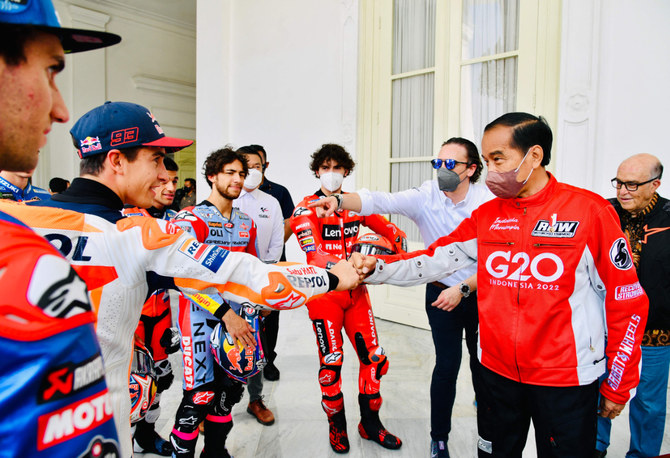
Indonesia’s President Joko Widodo (R) fist-bumps with Repsol Honda Team’s Spanish rider Marc Marquez (2nd-L) at the start of the MotoGP event in Jakarta on March 16, 2022. (Handout photo via AFP)
2 / 2
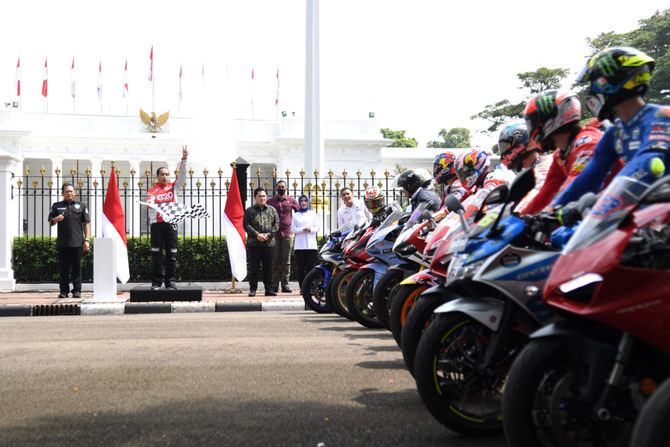
Indonesia’s President Joko Widodo waves the starting flag during a parade to mark the start of MotoGP event outside the presidential palace in Jakarta on March 16, 2022. (Handout photo via AFP)
Short Url
Updated 16 March 2022
Follow

Top racers take to Jakarta streets ahead of Indonesia’s first MotoGP in 25 years

  • Contest takes place at Mandalika International Street Circuit on Sunday
  • Nation has one of the most bike-race fans, including President Joko Widodo

JAKARTA: World-class racers rode through the streets of Jakarta on Wednesday as Indonesia gears up to host over the weekend its first motorcycle grand prix in 25 years.

The archipelago nation of more than 270 million has one of the world’s biggest communities of bike-race fans.

Sunday’s race — the second stop on the 2022 MotoGP World Championship calendar after the opening race in Qatar — will take place at the Mandalika International Street Circuit on the island of Lombok.

The parade in Jakarta saw a host of grand prix winners, including Spain’s six-time world champion Marc Marquez, cruising through the capital’s streets and greeting their Indonesian fans.

They were welcomed by President Joko Widodo, himself a biker.

“I have said before that Indonesia has 122 million motorbikes, so there are a lot of fans here in Indonesia. All of them are happy,” Widodo told reporters.

“We hope this will be our country’s new brand, that Indonesia has a MotoGP circuit comparable to that of other countries.”

The racers sparked quite a buzz both on the streets of the Indonesian capital and online, with some expressing their delight over the parade and upcoming races.

“We are excited to race in front of our Indonesian fans,” Marquez said, while his compatriot and also a motorcycle racer, Alex Rins, took to Twitter to say being in Indonesia for the race was “one of the best experiences” of his life.

“The way this country enjoy bikes is just incredible,” he tweeted.

With some 60,000 race day tickets sold out, Indonesian officials are expecting a full house at the Mandalika circuit this weekend.

The last time Indonesia hosted a MotoGP round was in 1997, at a track near Jakarta. It has since struggled to be included in the race calendar for lacking a world-class circuit.

The new 4.3-kilometer track in Mandalika — completed in 2021 — is part of a mega-tourism infrastructure project to help Lombok island compete with neighboring Bali, one of Indonesia’s top holiday destinations.

Authorities hope the project will create thousands of jobs and attract 2 million foreign visitors annually, as Lombok is still struggling to rebuild after devastating earthquakes shook the island in 2018, killing hundreds of people and causing extensive damage.

But the massive government-backed program is not without controversies. UN experts last year denounced it over evictions during land procurement for the track.

Riders during MotoGP testing last month had also raised concerns over the track surface, saying debris and stones from the peeling asphalt had flown into them as they hit full speed.

MotoGP racers will take to the track for practice and qualifying sessions on Friday and Saturday.

The race will start on Sunday 3 p.m. local time (7 a.m. GMT).


2025 among world’s three hottest years on record, WMO says

Updated 14 January 2026
Follow

2025 among world’s three hottest years on record, WMO says

  • All eight datasets confirmed that the last three years were the planet’s three hottest since records began, the WMO said
  • The slight differences in the datasets’ rankings reflect their different methodologies and types of measurements

BRUSSELS: Last year was among the planet’s three warmest on record, the World Meteorological Organization said on Wednesday, as EU scientists also confirmed average temperatures have now exceeded 1.5 degrees Celsius of global warming for the longest since records began.
The WMO, which consolidates eight climate datasets from around the world, said six of them — including the European Union’s European Center for Medium-Range Weather Forecasts (ECMWF) and the British national weather service — had ranked 2025 as the third warmest, while two placed it as the second warmest in the 176-year record.
All eight datasets confirmed that the last three years were the planet’s three hottest since records began, the WMO said. The warmest year on record was 2024.

THREE-YEAR PERIOD ABOVE 1.5 C AVERAGE ⁠WARMING LEVEL
The slight differences in the datasets’ rankings reflect their different methodologies and types of measurements — which include satellite data and readings from weather stations.
ECMWF said 2025 also rounded out the first three-year period in which the average global temperature was 1.5 C above the pre-industrial era — the limit beyond which scientists expect global warming will unleash severe impacts, some of them irreversible.
“1.5 C is not a cliff edge. However, we know that every fraction of a degree matters, particularly for worsening extreme weather events,” said Samantha Burgess, strategic ⁠lead for climate at ECMWF.
Burgess said she expected 2026 to be among the planet’s five warmest years.

CHOICE OF HOW TO MANAGE TEMPERATURE OVERSHOOT
Governments pledged under the 2015 Paris Agreement to try to avoid exceeding 1.5 C of global warming, measured as a decades-long average temperature compared with pre-industrial temperatures.
But their failure to reduce greenhouse gas emissions means that target could now be breached before 2030 — a decade earlier than had been predicted when the Paris accord was signed in 2015, ECMWF said. “We are bound to pass it,” said Carlo Buontempo, director of the EU’s Copernicus Climate Change Service. “The choice we now have is how to best manage the inevitable overshoot and its consequences on societies and natural systems.”
Currently, the world’s long-term warming level is about 1.4 C above the pre-industrial era, ECMWF said. Measured on a short-term ⁠basis, average annual temperatures breached 1.5 C for the first time in 2024.

EXTREME WEATHER
Exceeding the long-term 1.5 C limit would lead to more extreme and widespread impacts, including hotter and longer heatwaves, and more powerful storms and floods. Already in 2025, wildfires in Europe produced the highest total emissions on record, while scientific studies confirmed specific weather events were made worse by climate change, including Hurricane Melissa in the Caribbean and monsoon rains in Pakistan which killed more than 1,000 people in floods.
Despite these worsening impacts, climate science is facing political pushback. US President Donald Trump, who has called climate change “the greatest con job,” last week withdrew from dozens of UN entities including the scientific Intergovernmental Panel on Climate Change.
The long-established consensus among the world’s scientists is that climate change is real, mostly caused by humans, and getting worse. Its main cause is greenhouse gas emissions from burning fossil fuels like coal, oil and gas, which trap heat in the atmosphere.