Pakistan expresses ‘serious concern’ as Indian court upholds state hijab ban in schools

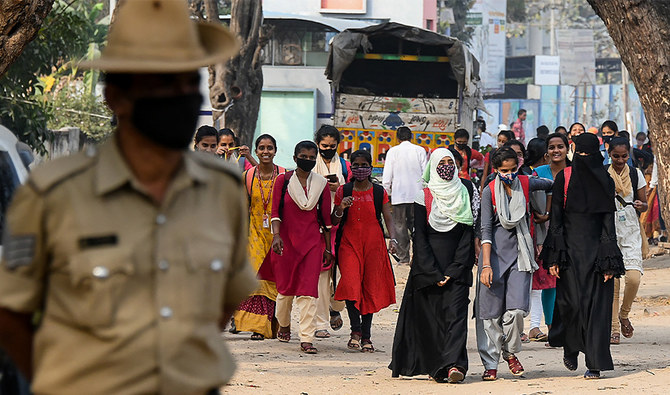
Students of a government college arrive in the premises of the educational institute in Mandya district in India's Karnataka state on February 16, 2022. (AFP)
Short Url
Updated 16 March 2022
Follow

Pakistan expresses ‘serious concern’ as Indian court upholds state hijab ban in schools

  • Ban imposed last month had sparked protests in southern state of Karnataka
  • Pakistan fears the ruling could set a precedent for the rest of the country

ISLAMABAD: Pakistan this week expressed “serious concern” as an Indian court upheld a ban on wearing the Muslim headscarf at schools in the southern state of Karnataka on the grounds the hijab was not an "essential religious practice" in Islam.
The ban, imposed last month, sparked protests by some Muslim, and counter-protests by Hindu, students. Critics say the ban is another reflection of efforts by Prime Minister Narendra Modi and his BJP party to marginalize Muslims who account for roughly 13% of India's 1.35 billion people. The country is majority Hindu.
“The decision manifestly has failed to uphold the principle of freedom to religious practices and impinges on the human rights,” the foreign office said in a statement.
“Equally sad is the fact that the judiciary in India which is expected to act as a bulwark against dehumanization, stigmatization and discrimination against minorities has completely failed to uphold the principles of justice and equality. This decision marks a fresh low in the relentless anti-Muslim campaign where even the pretext of secularism is being weaponized to target Muslims.”
Pakistan said it feared the ruling could set a precedent for the rest of India and its large Muslim minority.
On Tuesday, Chief Justice Ritu Raj Awasthi of the High Court of Karnataka said in the judgement the government had the power to prescribe uniform guidelines, dismissing various petitions challenging the ban ordered by Karnataka.
"We are of the considered opinion that the prescription of school uniform is only a reasonable restriction constitutionally permissible which the students cannot object to," Awasthi said.


Pakistan vaccinates over 42 million children during first anti-polio drive this year

Updated 7 sec ago
Follow

Pakistan vaccinates over 42 million children during first anti-polio drive this year

  • Last year, Pakistan reported 31 polio cases, a significant drop from 74 cases in 2024
  • Authorities appeal to parents to ensure all children below five years are vaccinated

ISLAMABAD: Pakistani health authorities have vaccinated more than 42 million children in an ongoing anti-polio drive this week, the National Emergency Operations Center (NEOC) said on Friday.

Polio is a highly infectious and incurable disease that can cause lifelong paralysis. The only effective protection is through repeated vaccination for every child under five.

Pakistan and Afghanistan are the only two countries in the world where polio remains endemic. Last year, Pakistan reported 31 polio cases, a significant drop from 74 cases in 2024.

Authorities on Feb. 2 began the first anti-polio drive of this year which will continue till Feb. 8 and aims to reach 45.4 million children, aged below five, across the South Asian country.

“The first national polio campaign of 2026 continues for the fifth day across the country,” the NEOC said on Friday. “Vaccination of more than 42.2 million children across the country has been completed in four days.”

Of these 42.2 million, more than 22.4 million children have been vaccinated in Punjab, 9.585 million in Sindh, 6.764 million in Khyber Pakhtunkhwa (KP) and over 2 million children have been inoculated in Balochistan.

It said more than 454,000 children were vaccinated in the federal capital of Islamabad, 261,000 in Gilgit-Baltistan and over 673,000 in Azad Kashmir.

“More than 400,000 polio workers are going door to door to administer polio drops to children,” the NEOC statement read. “Parents and communities are appealed to cooperate fully with polio workers.”

Another campaign is being simultaneously run in Afghanistan, according to the NEOC.

Pakistan reported six cases in 2023 and only one in 2021, but the country saw a sharp resurgence in 2024.

Pakistan’s polio program began in 1994, but efforts to eradicate the virus have been repeatedly undermined by vaccine misinformation and resistance from some religious hard-liners who claim that immunization is a foreign plot to sterilize Muslim children or a cover for Western espionage.

Militant groups have also frequently targeted polio vaccination teams and the security personnel assigned to protect them, often resulting in deadly at