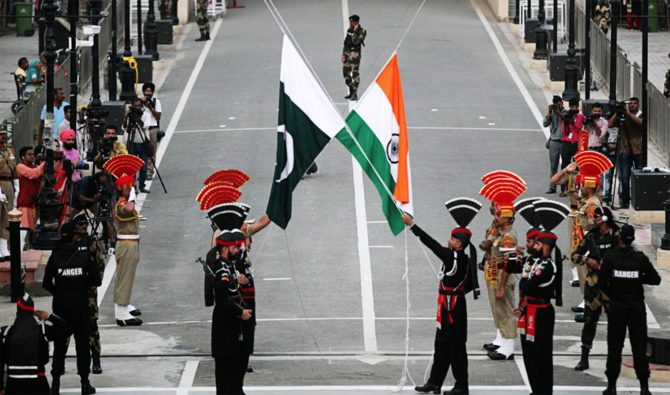
ISLAMABAD: Rizwan Saeed, Pakistan’s permanent representative to the Organization of Islamic Cooperation (OIC), has said Islamabad would raise the issue of an accidental missile launch by India into Pakistan at next week’s meeting of the OIC council of foreign ministers.
On Tuesday, India said it was reviewing its standing operating procedures for operations, maintenance and inspection of weapons systems following the accidental firing of an unarmed surface-to-surface missile that ended up in Pakistan’s eastern Punjab province last Wednesday. There was no loss of life.
Pakistani Foreign Minister Shah Mahmood Qureshi has said Islamabad rejects the Indian statement as "incomplete" and that he had written to the UN Security Council on the matter and also asked the international community to take the matter up. Last week, the Pakistan foreign office demanded a joint probe into the incident.
Pakistan is now also poised to take up the matter at the 48th session of the OIC council of the foreign minister’s, to be held in Islamabad on March 22-23.
Over the years, the OIC has passed several resolutions on the peace process between nuclear-armed neigbouring rivals Pakistan and India.
“As one of the standing resolutions that has been successively passed by the council of the foreign ministers previously, India-Pakistan peace process is a nomenclature of that,’ Saeed told Arab News in an interview on Tuesday. “Definitely, since it (missile misfiring) is an important development, there will be an opportunity to bring it to the notice of the member states.”
Pakistan is expecting 56 OIC member states to participate in next week’s conference.
“We have received ministerial-level (foreign ministers) participation from 48 countries thus far and there is still time in the conference, so we hope that there will be add-ons,” Saeed said.
Last year, around 70 delegations from OIC member states, non-members and regional and international organizations attended the 17th Extraordinary Session of the OIC's Council of Foreign Ministers hosted by Islamabad to discuss the humanitarian crisis in Afghanistan. At the summit's conclusion, OIC member states agreed to establish a Humanitarian Trust Fund to channel assistance, appoint a special envoy and work together with the UN in the war-ravaged country.
The session, however, did not accord recognition to the Taliban regime in Afghanistan.
Saeed said the process of recognizing the Taliban government would begin when it submitted a formal application.
“Recognition of any government or any authority in a member state has a process at the OIC and the forum to accord that approval is the council of the foreign ministers,” the diplomat said. “Once there is a formal request from the Afghan authority … the council and its procedures will come into play. And the entire membership will have a say.”
He said approval would be accorded after following the proper procedure and “if there is consensus.”
Speaking about the role of Saudi Arabia in the OIC, Saeed said the kingdom’s position in the body “only stands to grow in future.”
“It has done a lot economically as well as in terms of guiding and steering and also promoting the political and economic agenda of the organization,” he said. “I am confident that it only stands to grow further.”


Pakistan to take up Indian missile issue at OIC foreign ministers' conference next week
https://arab.news/z5aqr
Pakistan to take up Indian missile issue at OIC foreign ministers' conference next week

- Arab News interviews Rizwan Saeed, Pakistan’s permanent representative to OIC
- Pakistan expecting 56 OIC member states to participate in conference from March 22-23
Pakistan reports current account surplus in Jan. owing to improved trade, remittances
- Pakistan’s exports crossed the $3 billion mark in Jan. as the country received $3.5 billion in remittances
- Last month, IMF urged Pakistan to accelerate pace of structural reforms to strengthen economic growth
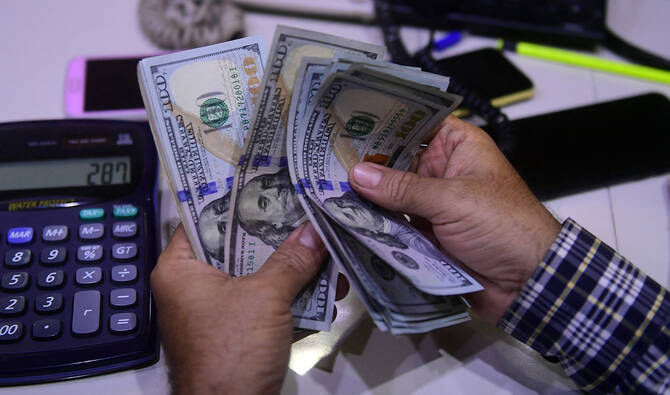
ISLAMABAD: Pakistan recorded a current account surplus of more than $120 million in January, the country’s finance adviser said on Tuesday, attributing it to improved trade balance and remittance inflows.
Pakistan’s exports rebounded in January 2026 after five months of weak performance, rising 3.73 percent year on year and surging 34.96 percent month on month, according to data released by the country’s statistics bureau.
Exports crossed the $3 billion mark for the first time in January to reach $3.061 billion, compared to $2.27 billion in Dec. 2025. The country received $3.5 billion in foreign remittances in Jan. 2026.
Khurram Schehzad, an adviser to the finance minister, said Pakistan reported a current account surplus of $121 million in Jan., compared to a current account deficit of $393 million in the same month last year.
“Improved trade balance in January 2026, strong remittance inflows, and sustained momentum in services exports (IT/Tech) continue to reinforce the country’s external account position,” he said on X.
Pakistan has undergone a difficult period of stabilization, marked by inflation, currency depreciation and financing gaps, and international rating agencies have acknowledged improvements after Islamabad began implementing reforms such as privatizing loss-making, state-owned enterprises (SOEs) and ending subsidies as part of a $7 billion International Monetary Fund (IMF) loan program.
Late last month, the IMF urged Pakistan to accelerate the pace of these structural reforms to strengthen economic growth.
Responding to questions from Arab News at a virtual media roundtable on emerging markets’ resilience, IMF’s director of the Middle East and Central Asia Jihad Azour said Islamabad’s implementation of the IMF requirements had been “strong” despite devastating floods that killed more than 1,000 people and devastated farmland, forcing the government to revise its 4.2 percent growth target to 3.9 percent.
“What is important going forward in order to strengthen growth and to maintain the level of macroeconomic stability is to accelerate the structural reforms,” he said at the meeting.
Azour underlined Pakistan’s plans to privatize some of the SOEs and improve financial management of important public entities, particularly power companies, as an important way for the country to boost its capacity to cater to the economy for additional exports.
“This comes in addition to the effort that the authorities have made in order to reform their tariffs, which will allow the private sector of Pakistan to become more competitive,” the IMF official said.


