Four paramilitary soldiers killed in bomb attack in southwest Pakistan

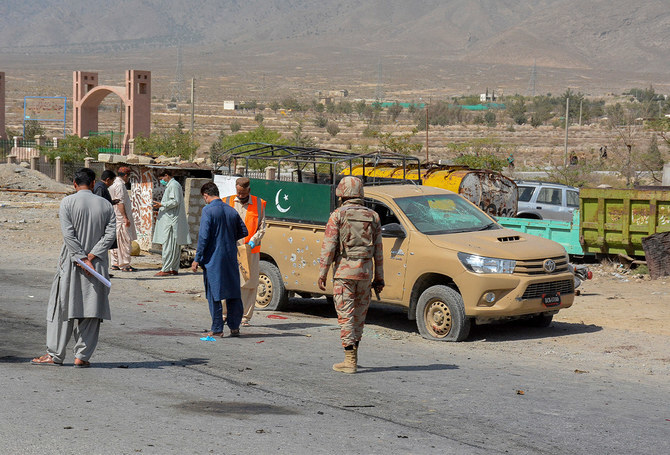
Security personnel examine the site of a blast near a checkpoint in the southwestern city of Quetta, Pakistan, on September 5, 2021. (AFP/File)
Short Url
Updated 15 March 2022
Follow

Four paramilitary soldiers killed in bomb attack in southwest Pakistan

  • Attack targeted a Frontier Corps convoy soon after leaving a check-post in Balochistan’s Sibi 
  • Seven other soldiers injured in the attack airlifted to Quetta, clearance operation underway

ISLAMABAD: Four paramilitary troops were killed and seven others sustained injuries in a bomb attack in the southwestern Pakistani province of Balochistan on Tuesday, officials said. 
The explosion targeted paramilitary Frontier Corps vehicles in Sangan area, some 65 kilometers from Sibi city. 
The outlawed Baloch Liberation Army claimed responsibility for the attack.
“Four Frontier Corps soldiers have been killed and seven injured in an IED (improvised explosive device) blast in Sangan area,” Mohammad Afzal, a levies official in Sibi, told Arab News. 
“The paramilitary troops were targeted at the Pakistan Check-post, when they were leaving the post for patrolling at 7:30am.” 
The injured persons were airlifted to Quetta, while a clearance operation was underway in the surrounding areas, the official said. 
Sibi Assistant Commissioner Sana Mahjabeen also confirmed to Dawn news website that the blast was caused by an IED. She, however, said it injured 10 personnel, of whom six were in critical condition. 
In a statement, adviser to the Balochistan chief minister on home affairs Mir Ziaullah Langove condemned the incident and directed for best medical treatment of the injured personnel. 
Balochistan has been the scene of a long-running insurgency by various Baloch separatist groups that for decades have waged attacks on security forces and police to press their demands for independence. 
Although authorities say they have quelled the insurgency, violence has continued in the province. Local militants and Daesh also have a presence there. 
Tuesday’s attack comes a week after the Daesh militant group claimed responsibility for a bombing in the same district that killed at least five soldiers, according to a monitoring group. 
Local media said the bombing occurred near an open area where an annual cultural show was being held, which was attended by Pakistan’s President Arif Alvi. 
The targeted convoy was part of the security deployment surrounding the visit of Alvi, who had left hours earlier. 


Pakistan condemns Netanyahu’s ‘hexagon of alliances’ plan, says alert to growing India-Israel defense ties

Updated 26 February 2026
Follow

Pakistan condemns Netanyahu’s ‘hexagon of alliances’ plan, says alert to growing India-Israel defense ties

  • Israel’s Netanyahu last week proposed an alliance of countries in and around Middle East against its adversaries
  • Pakistan maintains “robust military preparedness” to deter any potential aggression, says foreign office spokesperson

ISLAMABAD: Pakistan’s foreign office spokesperson on Thursday condemned Israeli Prime Minister Benjamin Netanyahu’s recent statement about forming a “hexagon of alliances” within or around the Middle East, saying Islamabad was alert to growing defense ties between New Delhi and Tel Aviv. 

Netanyahu on Sunday outlined plans to form a new regional bloc, describing it as a “hexagon of alliances” that he said could include Israel, India, Greece and Cyprus, along with other unnamed Arab, African and Asian states. He said the grouping would collectively stand against what he described as “radical” adversaries.

His comments came days before Indian Prime Minister Narendra Modi arrived in Israel on Wednesday for a two-day trip to bolster ties. The two are expected to discuss cooperation in science and technology, innovation, agriculture, water management, technology, defense and security during the trip. 

The statement drew a sharp response from Pakistan’s Senate, which unanimously passed a resolution on Tuesday rejecting Netanyahu’s remarks.

“I would also like to draw your attention to the recent resolution adopted by the Senate of Pakistan that strongly condemned such remarks and attempts to undermine Muslim unity,” Foreign Office spokesperson Tahir Andrabi told reporters during a weekly press briefing.

“We continue to condemn these provocative steps and statements by the leadership of the occupying power that threaten regional peace and stability,” he added.

Netanyahu had also said Israel’s goal was to create an axis of nations that see eye to eye against what he described as the “radical Shia” and “radical Sunni” axis of nations. 

Andrabi said attempts to divide the Muslim world along sectarian lines were a “nefarious design” on Netanyahu’s part.

India is Israel’s largest arms buyer and second-largest trading partner in Asia, after China. In response to a question on India’s growing defense ties with Israel, Andrabi said Pakistan remained cognizant of the risks posed by such cooperation.

“Yes, we remain seized of the defense ties between Israel and India,” the spokesperson said, noting that certain “systems and platforms” may have been used by India against Pakistan in the past.

“We are alive to the threats they pose to our security, sovereignty and territorial integrity, as well as to regional peace and stability.”

Andrabi said Pakistan maintained “robust military preparedness” to deter any potential aggression from hostile forces.

‘UTMOST CAUTION EXERCISED’

Andrabi spoke about Pakistan’s recent strikes against alleged militant camps in Afghanistan, saying Islamabad had conducted them in self-defense and with extreme caution to avoid casualties. 

Pakistan said it carried out airstrikes in Afghanistan against militant camps and hideouts in three provinces on Saturday night, killing over 100 militants. Afghanistan accused Pakistan of violating its territorial sovereignty and killing dozens of civilians. Kabul has vowed to retaliate. 

Andrabi said the strikes were carried out to ensure protection for the lives of the people of Pakistan and to prevent “imminent terrorist attacks.”

“These actions were directed solely against identified terrorist camps and hideouts, and utmost caution was exercised to prevent harm to civilians,” he said. 

He warned Pakistan would take necessary measures under its right to self-defense against “terrorist threats” emanating from Afghan territory.

On the safety of Pakistani nationals in Afghanistan following the strikes, Andrabi said Islamabad had raised the issue with Afghan authorities, adding that Islamabad expected “foolproof security” for Pakistani diplomats and civilians.