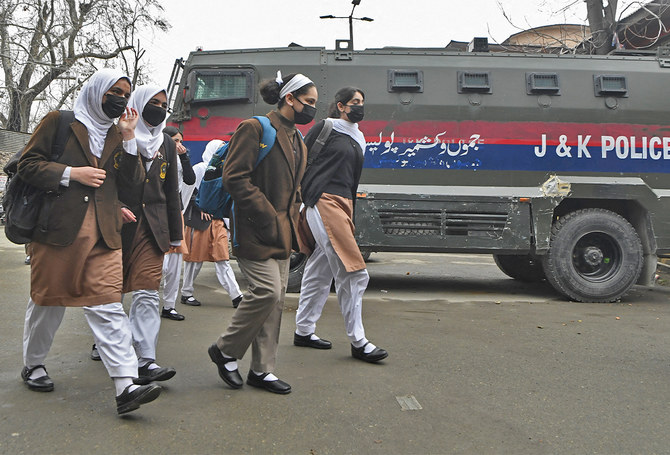
ISLAMABAD: Pakistan has condemned what it calls the “illegal” sealing off of an educational institute by Indian security forces in Indian-administered Kashmir, the foreign office said.
The reported sealing of the school follows a ban last month in Karnataka on wearing religious attire which sparked protests by Muslim students and parents, and counter-protests by Hindu students, forcing authorities to close schools there.
“Pakistan strongly condemns the reported shutting down of Darul Uloom Khadija tul Kubra,” the foreign office said, saying India forces gate-crashed the educational institute on Friday, insulted and maltreated tfemale students and forcefully evicted them before sealing the building.
Pakistan said the incident was a fresh reflection of Indian forces “trampling on and making a mockery of the fundamental rights of Kashmiri girls seeking education.”
“It also points toward growing Islamophobia,” the statement said.
Pakistan said denying Muslim girls access to education was a “new low” for the far-right government of Prime Minister Narendra Modi and his BJP party.
“Pakistan also calls upon the international community, including the United Nations and OIC, especially their human rights machinery, to take immediate notice of the worrying level of Islamophobia in India and prevail upon Indian authorities to prevent systematic human rights violations against minorities particularly Muslims in the country,” the foreign office said.
Modi denies his government targets Muslims or their practices.

Pakistan condemns ‘illegal’ sealing of girls’ school in Indian-administered Kashmir
https://arab.news/bwmfn
Pakistan condemns ‘illegal’ sealing of girls’ school in Indian-administered Kashmir
- Reported sealing follows ban last month in Karnataka on wearing religious attire which sparked protests by Muslims
- Pakistan says denying Muslim girls access to education a “new low” for far-right government of PM Modi and BJP party
Pakistan to begin first phase of Hajj 2026 trainings from today
- Training programs to be held in phases across Pakistan till February, says religion ministry
- Saudi Arabia allocated Pakistan a total quota of 179,210 pilgrims for Hajj 2026
ISLAMABAD: Pakistan’s religious affairs ministry has said that it will begin the first phase of mandatory Hajj 2026 training for pilgrims intending to perform the pilgrimage from today, Thursday.
The one-day Hajj training programs will be held in phases across the country at the tehsil level until February. The ministry directed intending pilgrims to bring their original identity cards and the computerized receipt of their Hajj application to attend the training sessions.
“Pilgrims should attend the one-day training program according to their scheduled date,” Pakistan’s Ministry of Religious Affairs (MoRA) said in a statement.
The ministry said training schedules are being shared through the government’s Pak Hajj 2026 mobile application as well as via SMS. It added that details of the schedule are also available on its website.
According to the ministry, training programs will be held in Abbottabad on Jan. 2; Ghotki, Thatta and Kotli on Jan. 3; and Tando Muhammad Khan and Khairpur on Jan. 4.
Hajj training sessions will be held in Rawalakot, Badin and Naushahro Feroze on Jan. 5, while pilgrims in Fateh Jang, Dadu and Tharparkar will receive the training on Jan. 6.
The ministry said training programs will be conducted in Umerkot and Larkana on Jan. 7, followed by sessions in Mirpurkhas, Shahdadkot and Mansehra on Jan. 8.
Pakistan’s religious affairs ministry has previously said these trainings will be conducted by experienced trainers and scholars using multimedia.
It said the training has been made mandatory to ensure that intending pilgrims are fully aware of Hajj rituals and administrative procedures.
Saudi Arabia has allocated Pakistan a quota of 179,210 pilgrims for Hajj 2026, of which around 118,000 seats have been reserved under the government scheme, while the remainder will be allocated to private tour operators.
Under Pakistan’s Hajj scheme, the estimated cost of the government package ranges from Rs1,150,000 to Rs1,250,000 ($4,049.93 to $4,236), subject to final agreements with service providers.


