



ISLAMABAD: China on Monday called on Pakistan and India to launch a “thorough investigation” days after New Delhi admitted it had accidentally fired a missile into Pakistan, blaming a “technical malfunction” during routine maintenance.
Pakistan’s military last Thursday said an unarmed surface-to-surface missile launched from neighboring India violated Pakistan’s airspace and ended up in eastern Punjab province on Wednesday, damaging a wall in a residential area but causing no casualties.
Maj. Gen. Babar Iftikhar, the head of the army’s media wing, protested over the “flagrant violation” and demanded an explanation from India. The foreign office summoned the charge d’affaires of India in Islamabad the same day to convey Pakistan’s ‘strong protest.’
On Friday, India responded that in the course of a routine maintenance, a technical malfunction led to the accidental firing of the missile, saying it was relieved there was no loss of life due to the accident.
“Pakistan and India both of them are important countries in south Asia and they share responsibility to uphold the regional security and stability,” Chinese Foreign Ministry Spokesperson Zhao Lijian said during a briefing.
“We call on relevant countries to have dialogue and communication as soon as possible and launch a thorough investigation into this incident, strengthen information sharing and establish a notification mechanism in time to prevent the recurrence of such incidents and miscalculation,” he added.
After India admitted the accidental firing, the Pakistani foreign office said on Saturday such a “serious matter” could not be addressed with the “simplistic explanation” provided by Indian authorities.
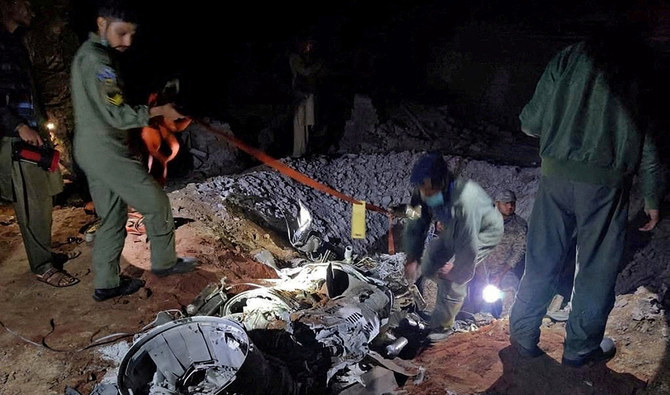
People work around remains of a missile fired into Pakistan from India, near Mian Chunnu, Pakistan, on March 9, 2022. (Pakistani security sources via REUTERS)
Military experts have in the past warned of the risk of accidents or miscalculations by the nuclear-armed neighbors, which have fought three wars and engaged in numerous smaller armed clashes, usually over the disputed territory of Kashmir.
“The grave nature of the incident raises several fundamental questions regarding security protocols and technical safeguards against accidental or unauthorized launch of missiles in a nuclearized environment,” the foreign office said, saying the incident indicated “many loopholes and technical lapses of serious nature in Indian handling of strategic weapons.”
“Indian decision to hold an internal court of inquiry is not sufficient since the missile ended up in Pakistani territory,” the statement added. “Pakistan demands a joint probe to accurately establish the facts surrounding the incident.”
It added: “Given the short distances and response times, any misinterpretation by the other side could lead to counter measures in self-defense with grave consequences. Pakistan, therefore, calls upon the international community to take serious notice of this incident of grave nature in a nuclearized environment and play its due role in promoting strategic stability in the region.”
The statement asked India to explain the particular circumstances of the accident, the type of missile that had ended up in Pakistan, and what measures and procedures were in place to prevent accidental missile launches from the Indian side.
It also asked for the flight path and trajectory of the accidentally launched missile and how it ultimately entered Pakistan.
“Was the missile equipped with self-destruct mechanism? Why did it fail to actualize? Are Indian missiles kept primed for launch even under routine maintenance? Why did India fail to immediately inform Pakistan about accidental launch of the missile and waited to acknowledge till after Pakistan announced the incident and sought clarification? Given the profound level of incompetence, India needs to explain if the missile was indeed handled by its armed forces or some rogue elements?” were among some of the questions asked by the foreign office to the New Delhi government.
Both countries possess nuclear arsenals of comparable size.
Pakistan holds about 100–120 nuclear weapons, which can be delivered by aircraft and land-based missiles, while India’s nuclear arsenal is around 90-110 nuclear weapons, according to estimates by the Stockholm International Peace Research Institute.
Of the world’s nine nuclear-armed countries, India and Pakistan are also among the handful that have been increasing their nuclear warhead stockpiles, according to the Federation of American Scientists (FAS).


