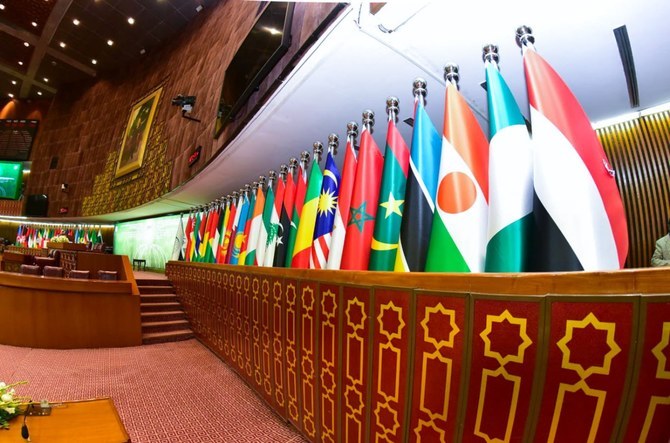
ISLAMABAD: Representatives of 46 Islamic nations have confirmed their participation in the 48th Organization of Islamic Cooperation’s (OIC) Council of Foreign Ministers meeting to be held in Islamabad later this month, the Pakistani foreign minister said on Saturday.
The OIC is the second-largest intergovernmental organization in the world after the UN. It comprises 57 Muslim member states spread across four continents. It is considered the collective voice of Muslim countries around the world and aims to promote the interests of its member states.
Pakistan will host the 48th foreign minister’s conference on March 22-23, which coincides with the Pakistan Day parade held on March 23 every year to commemorate the Lahore Resolution, which was adopted on the same day in 1940 and laid the foundation for a Muslim-majority state in South Asia. The OIC foreign ministers will be “guests of honor” at the parade.
“The foreign ministers of 46 Islamic countries confirmed their arrival,” Foreign Minister Shah Mahmood Qureshi told reporters. “This number can increase as well.”
OIC foreign ministers were last in Islamabad in December 2021 for an extraordinary session on Afghanistan, which was called by Saudi Arabia. At the end of the conference, an OIC-led Humanitarian Trust Fund for Afghanistan was announced and the OIC Secretary General’s Special Envoy for Kabul appointed.

46 OIC foreign ministers confirm participation in Islamabad conference on March 22-23
https://arab.news/rsdvm
46 OIC foreign ministers confirm participation in Islamabad conference on March 22-23
- Pakistan is hosting the 48th OIC Council of Foreign Ministers meeting this month
- Conference coincides with Pakistan Day parade where OIC FMs will be “guests of honor“
World Bank approves $700 million for Pakistan’s economic stability
- Of this, $600 million will go for federal programs and $100 million will support a provincial program in Sindh
- The results-based design ensures that resources are only disbursed once program objectives are achieved
ISLAMABAD: The World Bank has approved $700 million in financing for Pakistan under a multi-year initiative aimed at supporting the country’s macroeconomic stability and service delivery, the bank said on Friday.
The funds will be released under the bank’s Public Resources for Inclusive Development — Multiphase Programmatic Approach (PRID-MPA) that could provide up to $1.35 billion in total financing, according to the lender.
Of this amount, $600 million will go for federal programs and $100 million will support a provincial program in the southern Sindh province. The results-based design ensures that resources are only disbursed once program objectives are achieved.
“Pakistan’s path to inclusive, sustainable growth requires mobilizing more domestic resources and ensuring they are used efficiently and transparently to deliver results for people,” World Bank country director Bolormaa Amgaabazar said in a statement.
“Through this MPA, we are working with the Federal and Sindh governments to deliver tangible impacts— more predictable funding for schools and clinics, fairer tax systems, and stronger data for decision‑making— while safeguarding priority social and climate investments and strengthening public trust.”
The approval follows a $47.9 million World Bank grant in August to improve primary education in Pakistan’s most populous Punjab province.
In November, an IMF-World Bank report, uploaded by Pakistan’s finance ministry, said Pakistan’s fragmented regulation, opaque budgeting and political capture are curbing investment and weakening revenue.
Regional tensions may surface over international financing for Pakistan. In May, Reuters reported that India would oppose World Bank funding for Pakistan, citing a senior government source in New Delhi.
“Strengthening Pakistan’s fiscal foundations is essential to restoring macroeconomic stability, delivering results and strengthening institutions,” said Tobias Akhtar Haque, Lead Country Economist for the World Bank in Pakistan.
“Through the PRID‑MPA, we are launching a coherent nationwide approach to support reforms that expand fiscal space, bolster investments in human capital and climate resilience, and strengthen revenue administration, budget execution, and statistical systems. These reforms will ensure that resources reach the frontline and deliver better outcomes for people across Pakistan with greater efficiency and accountability.”
In Sindh, the program is expected to increase provincial revenues, enhance the speed and transparency of payments, and broaden the use of data to guide provincial decision making. The program will directly support the increase of public resources for inclusive development, including more equitable and responsive financing for primary health care facilities and more funding for schools.


