Turkey, Armenia vow to continue normalizing relations

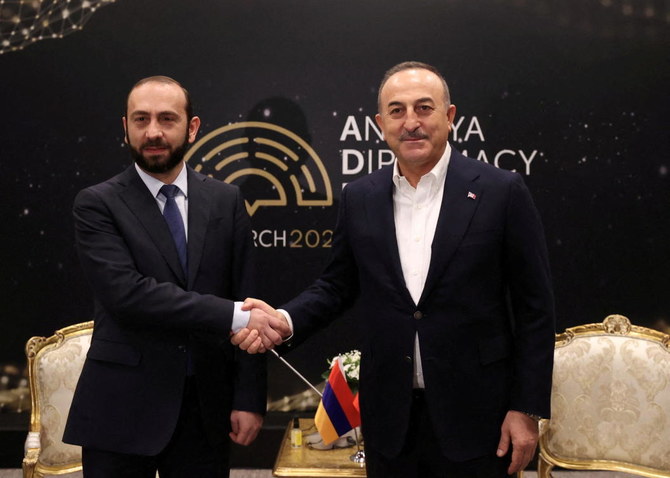
Turkish Foreign Minister Mevlut Cavusoglu meets with his Armenian counterpart Ararat Mirzoyan during the Antalya Diplomacy Forum (ADF) in Antalya, Turkey March 12, 2022. (Reuters)
Short Url
Updated 12 March 2022
Follow

Turkey, Armenia vow to continue normalizing relations

  • Armenia and Turkey have no diplomatic relations, a closed land border and a deep-seated hostility

Turkey and Armenia have pledged to pursue the normalization of ties in what the Turkish foreign minister Mevlut Cavusoglu described as a “productive and constructive” meeting on Saturday.
After talks with his Armenian counterpart, Ararat Mirzoyan, Cavusoglu said that Azerbaijan also “supports the process” of normalization.
Armenia and Turkey have no diplomatic relations, a closed land border and a deep-seated hostility rooted in the mass killing of Armenians under the Ottoman Empire during World War I.
But in December, the two countries appointed special envoys to normalize relations, spurred by support from regional powerbroker Russia and Armenia’s arch-foe Azerbaijan.
The push came a year after Azerbaijan used the help of Turkish combat drones to recapture most of the territory it lost to ethnic Armenians in a 1990s war in the disputed region of Nagorno-Karabakh.
A Russian-brokered truce that ended the second conflict removed Turkey’s main objection to talking to Armenia — namely, Yerevan’s support for the local Nagorno-Karabakh government’s claim of independence from Azerbaijan.
The first commercial flights for two years resumed in early February between Turkey and Armenia, but the land border between the two countries has remained closed since 1993, forcing trucks to transit through Georgia or Iran.


Syria welcomes Canada’s decision to amend sanctions

Syria’s Central Bank governor, Abdulkader Husarieh. (SANA)
Updated 4 sec ago
Follow

Syria welcomes Canada’s decision to amend sanctions

  • Husarieh said the decision could pave the way for Canadian participation in Syria’s reconstruction and infrastructure development

DAMSCUS: Syria’s Central Bank governor, Abdulkader Husarieh, commended the Canadian government’s decision to amend the sanctions imposed on Damascus under the Special Economic Measures Regulations, including the lifting of the comprehensive economic embargo in place since May 2011.
In a post published on his personal Facebook page, Husarieh described the move as an important milestone that reinforces the implementation of understandings reached during his recent visit to Canada.
He added that the amendment provides an opportunity to boost economic relations and activate cooperation between Canadian and Syrian banks and financial institutions.
Husarieh said the decision could pave the way for Canadian participation in Syria’s reconstruction and infrastructure development.
Meanwhile, the Syrian Arab Red Crescent and the Turkish Red Crescent signed cooperation agreements on Friday to strengthen humanitarian efforts in Syria amid ongoing crises and economic hardship.
Syrian Arab Red Crescent President Hazem Bakleh met in Damascus with Alper Kucuk, the Turkish Red Crescent’s director general for international affairs and migration services, to discuss rising humanitarian needs and ways to enhance coordination in support of vulnerable communities.
According to a statement released by the Syrian organization, the agreement provides for expanding relief and service activities.
It includes support for the construction of a new Red Crescent branch headquarters in Idlib province and the launch of a project to distribute hot meals and bread in Damascus and Aleppo during the holy month of Ramadan.
The Syrian Arab Red Crescent has sought to broaden partnerships with regional and international organizations in recent years to strengthen its operational capacity across multiple provinces, as the country continues to face economic strain and humanitarian challenges affecting large segments of the population.