ISLAMABAD: Wamiq Hassan, Pakistan’s first deaf software engineer, was inspired by his disability to develop an app to help deaf and hard-of-hearing Pakistanis, especially women, communicate more easily in a country where there are approximately 10 million hearing impaired citizens.
The DeafTawk mobile phone app, available globally, aims to bridge the gap between hearing-impaired people and their respective communities by providing a “real-time sign-language solution at their fingertips.”
The assistive app allows deaf users to sign up, connect with qualified interpreters, and use the service to communicate with anyone, including doctors, teachers, cab drivers, and relatives.
The app currently has over 18,000 users and employs around 1,100 professional interpreters, offering services in six different language styles, including Pakistani, American, British, Chinese, Singaporean and Malay.
Founder Hassan told Arab News he moved to the United States around 15 years ago because it was difficult for a deaf person to access quality education services in Pakistan. In 2015, he returned to his home country as a trained software engineer, and in 2019 co-founded DeafTawk with friends Ali Shabbar and Abdul Qadeer, who are both visually-impaired.
“The basic inspiration behind the development of this app is to uplift the deaf community and make this world inclusive for all with the help of mobile technology,” Hassan said in an interview.
“From my personal experience I know that deaf people face extreme communication barriers in Pakistan and there must be a solution to it. So, we are trying to bridge this gap through this app.”
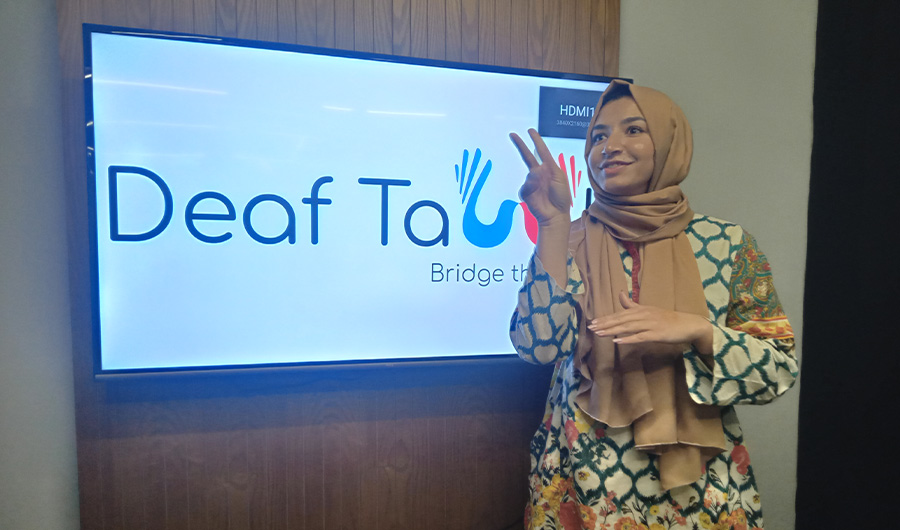
Sakina Batool, a deaf ambassador for DeafTawk, shares her life experiences and challenges through sign language in Islamabad, Pakistan, on March 7, 2022. (AN Photo)
DeafTawk recently launched live sign-language interpretation services for 446 million deaf people across the globe at the Mobile World Congress (MWC) Barcelona, an annual trade show primarily dedicated to the mobile communications industry.
People can avail the service by downloading the app on their mobile phones and paying for the subscription. Besides Pakistan, the service is also available in Denmark, Singapore and Puerto Rico.
Subscribers can have a two-person or group call round the clock to interact with anyone through an interpreter. The company is also working on the use of artificial intelligence (AI) to abolish the role of interpreters in the future.
“Our goal is to empower deaf people, especially women, to communicate with their communities, get education and enjoy all the festivities as a normal person,” Tehmina Zafar, a program manager for DeafTawk, told Arab News.
Sakina Batool, a deaf undergrad student of fashion design in Islamabad and an ambassador for DeafTawk, said the app was “nothing less than a revolution,” particularly for women in Pakistan.
“We’re a marginalized community, especially young girls, but DeafTawk has empowered us to not only communicate effectively but also participate in all activities without any hurdle,” she told Arab News, interacting with the help of her brother, Ehtisham Hussain, a computer science student who learnt sign language for his sister and is now a professional interpreter.
Batool, who teaches sign language to students, said she knew many deaf students who were using the app to communicate with teachers and fellow students at their respective institutes. Her own aim is to get higher education abroad, return to Pakistan and open an institution to help hearing-impaired people receive an education and plan careers.
“All human beings are born equal and no one should be discriminated against,” she said. “It is unfortunate that people with hearing impairment are victimized in education, jobs and public places.”
Her brother said Batool’s “biggest challenge” had been to get an education as a hearing-impaired person.
“But we challenged the myth that deaf people can’t do anything,” Hussain said, “and showed the world they can also lead a normal life.”