

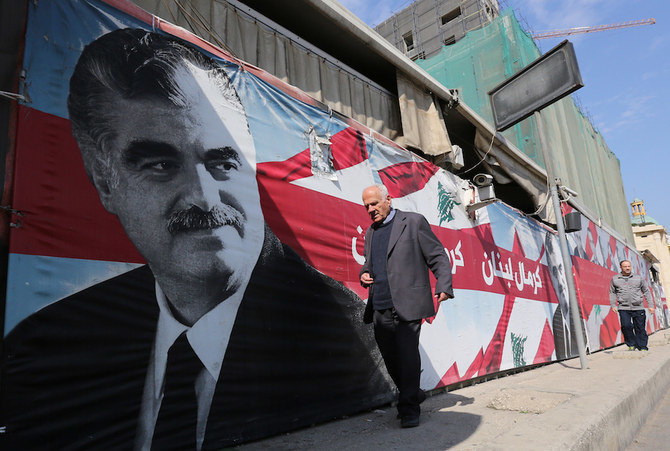

BEIRUT: The Appeals Chamber of the Special Tribunal for Lebanon on Thursday found Hezbollah members Hussein Oneissi and Hassan Habib Merhi guilty of involvement in the assassination of former Prime Minister Rafik Hariri in 2005.
When the verdict was announced, a number of members of the Future Movement, including party leader and former Prime minister Saad Hariri, accused Hezbollah of “covering up” the crime and “protecting criminals.”
The UN-backed STL ordered Lebanese authorities to arrest the men, who were convicted in their absence.
“The Public Prosecution is waiting for the arrest warrants to carry out its work,” a judicial source told Arab News. “However, since an arrest warrant was issued against Salim Ayyash (who was convicted in December 2020 by the STL of involvement in the assassination), the public prosecution has been instructing the authorities concerned to arrest him but to no avail.
“Usually, arrest warrants include the addresses at which the convicts are likely to be found but the search has not yielded any results so far.”
Reacting to the verdict, Hariri said: “It is imperative for the Lebanese state, with all its authorities and military and security forces, to work on arresting the convicts and handing them over to the STL to implement penalties.”
He directly accused Hezbollah of covering up the crime, protecting its members who were involved in it and helping them to evade international justice.
“History will not be merciful to any of the accomplices in the assassination,” he said. “We will remain on the lookout for every party or leadership that fails to implement justice and punish the killers.”
Former Prime Minister Fouad Siniora said: “This development proves that we were right to resort to the STL, especially since we are seeing every day how the Lebanese judiciary is unable to investigate certain crimes committed in Lebanon, the latest of which is the flagrant inability to make any progress in the Beirut port blast probe.
“The verdict exposes Hezbollah’s involvement in the assassination and exposes the falseness of the party’s allegations and practices against Lebanon and the Lebanese. The verdict obligates Hezbollah to hand over the criminals without any delay.”
In December 2020, the STL ruled that there was insufficient evidence to convict Oneissi, Merhi and a third defendant, Assad Hassan Sabra. It found Ayyash, also a Hezbollah member, guilty beyond reasonable doubt of “orchestrating a conspiracy aimed at committing a terrorist act and committing a terrorist act using an explosive device, intentionally killing Rafik Hariri using explosive materials, intentionally killing 21 other people using explosive materials, and trying to intentionally kill 226 people using explosive materials.”
He was sentenced, in his absence, to life imprisonment and the court said that he cannot appeal against the verdict unless he turns himself in.
The public prosecution appealed against the 2020 ruling on Merhi and Oneissi, and the appeals judges unanimously said on Thursday that “the trial judges had committed errors.” The case against the four defendants relied on circumstantial evidence in the form of mobile phone records that prosecutors said revealed a Hezbollah cell plotting the attack.
Judge Ivana Hrdlickova, the STL president, announced that the Appeals Chamber would issue arrest warrants for Oneissi and Merhi later on Thursday.
The STL is expected to close after this appeals phase due to a lack of funding. Lebanese nationals have donated €500,000 euros ($548,000) to ensure the STL’s work could continue after Lebanese state failed to provide the funding it owes the court, as a result of the economic crisis the country is facing.
Hezbollah Secretary-General Hassan Nasrallah has refused to hand over the accused, stating that he does not recognize the authority of the STL.
Former MP Marwan Hamadeh said: “The STL, despite the wasted time and high costs, proved that the truth cannot be hidden by a group of villains who committed the crime of the century against Rafik Hariri and all his companions.”
Hamadeh, who was injured in a car bomb attack that targeted him for assassination in 2004, a few months before Hariri was killed in a similar attack, added: “Proving Hezbollah’s involvement in the assassination gives justice for Lebanon a new depth that requires the official authority to implement international arrest warrants against the criminals. Staying silent regarding the crime and its perpetrators has led to the collapse of Lebanese justice.”
The STL verdict comes days before the 17th anniversary of the March 14 uprising that followed the assassination of Hariri in 2005.
Hezbollah has yet to react to the verdict against Oneissi and Merhi. However, comments made on Friday by the head of the party’s parliamentary bloc, MP Mohammed Raad, about a forensic audit into the accounts of the country’s Central Bank were highlighted by some as evidence of Hezbollah’s double standards when it comes to prosecuting criminals.
“Hezbollah does not want to fool anyone; criminals must be punished,” Raad said.


