

Pakistan air force inducts Chinese-made J-10C fighter jets

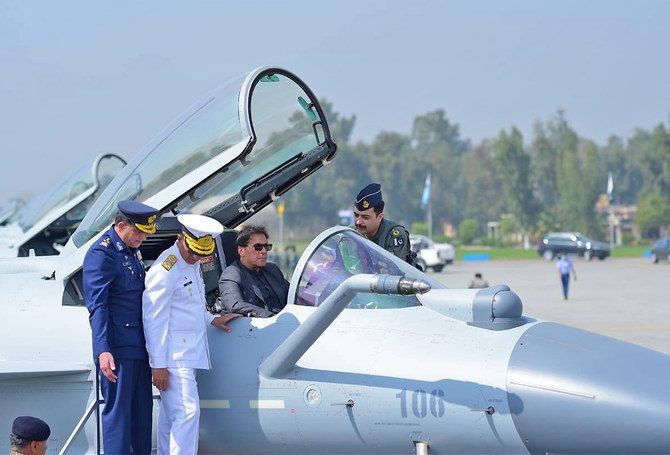
Pakistan Prime Minister Imran Khan (third left) inspects newly inducted Chinese-made J-10C fighter jets in Kamra Base, Pakistan, on March 11, 2022. (PMO Office/Twitter)
Short Url
Updated 11 March 2022
Follow

Pakistan air force inducts Chinese-made J-10C fighter jets

  • Planes inducted in response to arch-rival India’s purchase of French-made Rafale combat jets
  • Induction ceremony on Friday was attended by PM Imran Khan and the military service chiefs

ISLAMABAD: Pakistan Air Force on Friday inducted Chinese-made J-10C fighter jets into its fleet, with the country’s air chief calling it a “historic occasion.”
China is one of the biggest weapons suppliers for the Pakistani armed forces.
The induction ceremony on Friday was attended by Prime Minister Imran Khan and the military service chiefs. 
“Unfortunately, there are efforts to create an imbalance in South Asia and to address that security imbalance, thank god, we have made a major induction today in our defense system,” Khan said. 
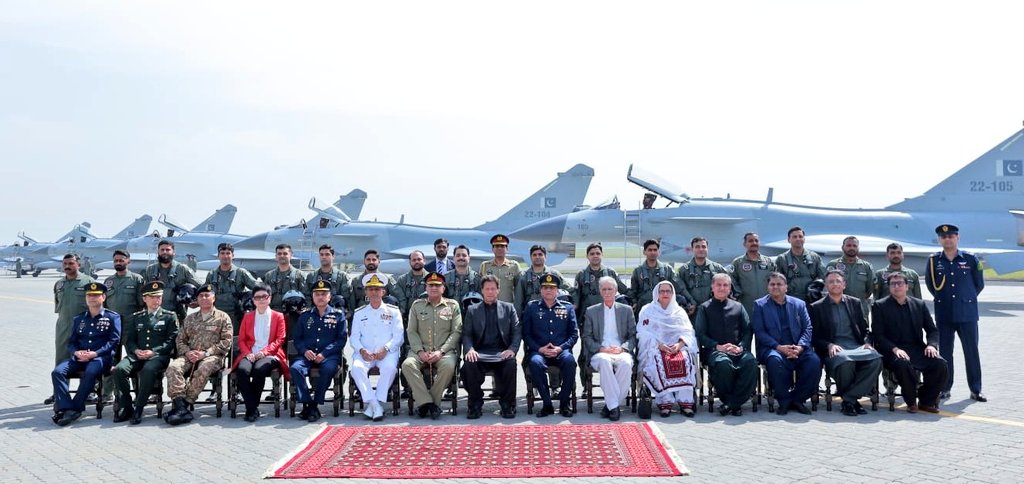


Pakistan Prime Minister Imran Khan (eight from left in first row) poses for a group photograph during the induction of Chinese-made J-10C fighter jets in Kamra Base, Pakistan, on March 11, 2022. (PMO Office/Twitter)

He was referring to arch-rival India’s purchase of French-made Rafale combat jets, which employ dual-capable systems that can be modified as nuclear weapon delivery platforms. 
In 2016, India signed a deal to buy 36 Rafale fighter jets from France for around $8.7 billion, the country’s first major acquisition of combat planes in two decades and a boost for Prime Minister Narendra Modi’s plan to rebuild an aging fleet. India has so far received 26 of the 36 planes.
Air Chief Marshal Zaheer Ahmad Babar said the J-10C can detect, engage and destroy targets at long range both in the air to air and air to surface domains.
“With multi domain capability J-10C would indeed revolutionize Pakistan Air Force’s operational thought. It will enhance net centric and integrated employment of electronic warfare while ensuring retention of first shoot capabilities,” he said.
It is reported the new jets will also fly-past at the Pakistan day military parade on March 23.
The Pakistan Day parade is held on March 23 every year to commemorate the Lahore Resolution, which was adopted on the same day in 1940 and laid the foundation for a Muslim-majority state in South Asia. 


World Bank approves $400 million to expand water, sanitation services in Pakistan’s Punjab

Updated 4 sec ago
Follow

World Bank approves $400 million to expand water, sanitation services in Pakistan’s Punjab

  • Project aims to improve access for 4.5 million people and curb waterborne diseases
  • Program to prioritize women’s participation and climate-resilient urban infrastructure

ISLAMABAD: The World Bank this week approved $400 million for a new project to expand access to safe water, sanitation and hygiene services for around 4.5 million people in Pakistan’s most populous Punjab province, aiming to curb waterborne diseases and reduce long-term public health costs.

The project, known as the Punjab Inclusive Cities Program (PICP), is the second phase of the World Bank-supported Pakistan Urban Water, Sanitation and Hygiene Services Multiphase Programmatic Approach. It will focus on rehabilitating water supply networks, sewerage systems and wastewater treatment plants, while expanding stormwater drainage infrastructure across 16 secondary cities in Punjab.

Punjab faces persistent challenges in providing safe drinking water and adequate sanitation, with many urban households relying on contaminated sources. Weak infrastructure and limited hygiene services contribute to high rates of waterborne diseases such as diarrhea, typhoid and hepatitis, which disproportionately affect children and low-income communities.

“Reducing child stunting is essential for Pakistan’s future. Through the Punjab Inclusive Cities Program, we are investing in safe water, sanitation, and hygiene services to break the cycle of malnutrition and disease that holds back so many children from reaching their full potential,” the World Bank quoted its Country Director for Pakistan, Bolormaa Amgaabazar, as saying in a statement.

“In collaboration with the Punjab Government, the program represents a significant step forward in improving urban infrastructure and strengthening local institutions, thereby laying the foundation for healthier communities and a more prosperous Pakistan.”

Child stunting, a form of chronic malnutrition that leaves children too short for their age, is often linked to repeated infections, poor sanitation and unsafe drinking water, and remains a major public health concern in Pakistan.

Beyond water and sanitation, the project will also support solid waste management systems to improve sanitary waste disposal, extending services to an additional two million people in Punjab’s urban areas. The program will strengthen the capacity of local governments, including efforts to improve revenue generation and long-term service sustainability.

“The program complements infrastructure investments with capacity building and revenue generation, helping to ensure that service delivery is well sustained,” the statement quoted Amena Raja, Senior Urban Specialist at the World Bank, as saying.

“It will also help Punjab’s cities better withstand floods and droughts, ensuring urban development is both environmentally responsible and resilient to climate change.”

The program includes a gender-focused component, prioritizing the hiring of women in decision-making roles, establishing gender-compliant service desks and supporting skills development. It also aims to mobilize private capital to support water and sanitation services in Punjab’s secondary cities.

Pakistan has been a member of the World Bank since 1950 and has received more than $48 billion in assistance since. The Bank’s current portfolio in the country comprises 54 projects with total commitments of $15.7 billion, while its private-sector arm, the International Finance Corporation, has invested about $13 billion since 1956.

Earlier this year, Pakistan and the World Bank signed a first-of-its-kind agreement for a plan to focus $20 billion in lending to the cash-strapped nation over the coming decade on development issues like the impact of climate change as well as boosting private-sector growth.