KARACHI: The Muttahida Qaumi Movement-Pakistan (MQM-P) is likely to support Prime Minister Imran Khan who is facing a no-trust motion that can topple his administration even as its leaders are meeting opposition politicians in Islamabad, independent analysts and politicians belonging to the ruling party said on Thursday.
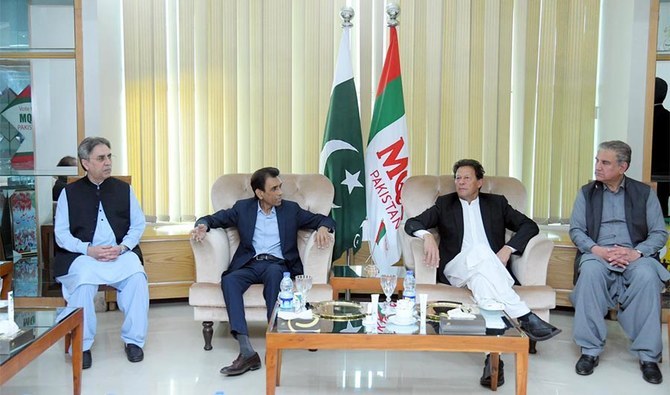
The prime minister flew to Karachi on Wednesday to interact with the top leaders of MQM-P and Grand Democratic Alliance (GDA) after the opposition filed the no-confidence motion in parliament against him.
He was also accompanied by foreign minister Shah Mahmood Qureshi who told reporters the prime minister had met his coalition partners to assess the “current political situation” and discuss a “joint strategy,” though the MQM-P dismissed the claim and said the no-trust vote was not even brought under discussion.
While the MQM-P did not respond to Arab News queries, one of its leaders Dr. Khalid Maqbool Siddiqui said after holding a meeting with the president of the opposition Pakistan Democratic Movement (PDM) alliance, Maulana Fazlur Rahman, that his party was analyzing the situation.
MQM-P leaders flew out of Karachi on Thursday morning for a scheduled meeting with Asif Ali Zardari of the Pakistan Peoples Party (PPP).
“We are concerned about the prevailing situation in the country. We do not want to see democracy getting harmed. Governments come and go,” Siddiqui said without divulging which side his party was going to choose.
Leaders of the ruling Pakistan Tehreek-e-Insaf (PTI) party said, however, they were confident the MQM-P was “not going to ditch the prime minister.”
“The MQM-P is a political party that has the right to meet anyone including Asif Ali Zardari,” Haleem Adil Sheikh, PTI lawmaker in the Sindh Assembly, said. “Such meetings with opposition leaders will not impact the relationship between the two coalition partners.”
Political analysts said there were thin chances the MQM-P would go against the PTI since it was likely to gain very little from the opposition.
“The MQM-P has serious grievances against the PPP,” said Amir Zia, a political analyst. “I don’t think it will abandon the PTI to support Bilawal Bhutto Zardari-led political party.”
“The urban regions of Sindh should get their rights,” he continued. “However, the past experience shows the PPP is not willing to do anything in those areas since it will help the MQM-P gain votes. The PPP will never want that.”
Zia also ruled out any deal between the two political parties since he argued that elections were near, adding their leaders would compete, instead of collaborate, with each other at this stage.
Mazhar Abbas, a Karachi-based analyst, said the MQM-P was not convinced the no-trust vote would be a success.
“MQM-P leaders want abolition of quota system in Sindh and devolution of power to local bodies,” he said. “The PPP is not likely to admit these demands while the PTI has already fulfilled many MQM-P wishes which include holding a new census.”
Owais Tohid, another political analyst, noted the prime minister’s Karachi visit negated his own stance against the MQM-P since he had remained a bitter critic of the party in the past.
“However, the MQM-P alliance with the PPP will be unnatural,” he maintained while recognizing that PPP’s Asif Ali Zardari believed in “politics of reconciliation.”
“When Zardari was at the helm of affairs, he did not allow the MQM-P to go away,” he continued. “Yet, it is an unnatural alliance. The MQM-P will explore all options before taking any decision.”


![]()

Ruling party ally MQM-P likely to side with PM to defeat no-trust vote – experts
Short Url
https://arab.news/cgae8
Ruling party ally MQM-P likely to side with PM to defeat no-trust vote – experts
- Political commentators say the MQM-P has several grievances against the PPP, adding the two parties make an ‘unnatural alliance’
- Politicians say MQM-P has the right to meet with opposition factions before taking a final decision on the matter
Latest updates


Recommended


© 2026 SAUDI RESEARCH & PUBLISHING COMPANY, All Rights Reserved And subject to Terms of Use Agreement.