BIRMINGHAM, United Kingdom: Tens of thousands of dogs and their owners — minus Russians — flocked to the world’s biggest dog show on Thursday, as Crufts made a comeback after a two-year absence.
The last edition was in March 2020, just before Britain locked down as coronavirus swept the globe and before the country geared up to leave the European Union after Brexit.
This time round, the invasion of Ukraine hangs over the four-day event, after organizers The Kennel Club banned the attendance of Russian owners and their dogs.
Many owners sported ribbons in the yellow and blue colors of Ukraine’s flag as a show of support.
“It’s my way to show I’m thinking of the Ukrainians,” said Sara Davies, 63, from northeast England, who has entered Crufts for the first time with her black German shepherd, Laxi.
“I mean, it’s appalling. At least I can live my daily life normally. They can’t,” she told AFP as Laxi lay at her feet.
The Kennel Club’s decision affects about 30 Russian owners and breeders and 51 dogs that had been due to participate in the show, which was first held in 1891.
“In the light of rapidly evolving circumstances, it is with a heavy heart we have taken the decision not to allow exhibitors from Russia to compete at Crufts 2022,” it said.
“Our friends in Ukraine, and their dogs, are fearing for their lives and we will do all that we can to support them wherever possible.”
It is donating £50,000 (60,000 euros, $66,000) to help partner organizations in Ukraine, Poland and Hungary help breeders, owners and their dogs affected by the conflict.
Despite the conflict in Ukraine, the chief executive of The Kennel Club, Mark Beazley, said Crufts was “a little bit of joy in some pretty sad days for the world at the moment.”
Lockdown restrictions, which forced last year’s Crufts to be canceled, increased stress and isolation for both humans and their four-legged friends.
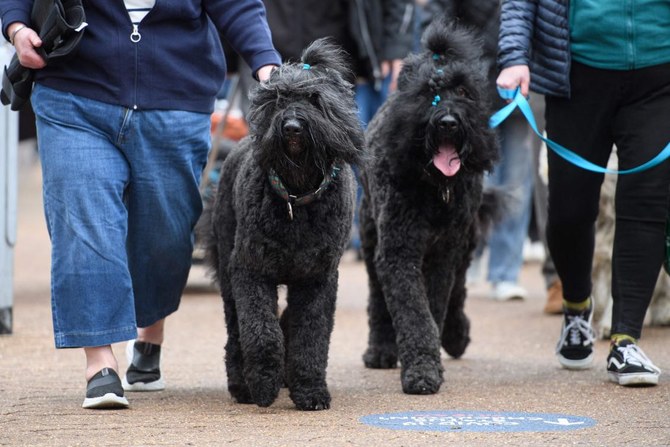
“The pandemic was very difficult,” said Stacie Young, from Kent, southeast England, as she sat with her imposing Newfoundland, Bumbee, taking part in her second Crufts.
“She used to socialize a lot with other dogs during shows. Suddenly there was nothing happening at all. When we were finally allowed to gather in a group of six, we would gather in the park with some friends to practice.”
The last coronavirus restrictions were lifted in England last month, and few people were seen wearing masks as they watched a parade of Cavalier King Charles Spaniels.
But organizers said it will take time for the show to get back to its previous level: in 2020, some 150,000 people attended.
Changes to pet travel after Brexit, as well as the pandemic, have hampered many Crufts regulars’ ability to travel this time.
More than 20,000 dogs are due to compete on looks, obedience and agility at the vast National Exhibition Center near Birmingham, in central England.
Some 16,000 dogs from 38 countries are in the running to bag seven spots for the prestigious “Best in Show” finale, which will be decided on Sunday evening.
Of those, just over 1,800 are from overseas — well down on the more than 3,000 foreign entrants in various competitions in the show two years ago.
Since the UK’s full departure from the EU in January last year, European visitors — and their pets — are subject to more stringent entry requirements.
The winner of the 2020 Best in Show was Maisie, a wire-haired dachshund.


Russian dogs absent as Crufts returns

https://arab.news/68f2w
Russian dogs absent as Crufts returns

- This time round, the invasion of Ukraine hangs over the four-day event, after organisers The Kennel Club banned the attendance of Russian owners and their dogs
- Many owners sported ribbons in the yellow and blue colours of Ukraine's flag as a show of support


Cambodia takes back looted historic artifacts handled by British art dealer
- The objects were returned under a 2020 agreement between the Ministry of Culture and Fine Arts and the family of the late Douglas Latchford, a British art collector and dealer who allegedly had the items smuggled out of Cambodia
PHNOM PENH, Cambodia: Cambodian officials on Friday received more than six dozen historic artifacts described as part of the country’s cultural heritage that had been looted during decades of war and instability.
At a ceremony attended by Deputy Prime Minister Hun Many, the 74 items were unveiled at the National Museum in Phnom Penh after their repatriation from the United Kingdom.
The objects were returned under a 2020 agreement between the Ministry of Culture and Fine Arts and the family of the late Douglas Latchford, a British art collector and dealer who allegedly had the items smuggled out of Cambodia.
“This substantial restitution represents one of the most important returns of Khmer cultural heritage in recent years, following major repatriations in 2021 and 2023 from the same collection,” the Culture Ministry said in a statement. “It marks a significant step forward in Cambodia’s continued efforts to recover, preserve, and restore its ancestral legacy for future generations.”
The artifacts were described as dating from the pre-Angkorian period through the height of the Angkor Empire, including “monumental sandstone sculptures, refined bronze works, and significant ritual objects.” The Angkor Empire, which extended from the ninth to the 15th century, is best known for the Angkor Wat archaeological site, the nation’s biggest tourist attraction.
Latchford was a prominent antiquities dealer who allegedly orchestrated an operation to sell looted Cambodian sculptures on the international market.
From 1970 to the 1980s, during Cambodia’s civil wars and the communist Khmer Rouge ‘s brutal reign, organized looting networks sent artifacts to Latchford, who then sold them to Western collectors, dealers, and institutions. These pieces were often physically damaged, having been pried off temple walls or other structures by the looters.
Latchford was indicted in a New York federal court in 2019 on charges including wire fraud and conspiracy. He died in 2020, aged 88, before he could be extradited to face charges.
Cambodia, like neighboring Thailand, has benefited from a trend in recent decades involving the repatriation of art and archaeological treasures. These include ancient Asian artworks as well as pieces lost or stolen during turmoil in places such as Syria, Iraq and Nazi-occupied Europe. New York’s Metropolitan Museum of Art is one of the prominent institutions that has been returning illegally smuggled art, including to Cambodia.
“The ancient artifacts created and preserved by our ancestors are now being returned to Cambodia, bringing warmth and joy, following the country’s return to peace,” said Hun Many, who is the younger brother of Prime Minister Hun Manet.