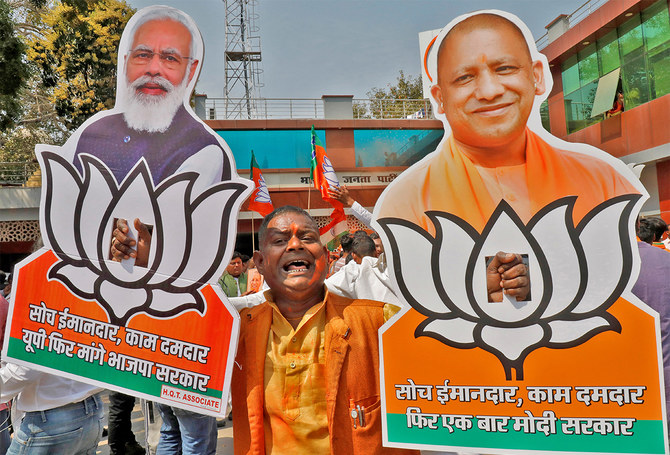
JAIPUR: The ruling Bharatiya Janata Party remained in control of India’s most populous state, Uttar Pradesh, initial results showed on Thursday, in vote that is seen a pulse check on support for Prime Minister Narendra Modi ahead of the national elections in 2024.
More than 180 million votes were cast in five Indian states — Uttar Pradesh, Uttarakhand, Punjab, Manipur and Goa — all of which went to the polls over the past month.
Uttar Pradesh is home to over 220 million people, about a fifth of India’s population. Winning the state is considered crucial for securing a majority in parliament, as it sends the most legislators of any state to the country’s supreme legislative body.
Tight races in Manipur, Goa and Uttarakhand have been in favor of the BJP, while the Aam Aadmi Party that also governs the national capital territory of Delhi is headed for a big victory in Punjab.
“But for Punjab, the BJP has achieved astounding victory in Uttar Pradesh, Uttarakhand, Goa and Manipur. “These victories would rewrite India’s political road map,” BJP spokesperson Sudesh Verma said in a statement.
Rahul Gandhi, leader of India’s main opposition Congress party, which is trailing in all five states, took to Twitter to say he accepted the result of the popular vote.
“Humbly accept the people’s verdict,” he said. “Best wishes to those who have won the mandate.”
The Hindu nationalist BJP has been in power in Uttar Pradesh since 2017, when it won 312 seats of the 384 it contested.
The 2022 win, coming despite criticism over the handling of the COVID-19 pandemic and mass antigovernment protests by farmers last year, would make incumbent Yogi Adityanath, a controversial Hindu monk, the first Uttar Pradesh chief minister to complete a full term and return to office.
It was not certain if farmers, an influential voting bloc, would support the ruling party after it pushed laws to privatize the agriculture sector triggered a yearlong protest that ended with the government revoking the plan in November.
But it still pinned hopes on a slew of development schemes carried out by local governments.
Delhi-based writer and analyst Nilanjan Mukhopadhyay told Arab News the win was an “endorsement of the BJP’s welfare politics that it has introduced by building toilets, distributing rations and all among the poorer sections of the society.”
He added that it would also consolidate majoritarian politics that Modi’s party has been introducing in the Hindu dominated country since its ascent to power in 2014: “The results show the normalization of the BJP’s majoritarian narrative that it has introduced in India’s polity in the last eight years.”


![]()

Modi’s ruling party set for landslide win in crucial Indian state polls
Short Url
https://arab.news/n3u6j
Modi’s ruling party set for landslide win in crucial Indian state polls
- Winning Uttar Pradesh is seen as necessary for securing a majority in India's parliament
- Leader of India's main opposition Congress party says accepts the result of the popular vote
Latest updates



© 2026 SAUDI RESEARCH & PUBLISHING COMPANY, All Rights Reserved And subject to Terms of Use Agreement.