Boost for Saudi Arabia’s hopes of staging 2027 AFC Asian Cup

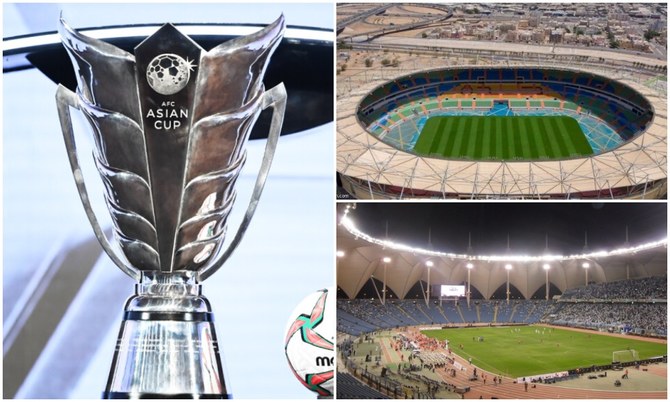
Saudi Arabia is in a strong position when it comes to winning the rights to host the 2027 Asian Cup. (AFC.com/Arriyadh)
Short Url
Updated 08 March 2022
Follow

Boost for Saudi Arabia’s hopes of staging 2027 AFC Asian Cup

  • Riyadh, Jeddah, Buraidah and Dammam will hold five groups in the 2022 AFC Champions League, confirming Asian confederation’s view that the Kingdom is a ‘safe pair of hands’

LONDON: Saudi Arabia’s hopes of staging the 2027 Asian Cup have been boosted by last week’s decision of the Asian Football Confederation to give the country hosting rights to no less than five groups in the 2022 AFC Champions League.

On Thursday, it was announced that Riyadh will host two groups of Asia’s flagship club tournament, with Jeddah, Buraidah and Dammam all taking care of one each. These centralized venues, necessary due to travel restrictions and scheduling challenges in place due to the global pandemic, will be in use April 7-27 when the four teams will play each other twice. The fact that there are four cities involved is significant for the 2027 bid in which Saudi Arabia is up against India, Iran and Qatar.

“It is no secret that the AFC sees Saudi Arabia as a safe pair of hands when it comes to hosting major events, especially in difficult times,” a high-ranking AFC official told Arab News. “It is more than being safe, however. We know that the country has the necessary facilities, expertise and experience not just to be a reliable option but to be a top-class host nation.”

There was interest from other countries in the western half of the Champions League — the tournament is split into two geographic zones until the final — but instead of dividing the groups between different nations, as happened in 2021 when India and the UAE were also involved, the decision was made to make it an all-Saudi Arabian affair. In contrast, four of the five groups in the eastern zone will be hosted by three separate countries in Thailand, Vietnam and Malaysia, with a decision on the fifth still to be confirmed. 

“There was some debate as to whether to give a group to cities such as Dammam and Buraidah, but there is no doubt that they can do a good job and there will be a festival of football all over the country in April,” the official added. “It also shows that there is now a close working relationship between the AFC and the Saudi Arabian Football Federation.”

This is not the first time in recent months that the SAFF has been heartened by positive noises from the AFC regarding the decision that will be taken later this year after a vote from the body’s member associations, one that has been delayed due to COVID-19. Confederation officials were impressed last October and November as Riyadh smoothly hosted the latter stages in the western zone and also the final when local club Al-Hilal lifted the title for a record fourth time in front of over 50,000 fans. It has been hinted that, if centralized venues are still necessary for the knockout stages in the 2022 club competition, which will take place early next year due to the Qatar World Cup being held in November and December, Saudi Arabia will once again get the nod.

There are other reasons for fans in the country to be positive about 2027. The three-time continental champions have surprisingly never hosted the continent’s biggest event unlike rival Qatar, which staged the event as recently as 2011 and also did so in 1988. Iran’s current policy of not allowing women into stadiums is expected to count against their bid. India and the region of South Asia with a market of close to 2 billion people is seen by the AFC as well as FIFA as a necessary host for the future but there is a widespread feeling that the next decade may be preferable. 

It leaves Saudi Arabia in a strong position when it comes to winning the rights to host the 2027 Asian Cup, and success in the AFC Champions League group stages — on and off the pitch — can only make that position even stronger.


Morocco banish any doubts about ability to host World Cup 2030

Updated 19 January 2026
Follow

Morocco banish any doubts about ability to host World Cup 2030

  • Impressive stadiums, easy transportation links and a well-established tourism infrastructure ensured the 24-team tournament went off without any major hitch and will assuage any doubters about the World Cup in four years’ time

RABAT: Morocco’s successful staging of the Africa Cup of Nations means there should be no skepticism about its ability to co-host the World Cup with Portugal and Spain in 2030, even if Sunday’s final was clouded by a walk-off and defeat for the home team.

Impressive stadiums, easy transportation links and a well-established tourism infrastructure ensured the

24-team tournament went off without any major hitch and will assuage any doubters about the World Cup in four years’ time.

Morocco plans to use six venues in 2030 and five of them were used for the Cup of Nations, providing world-class playing surfaces and a spectacular backdrop.

The Grande Stade in Tangier with a 75,000 capacity is an impressive facility in the northern coastal city, less than an hour’s ferry ride from Spain.

Meanwhile, FIFA President Gianni Infantino condemned "some Senegal players" for the "unacceptable scenes" which overshadowed their victory in the final when they left the pitch in protest at a penalty awarded to Morocco.

African football's showpiece event was marred by most of the Senegal team walking off when, deep into injury time of normal play and with the match locked at 0-0, Morocco were awarded a spot-kick following a VAR check by referee Jean-Jacques Ndala for a challenge on Brahim Diaz.

security personnel at the other end of the stadium, Senegal's players eventually returned to the pitch to see Diaz shoot a soft penalty into the arms of their goalkeeper Edouard Mendy.

The match was played at the Stade Moulay Abdellah in the capital Rabat, which has a capacity of 69,500. The attendance for the final was 66,526.

Stadiums in Agadir, Fes and Marrakech were also more than adequate and will now be renovated over the next few years.

But the crowning glory is the proposed 115,000-capacity Stade Hassan II on ⁠the outskirts of Casablanca which Morocco hope will be chosen to host the final over Madrid’s Santiago Bernabeu Stadium.

In all, Morocco will spend $1.4 billion on the six stadiums. Also planned is extensive investment in airports, with some 10 Moroccan cities already running direct air links to Europe and many budget airlines offering flights to the country.

An extension of Africa’s only high-speed rail service, which already provides a comfortable three-hour ride from Tangier to Casablanca, further south to Agadir and Marrakech is also planned. Morocco hopes all of this will modernize its cities and boost the economy.

On the field, Morocco will hope to launch a credible challenge for a first African World Cup success, although on Sunday they continued their poor return in the Cup of Nations, where their only triumph came 50 years ago.

They surprised with a thrilling run to the last four at the Qatar 2022 World Cup as the first African nation to get that far and will hope for a similar impact at this year’s finals in North America. They are in Group C with Brazil, Scotland and Haiti.