KYIV/LVIV: Moscow on Monday offered escape routes to Ukrainians fleeing airstrikes and artillery bombardment — but only to Russia or its ally Belarus.
A spokesman for Ukrainian President Volodymyr Zelensky described the proposal as “completely immoral” and said Russia was trying to “use people’s suffering to create a television picture.”
“They are citizens of Ukraine, they should have the right to evacuate to the territory of Ukraine,” the spokesman said.
The Russian offer came before a third round of peace talks between Ukrainian and Russian negotiators. Earlier rounds produced little other than pledges to allow humanitarian access that have not been implemented.
Two days of failed ceasefires in the besieged southern port city of Mariupol have left hundreds of thousands trapped without food and water under relentless bombardment. In the town of Makariv in the Kyiv region, at least 13 civilians were killed in a Russian airstrike on a bread factory.
As Russian and Ukrainian delegations assembled for the ceasefire talks, a Ukrainian negotiator urged Russia to stop its assault on Ukraine, which the UN said had created 1.7 million refugees.
After Monday's third round of peace talks between Ukrainian and Russian negotiators, Russia’s U.N. Ambassador, Vassily Nebenzia, told the U.N. Security Council that Russia would carry out a cease-fire Tuesday morning and open humanitarian corridors leading away from Kyiv, Mariupol, Sumy and Chernigov. Zelenskyy expressed skepticism — saying that instead of an agreement on humanitarian corridors, what Ukraine got Monday was “Russian tanks, Russian Grad rockets, Russian mines.”
The two sides held a third round of talks Monday, with Russia’s top negotiator, Vladimir Medinsky, saying afterward that no progress was made toward a political settlement that would end the war. The countries’ foreign ministers are scheduled to meet Thursday in Turkey, according to that country’s top diplomat.
“In a few minutes, we will start talking to representatives of a country that seriously believes large-scale violence against civilians is an argument,” Ukrainian negotiator Mykhailo Podolyak said. “Prove that this is not the case.”
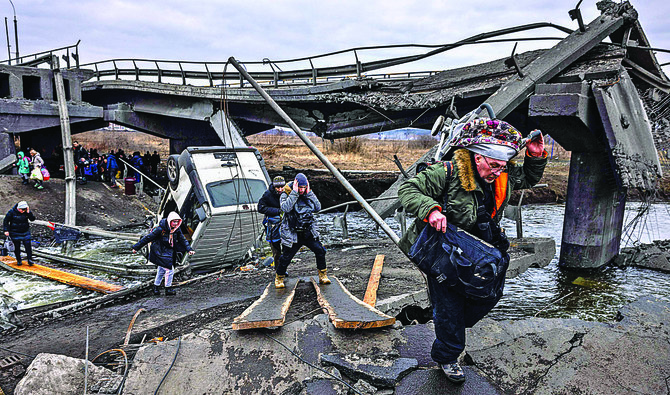
The general staff of Ukraine’s armed forces said Russian troops were “beginning to accumulate resources for the storming of Kyiv,” after days of slow progress in their advance south from Belarus. Ukraine said 2,000 civilians had been evacuated from Irpin, a Kyiv suburb that has been under heavy attack.
In Mariupol, deputy mayor Sergei Orlov said there had been continuous air raids on the city. Orlov said authorities were ready to evacuate 6,000 people but the Russians had bombed the buses that were to transport them.
Ukraine said its forces had retaken control of the town of Chuhuiv in the northeast, the scene of heavy fighting for days, and of the strategic Mykolayiv airport in the south, which the regional governor said was under tank fire.
Ed Arnold, an analyst with the Royal United Services Institute in the UK, said Russia would need to try to consolidate the gains it had already made and pause to mobilize more forces unless the pace of the assault picked up.
“At the current rate of Russian losses ... we do have indications that this operation would be unsustainable within about three weeks,” he said.
A Russian general was killed in the fighting around Kharkiv, Ukraine’s second-largest city, which Russian forces have been trying to seize since the invasion began, the Ukrainian military intelligence agency said.
It identified him as Maj. Gen. Vitaly Gerasimov, 45, and said he had fought with Russian forces in Syria and Chechnya and had taken part in the seizure of Crimea in 2014.
It was not possible to confirm the death independently. Russia has not commented.
Another Russian general was killed earlier in the fighting. A local officers’ organization in Russia confirmed the death in Ukraine of Maj. Gen. Andrei Sukhovetsky, the commanding general of the Russian 7th Airborne Division.
Sukhovetsky also took part in Russia’s military campaign in Syria.
U.S. Secretary of State Antony Blinken visited Lithuania and Latvia on Monday to calm any fears that they and Estonia, which he'll visit Tuesday, have about their security in the event Russia expands its military operations. The three Baltic countries, which endured decades of Soviet occupation before regaining their independence in 1991, are members of the EU and NATO.
Blinken stressed that the U.S. commitment to NATO’s mutual defense pact is “sacrosanct” and that NATO and the U.S. were discussing stationing troops in the Baltics permanently.
A growing number of multinational businesses have cut Russia off from vital financial services, technology and a variety of consumer products in response to Western economic sanctions and global outrage over the war.
Two of the so-called big four accounting firms — KPMG and PricewaterhouseCoopers — said Sunday that they were pulling out of Russia, ending relationships with member firms based in the country.
TikTok said users won’t be able to post new videos in Russia in response to the government’s crackdown on what people can say on social media about the invasion, and American Express announced it was suspending all operations in Russia and Belarus. Netflix also announced it was suspending its service in Russia.


![]()

Moscow offers escape route to Ukrainian refugees fleeing war — but only to Russia
Short Url
https://arab.news/vpeba
Moscow offers escape route to Ukrainian refugees fleeing war — but only to Russia
- Hundreds of thousands trapped inside Mariupol without food and water under relentless bombardment
- Russian general who fought in Syria and Chechnya and had taken part in the seizure of Crimea killed


Latest updates





© 2026 SAUDI RESEARCH & PUBLISHING COMPANY, All Rights Reserved And subject to Terms of Use Agreement.