

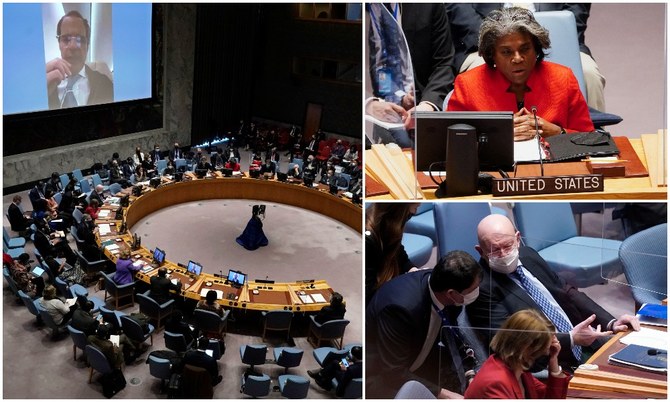

NEW YORK: “By the grace of God, the world narrowly averted a nuclear catastrophe last night,” Linda Thomas-Greenfield, the permanent US representative to the UN, told the Security Council on Friday.
“We all waited to exhale as we watched the horrific situation unfold in real time.”
She was speaking during an emergency meeting of the council that was called by the UK to discuss a fire that broke out the night before at the Zaporizhzhia nuclear power plant in Ukraine as Russian troops attacked and seized control of the facility.
The envoy said the attack on Europe’s largest nuclear power plant was “incredibly reckless and dangerous” and had put it “at grave risk.”
The fire was extinguished early on Friday. It caused damage to a training facility at the plant but did not affect any of its six reactors.
Rafael Grossi, director general of the International Atomic Energy Agency, confirmed that none of the nuclear reactors or other essential equipment were damaged and radiation levels remain normal. The Ukrainian staff at the plant continue to run it, and safety systems are functioning, he added.
The incident triggered condemnation worldwide, along with warnings of the potentially catastrophic consequences of such an attack for the Ukrainian people and populations across the region.
Rosemary DiCarlo, the UN’s under-secretary-general for political and peacebuilding affairs, said the people of Ukraine are all too aware of the devastation nuclear accidents can cause.
“The Chernobyl disaster in 1986 stands as a lasting example of why it is vital to ensure all nuclear power plants have the highest standards of safety and security,” she told the council.
She added that UN Secretary-General Antonio Guterres has followed “with great alarm” the reports of fighting around the plant.
“Military operations around nuclear sites and other critical civilian infrastructure are not only unacceptable but highly irresponsible,” DiCarlo said. “Every effort should be made to avoid a catastrophic nuclear incident.”
Thomas-Greenfield joined other council members in calling on Russia to withdraw its troops from the plant “to permit medical treatment for injured personnel, to ensure operators have full access to the site,” and to halt any further use of force that might put at risk the 15 operable nuclear reactors across Ukraine.
Directly addressing Vassily Nebenzia, her Russian counterpart on the council, Thomas-Greenfield said: “This Council needs answers. We need to hear you say this won’t happen again.
“We call on you to withdraw your troops and weaponry from Ukraine. We call on you to respect Ukraine’s borders, its people, and the UN Charter.
We call on you to respect your own troops enough not to send them into an unjust war — or on a suicide mission against a nuclear power plant.”
She added: “(Russian President Vladimir) Putin must stop this madness and he must stop it now. Cooler heads must prevail.”
In response, Nebenzia said: “Today’s meeting is another attempt by Kyiv authorities to spread artificial hysteria around what is taking place in Ukraine and they are being assisted by their Western backers.”
The Russian envoy said news reports about the incident at Zaporizhzhia were false and “part of an unprecedented campaign of lies and disinformation against Russia.”
He said the fire was not caused by Russian shelling and instead accused Ukrainian “saboteurs” of causing it by shooting at a Russian patrol. He added that forces from his country now control the power plants at both Zaporizhzhia and Chernobyl, to prevent them falling into the hands of “Ukrainian terrorists.”
Nebenzia dismissed what he described as an attempt by his “dear Western colleagues” to turn the incident on Thursday into a global scandal.
“Ukrainian nationalists are now under your protection and have carte blanche from you,” he added.
Lana Nusseibeh, the UAE’s permanent representative, and president of the Security Council this month, said another Chernobyl must be prevented, as the dire consequences would affect not only Ukraine but the entire region.
“Nuclear safety is a critical issue for my country and we will continue every possible effort to maintain nuclear safety,” she said.
Nusseibeh joined the other ambassadors in welcoming a second round of talks between Russia and Ukraine which resulted in a preliminary agreement for the opening of humanitarian corridors so that people fleeing the war can leave safely.
She added that the UAE calls for an immediate end to hostilities and for the conflict to be resolved through dialogue and diplomacy.


