

Pakistani dairy sellers fear $73 million annual losses, seek action against smuggled Iranian products

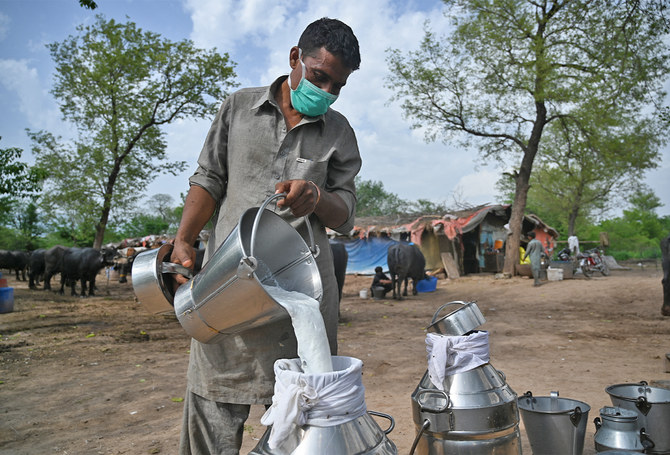
A vendor wearing a facemask fills a can with milk at a farm in Islamabad, Pakistan, on April 15, 2020. (AFP/File)
Short Url
Updated 04 March 2022
Follow

Pakistani dairy sellers fear $73 million annual losses, seek action against smuggled Iranian products

  • Iranian origin products being smuggled into Pakistan include long life dairy creams, liquid milk, flavoured milk
  • An official at Sindh Food Authority said action had been initiated against the smuggling of illegal dairy products

KARACHI: Pakistani dairy product manufacturers have sought intervention from provincial and federal authorities against what they call the smuggling of non-compliant dairy products of Iranian origin, saying they could cause an estimated Rs13 billion ($73 million) annual loss to the indigenous industry.
The Iranian origin products being smuggled into Pakistan according to local officials include long life dairy creams, liquid milk, flavoured milk and other products.
“The Irani products being sold in Pakistan are mainly coming through smuggling and an impact assessment shows that this could cause the local dairy sector to suffer Rs13 billion losses per year,” Dr. Shehzad Amin, CEO of the Pakistan Dairy Association (PDA), told Arab News on Thursday, adding that the “non-compliant,” unregulated products were widely available at retail stores in Pakistan despite being of low quality.
An official at the Sindh Food Authority who did not want to be named said action had been initiated against the smuggling of dairy products, but did not specify what measures had been taken. The federal bureau of revenue and the commerce ministry could not be reached for comment. The Iranian embassy in Islamabad did not respond to emailed queries.
The Association has also said Iranian dairy products were being sold in violation of labelling requirements, according to letters by the PDA written to four provincial food authorities as well as the federal commerce ministry and the federal bureau of revenue.
“In addition to causing heavy revenue losses to the national exchequer, this product is clearly a violation of labeling requirements of SRO 237-Ministry of Commerce, applicable quality and nutrition standards of provincial and federal food authorities,” the PDA said in a letter dated last month, referring to a commerce ministry rule.
“Despite legal requirement to check imported processed food products as per Pakistan Standards and existence of Pakistan Standards for the aforementioned Dairy Products, unregulated and noncompliant dairy products are available in market which can be detrimental to health.”
PDA in its letters has also pointed out what it calls design infringement, labelling anomalies, import irregularities, food safety risks and violation of the government’s SRO237 legal framework under which goods are imported or manufactured and which requires products to have 66 percent shelf life from the date of manufacturing as well as stipulates that ingredients and details of products be printed in Urdu and English on the packaging. 
“We have been meeting with the authorities and their response so far is encouraging,” the PDA chief said. “We are asking them to take corrective measures at the borders. We are seeking to ensure compliance of imported dairy products as per applicable standards as being applied on locally regulated dairy products.”
Dairy sector stakeholders also said the unregulated products were against the promotion of fair business practices in the country. 
“Dairy products including dry milk are coming through smuggling in large quantities,” said Shakir Umar Gujjar, president of the Dairy and Cattle Farmers Association (DCFA), “and are certainly impacting the local market.”

"The smuggled dry milk is sold in the local market after mixing with water and is being presented as fresh milk," Gujjar added. "This practice is denting our market share." 


Pakistan, Iran seek to boost economic cooperation through agriculture, improved connectivity

Updated 5 sec ago
Follow

Pakistan, Iran seek to boost economic cooperation through agriculture, improved connectivity

  • Pakistan-Iran trade has hovered around $3 billion in recent years, with both countries pledging to take it to $10 billion
  • Pakistan minister says improved connectivity, streamlined procedures and practical coordination can help achieve target

KARACHI: Pakistan and Iran on Tuesday agreed to step up cooperation in agriculture and food security with a focus on improving connectivity and streamlining procedures to boost broader economic ties, the Pakistani food security ministry said.

Trade between Pakistan and Iran has hovered around $3 billion in recent years and both countries signed a memorandum of understanding (MoU) in Feb. 2025 to take it to $10 billion.

Iran was prioritizing Pakistan’s rice, meat and other exports as part of a trade understanding reached between the two countries in Tehran, the Pakistani government said in Aug. last year.

On Tuesday, Iran’s agriculture minister Gholamreza Nouri Ghezeljeh met Pakistani food security and commerce ministers in Islamabad to advance bilateral cooperation in agriculture and food security.

“Federal Minister for Commerce Jam Kamal Khan also highlighted the importance of facilitating cooperation through improved connectivity, streamlined procedures, and practical coordination at the operational level,” the Pakistani food security ministry said.

“He emphasized that sustained engagement and mutual understanding would help unlock the full potential of bilateral relations across multiple sectors.”

Pakistan’s food security minister emphasized that agriculture remains a vital sector for ensuring food security, rural development, and economic stability in both countries, urging enhanced technical cooperation, exchange of expertise and strengthened coordination between relevant departments and research institutions.

The Iranian minister suggested closer cooperation in horticulture, livestock, crop management, and modern farming practices, noting that both countries possessed complementary strengths and could benefit from structured collaboration, joint initiatives and regular institutional dialogue, according to the Pakistani ministry.

Matters relating to agricultural exchange, research collaboration, capacity building, and facilitation of farmers and agri-business stakeholders were also discussed.

“The two sides acknowledged the need to promote joint research in areas such as water conservation, high-value crops, livestock improvement, and sustainable agricultural practices in view of shared climatic and environmental challenges,” the Pakistani food security ministry said.

“The ministers discussed ongoing collaboration under existing agreements, including cooperation in veterinary and animal health, plant protection and quarantine. Both sides agreed on the importance of effectively implementing signed agreements and expediting pending institutional mechanisms to ensure consistent progress.”
