

Blast in Pakistan’s southwest kills 3, injures over 20 people

Firefighters try to extinguish fire at the site of an explosion, which killed three people and wounded several others, at a market area in Quetta, Pakistan, on March 2, 2022. (AFP)
Short Url
Updated 02 March 2022
Follow

Blast in Pakistan’s southwest kills 3, injures over 20 people

  • The explosion took place inside a crowded shop in Quetta, taking the life of a senior police official
  • The Balochistan chief minister has directed the authorities to take strict action against the perpetrators of such crimes

QUETTA/KARACHI: A blast in Pakistan’s southwestern Balochistan province on Wednesday killed at least three people, including a senior police official, while injuring more than 20 others, confirmed officials while talking to Arab News.
CCTV footage of the explosion showed that it took place inside a crowded shop on Fatimah Jinnah Road in Quetta where a police van was also parked nearby.
“Three people have died in the blast while 24 others are injured,” Dr. Waseem Baig, media coordinator of the Balochistan health department, told Arab News, adding that two of the three deceased had been identified.
“One of the deceased is Ajmal Sadozai, a deputy superintendent of police, while the other is Ali Muhammad,” he added. “Four injured people are in critical condition.”
Briefing the media on the site of the blast, a senior police official maintained the attack was possibly an attempt to target law enforcement personnel covering the urban areas of the province.
“A bomb disposal team has confirmed that explosive material weighing about two and a half kilograms was used in the blast that happened inside the shop,” deputy inspector general of police Fida Hassan said.
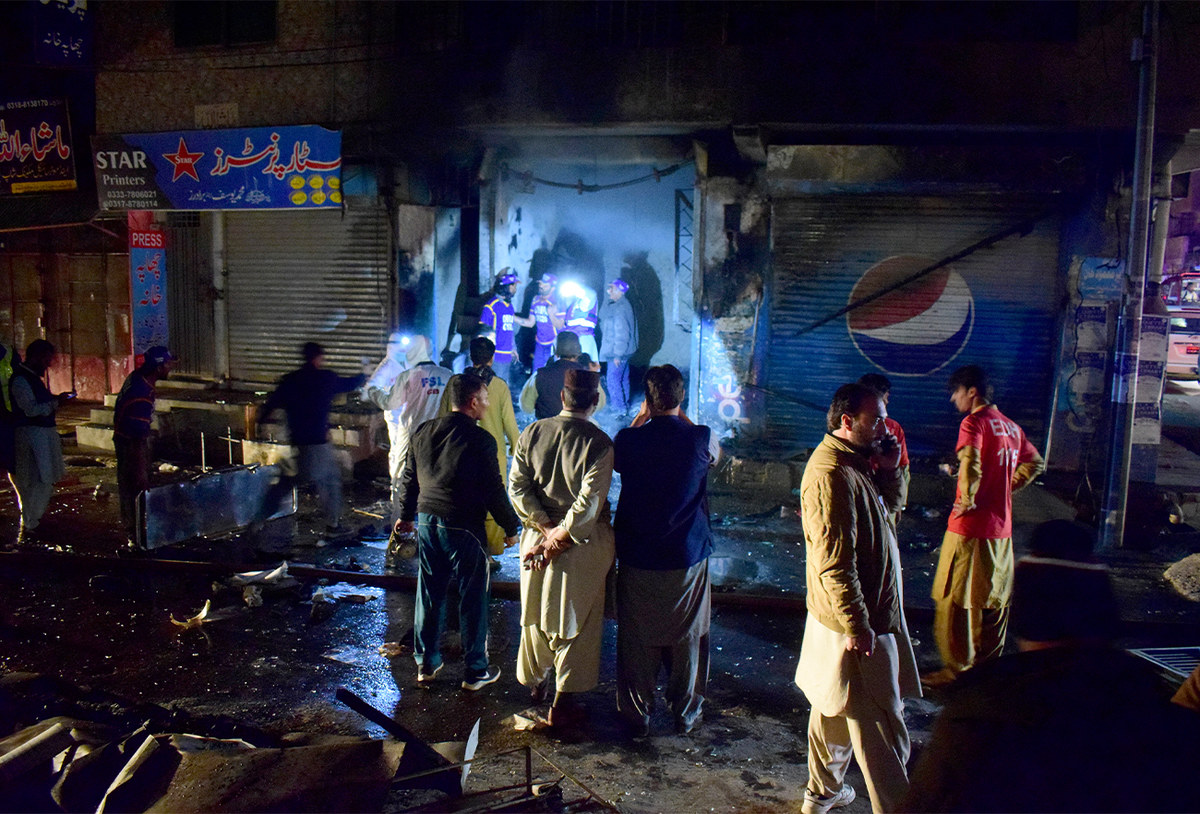


Rescue workers gather at the site of bombing, in Quetta, Pakistan, on March 2, 2022. (AP)

Many shops and vehicles near the site of the incident were damaged due to the intensity of the explosion.
“There are reports that the shop was owned by a member of the Hazara community,” he added. “There was also a brawl and gunfire before the explosion.”
Balochistan is a sparsely populated province that has intermittently witnessed low-intensity insurgency for decades. The government has launched full-scale military operations as well as targeted interventions to quell the violence.
So far, no insurgent group has claimed responsibility for the blast.
However, Baloch insurgent outfits launched coordinated attacks on Frontier Corps camps in Panjgur and Naushki earlier this month that lasted for several hours.
A political member of the ruling Balochistan Awami Party was also targeted and killed in a magnetic bomb attack last week in Hub near Karachi.
Balochistan Chief Minister Mir Abdul Qudoos Bizenjo strongly condemned Wednesday’s attack and directed the authorities to take strict action against insurgents targeting security forces and innocent civilians.


Pakistan finance minister highlights economic stability, improving debt outlook at AlUla Conference

Updated 6 sec ago
Follow

Pakistan finance minister highlights economic stability, improving debt outlook at AlUla Conference

  • Global public debt remains at historic highs, exerting pressure on emerging countries, says Pakistani finance minister
  • Muhammad Aurangzeb says Pakistan’s debt-to-GDP ratio has declined to 70 percent from 74 percent over three years

ISLAMABAD: Pakistan’s Finance Minister Muhammad Aurangzeb highlighted the country’s improving debt outlook and efforts to restore economic stability at the AlUla Conference for Emerging Market Economies on Monday, calling for enhanced global coordination to address sovereign debt vulnerabilities. 

The second edition of the annual AlUla conference was launched by the Saudi Arabia’s Ministry of Finance and the International Monetary Fund (IMF) on Sunday. The conference brings together economic decision-makers, finance ministers, central bank governors, leaders of international financial institutions and a select group of experts and specialists from around the world.

This year’s conference highlights the rapid transformations in the global economy and challenges and the opportunities they present for emerging market economies, particularly in international trade, monetary and financial systems. 

Speaking at a roundtable titled: ‘Addressing Sovereign Debt Vulnerabilities,’ Aurangzeb noted that global public debt remains at historic highs, exerting pressure on emerging and developing economies through higher debt servicing costs, tighter financing conditions and constrained fiscal space, the Finance Division said. 

“The finance minister highlighted that Pakistan has made initial but meaningful progress in restoring stability through disciplined macroeconomic policies, institutional reforms, and proactive debt management, while acknowledging that the reform journey remains ongoing,” the Finance Division said. 

The minister said Pakistan remains on track to contain and better manage public debt, extending maturities, reducing costs and undertaking early debt repayments. Aurangzeb noted that these efforts have contributed to a decline in the debt-to-GDP ratio to around 70 percent from about 74 percent over the past three years.

Aurnagzeb also spoke about Pakistan’s progress in domestic resource mobilization, noting that Islamabad has raised its tax-to-GDP ratio, adding that it is now moving to the figure of 12 percent from single-digit levels in earlier years. The minister cited by tax reforms, digitization and base-broadening measures as reasons for the improvement.

“Concluding his remarks, the finance minister stressed that addressing sovereign debt vulnerabilities requires early action, strong institutions, transparency, and credible policy frameworks, supported by enhanced global coordination,” the statement said. 

“Strengthening creditor cooperation, expanding the effective use of liability management operations, and integrating climate resilience into debt frameworks, he noted, will be essential to help emerging economies manage debt sustainably while preserving growth and development priorities.”

Pakistan has recently undertaken reforms mandated by the IMF under its $7 billion loan program to strengthen its fragile economy. While the IMF has acknowledged progress on Islamabad’s part, it has also cautioned that the country’s recovery remains fragile and warned that high public debt, fiscal pressures and exposure to external shocks continue to pose risks to long-term stability.

Pakistan faced a prolonged economic crisis in recent years, marked by fiscal pressure, high debt levels and balance-of-payments difficulties, and subsequently entered an IMF-supported program to stabilize the economy.

Pakistani officials say decreasing levels of inflation and higher foreign exchange reserves reflect the government’s prudent fiscal policies and debt management.