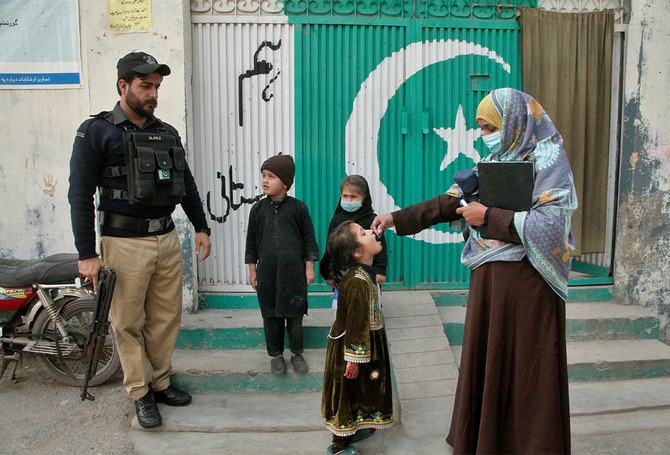
PESHAWAR: Gunmen in northwestern Pakistan shot and killed a female polio worker as she was returning home Wednesday after taking part in the country’s latest anti-polio campaign, police said.
There was no immediate claim of responsibility for the attack. However, militants often target polio teams and police assigned to protect them in Pakistan, falsely claiming the vaccination campaigns are a Western conspiracy to sterilize children.
Wednesday’s attack happened on the outskirts of the city of Peshawar. Iqra Iqbal was gunned down on her way home, said Iftikhar Khan, a police official.
Pakistan regularly launches anti-polio campaigns in an effort to eradicate the highly infectious disease. The latest five-day drive against polio started on Monday.
Since January last year, Pakistan has not reported any new cases, raising hopes the Islamic nation is close to becoming a polio-free country. Pakistan and Afghanistan are the only remaining countries in the world still trying to eradicate polio, which can cause severe paralysis in children.

Gunmen kill female polio worker in Pakistan vaccination campaign
https://arab.news/wh48v
Gunmen kill female polio worker in Pakistan vaccination campaign
- Iqra Iqbal was gunned down on her way home, according to police officials
- Pakistan has not reported any new polio case since January last year, raising hopes it is close to becoming polio-free
Pakistan top military commander urges ‘multi-domain preparedness’ amid evolving security threats
- Asim Munir says Pakistan faces layered challenges spanning conventional, cyber, economic and information domains
- His comments come against the backdrop of tensions with India, ongoing militant violence in western border regions
ISLAMABAD: Pakistan’s top military commander Field Marshal Asim Munir on Tuesday stressed the need for “multi-domain preparedness” to counter a broad spectrum of security challenges facing the country, saying they ranged from conventional military threats to cyber, economic and information warfare.
Pakistan’s security environment has remained volatile following a brief but intense conflict with India earlier this year, when the two nuclear-armed neighbors exchanged missile and artillery fire while deploying drones and fighter jets over four days before a ceasefire was brokered by the United States.
Pakistan has also been battling militant violence in its western provinces of Khyber Pakhtunkhwa and Balochistan, where authorities say armed groups operate from across the border in Afghanistan and receive backing from India. Both Kabul and New Delhi have rejected claims.
The military has also warned that disinformation constitutes a new form of security threat, prompting tighter regulations that critics say risk suppressing dissent. Munir also pointed to a “complex and evolving” global, regional and internal security landscape while addressing participants in the National Security and War Course at the National Defense University (NDU).
“These challenges span conventional, sub-conventional, intelligence, cyber, information, military, economic and other domains, requiring comprehensive multi-domain preparedness, continuous adaptation and synergy among all elements of national power,” he said, according to a military statement.
“Hostile elements increasingly employ indirect and ambiguous approaches, including the use of proxies to exploit internal fault lines, rather than overt confrontation,” he continued, adding that future leaders must be trained and remain alert to recognize, anticipate and counter these multi-layered challenges.
Munir also lauded the NDU for producing strategic thinkers who he said were capable of translating rigorous training and academic insight into effective policy formulation and operational outcomes.


