

UAE ambassador meets Pakistan’s finance chief, discusses strategies to expand bilateral cooperation

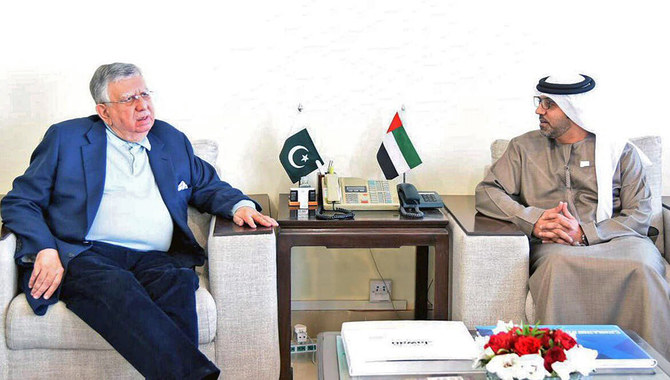
UAE's Ambassador to Pakistan Hamad Obaid Al-Zaabi, right, calls on Pakistan's Finance Minister Shaukat Tarin in Islamabad on March 1, 2022. (Photo courtesy: @UAEembassyIsb/Twitter)
Short Url
Updated 01 March 2022
Follow

UAE ambassador meets Pakistan’s finance chief, discusses strategies to expand bilateral cooperation

  • The UAE is Pakistan’s largest trading partner in the Middle East and home to over 1.6 million Pakistani nationals
  • Last month, a UAE-based group signed an agreement with Pakistan to invest Rs60 billion in a construction project

ISLAMABAD: United Arab Emirates Ambassador Hamad Obaid Al-Zaabi on Tuesday met Pakistan’s Finance Minister Shaukat Tarin to discuss ways of strengthening bilateral cooperation between the two countries, said in an official statement.

Pakistan and the UAE have close fraternal relations and bilateral cooperation in a range of fields.

The UAE is also Pakistan’s largest trading partner in the Middle East and home to more than 1.6 million Pakistani nationals.

The two officials “discussed various dimensions of the bilateral relations” between the two countries, the statement released by the finance ministry said.

“Both the dignitaries shared their contentment over the strength of the prevailing relations,” it added.

The finance minister highlighted the initiatives undertaken by the Pakistani government to ensure economic progress and development in the country.

The UAE ambassador said his country greatly valued its relations with Pakistan.

“It was further expressed that bilateral cooperation in various fields, including trade, investment and religious tourism, would be strengthened between both states,” the statement said.

Last month the UAE-based Dhabi Group signed an agreement with Pakistan to invest Rs60 billion in a construction project called the “Mabarak Center” in Lahore, the capital of the city of the country’s most densely populated Punjab province.


Pakistan Navy chief in Malaysia to strengthen operational cooperation, discuss maritime security

Updated 5 sec ago
Follow

Pakistan Navy chief in Malaysia to strengthen operational cooperation, discuss maritime security

  • Pakistan Navy chief in Malaysia to strengthen operational cooperation, discuss maritime security
  • Navy chief calls for strengthened cooperation between hydrographic offices of both countries 

ISLAMABAD: Pakistan Navy chief Admiral Naveed Ashraf is in Malaysia where he held talks with the leadership of the Royal Malaysian Navy (RMN) to enhance operational cooperation, capacity building and responses to maritime security challenges, the Pakistani Navy said on Sunday.

Pakistan and Malaysia have historically enjoyed close ties ever since they established diplomatic ties in 1957. Both countries have strengthened cooperation in various sectors such as defense, trade, economy, manpower exports and education over the years.

Ashraf was received at the RMN’s headquarters by Admiral Tan Sri (Dr.) Zulhelmy bin Ithnain, the RMN chief, Pakistan’s Navy said in a statement. 

“Discussions focused on aligning strategic perspectives and enhancing operational cooperation, capacity building, and coordinated responses to maritime security challenges,” the statement said. 

Ashraf highlighted Pakistan Navy’s contributions to regional stability through the Regional Maritime Security Patrols and its participation in the Combined Maritime Forces.

He also visited Malaysia’s National Hydrographic Center, calling for strengthened cooperation with Pakistan’s National Hydrographic Office in training, data exchange, and professional collaboration.

“The visit reaffirmed the enduring Pakistan-Malaysia naval partnership and commitment to future-oriented maritime cooperation,” Pakistan Navy said. 

Pakistan’s army, navy and air force have aimed to strengthen bilateral cooperation with their counterparts since last year when Pakistan and India were embroiled in a brief military confrontation. 

Both countries pounded each other with missiles, drone strikes, fighter jets and artillery fire for four days until Washington brokered a ceasefire between them on May 10.