

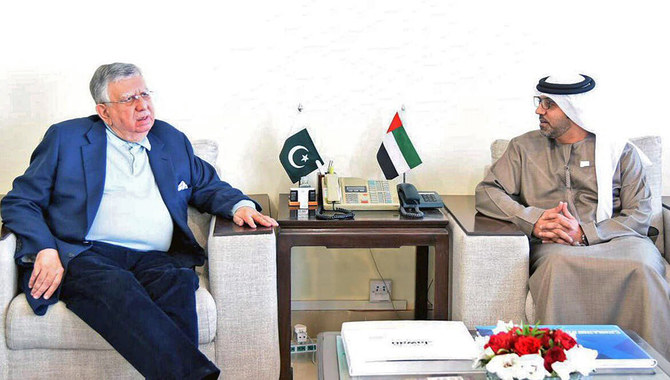
UAE ambassador meets Pakistan’s finance chief, discusses strategies to expand bilateral cooperation

UAE's Ambassador to Pakistan Hamad Obaid Al-Zaabi, right, calls on Pakistan's Finance Minister Shaukat Tarin in Islamabad on March 1, 2022. (Photo courtesy: @UAEembassyIsb/Twitter)
Short Url
Updated 01 March 2022
Follow

UAE ambassador meets Pakistan’s finance chief, discusses strategies to expand bilateral cooperation

  • The UAE is Pakistan’s largest trading partner in the Middle East and home to over 1.6 million Pakistani nationals
  • Last month, a UAE-based group signed an agreement with Pakistan to invest Rs60 billion in a construction project

ISLAMABAD: United Arab Emirates Ambassador Hamad Obaid Al-Zaabi on Tuesday met Pakistan’s Finance Minister Shaukat Tarin to discuss ways of strengthening bilateral cooperation between the two countries, said in an official statement.

Pakistan and the UAE have close fraternal relations and bilateral cooperation in a range of fields.

The UAE is also Pakistan’s largest trading partner in the Middle East and home to more than 1.6 million Pakistani nationals.

The two officials “discussed various dimensions of the bilateral relations” between the two countries, the statement released by the finance ministry said.

“Both the dignitaries shared their contentment over the strength of the prevailing relations,” it added.

The finance minister highlighted the initiatives undertaken by the Pakistani government to ensure economic progress and development in the country.

The UAE ambassador said his country greatly valued its relations with Pakistan.

“It was further expressed that bilateral cooperation in various fields, including trade, investment and religious tourism, would be strengthened between both states,” the statement said.

Last month the UAE-based Dhabi Group signed an agreement with Pakistan to invest Rs60 billion in a construction project called the “Mabarak Center” in Lahore, the capital of the city of the country’s most densely populated Punjab province.



Pakistan, UK discuss regional security, cross-border attacks as senior official visits Islamabad

Updated 7 sec ago
Follow

Pakistan, UK discuss regional security, cross-border attacks as senior official visits Islamabad

  • British envoy for Afghanistan Richard Lindsay’s visit comes at a time of a surge in militancy in Pakistan’s border regions
  • Pakistani diplomat says both sides reviewed broader security challenges, emphasized coordination to address ‘shared concerns’

ISLAMABAD: Pakistani and British officials have discussed regional security challenges and cross-border attacks during talks in Islamabad, a Pakistani diplomat said on Tuesday, during a visit of the United Kingdom’s Afghanistan envoy, Richard Lindsay, to the Pakistani capital.

Pakistan and the UK regularly cooperate on counterterrorism and security, with a focus on intelligence-sharing to combat militant activity. Lindsay’s visit comes at a time of a rise in militancy in Pakistan’s western provinces, which border Afghanistan.

Mohammad Sadiq, Pakistan’s special representative for Afghanistan, said the discussions in Islamabad focused on the regional security situation, particularly the urgent challenge posed by cross-border attacks.

“We also exchanged views on the latest regional security developments and broader security challenges,” he said on X. “We emphasized the importance of continued cooperation and coordination to address shared concerns and promote regional stability.”

Islamabad frequently accuses Afghanistan of allowing its soil and India of backing militant groups, such as the Tehreek-e-Taliban Pakistan (TTP) and the Balochistan Liberation Army (BLA), for attacks against Pakistan. Kabul and New Delhi deny this.

In recent years, Pakistan and the UK have engaged with each other on counterterrorism and cross-border crimes as part of bilateral cooperation.

Both sides held the second round of the Pakistan-UK Counter Terrorism Dialogue in London in February last year, reviewing global and regional threats and exchanging best practices. Over the years, armed forces of both countries have also maintained close cooperation, particularly in counterterrorism efforts and professional military training.