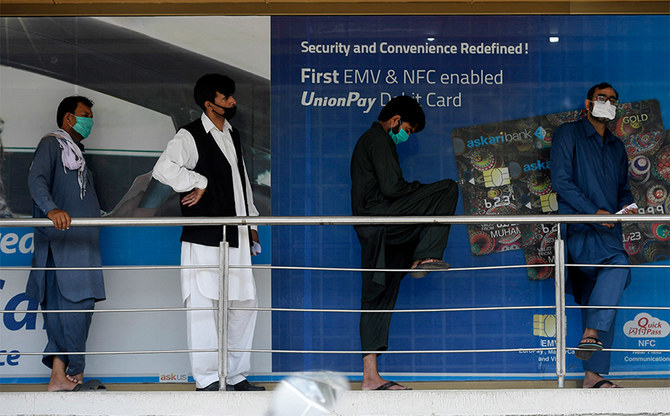
ISLAMABAD: E-banking transactions grew by 12 percent in volume and 16 percent in value in the first quarter of Fiscal Year 2021-22, the Pakistani central bank said on Monday, as the country’s payment ecosystem continued to grow at a fast pace.
These transactions were conducted via electronic channels, including real-time online branches, ATMs, mobile banking, Internet banking, call center banking, Point of Sale (PoS) and e-commerce.
Two major areas where high adoption in digital payments was witnessed were mobile and Internet banking, the State Bank of Pakistan (SBP) said in its first quarterly report of payment systems, covering the period July 2021 till September 2021.
“The number of mobile banking users grew by 4 percent on quarter over quarter (QoQ) basis, reaching a total of 11.3 million. The number of transactions conducted via mobile banking channels was 79.1 million with a value of around PKR 2.2 trillion, showing a QoQ growth of 29 percent by volume and 36 percent by value,” the SBP report read.
“Internet banking also contributed to the upswing in usage of e-Banking services by registering 31 percent QoQ growth in Internet banking users who conducted 30 million transactions amounting to PKR 1.9 trillion. This amounts to 6 percent progress in terms of volume and 10 percent increase in the value of these transactions on QoQ basis.”
The retail banking sector continued to show adoption of digital payments, while overall e-commerce transactions recorded an impressive QoQ growth of 87 percent by volume and 21 percent by value, though the number of e-commerce merchants remained almost the same as of the last quarter, according to the report.
During the quarter, 12.7 million e-commerce-related transactions amounting to Rs22.3 billion were conducted using digital payment channels. Similarly, the number of merchant POS machines increased by 10 percent QoQ, reaching to 79,134 in the country. These machines processed 28.1 million card-based transactions at merchant locations, amounting to almost Rs134.9 billion, which showed QoQ increase of 16.1 percent by volume and 10.6 percent by value.
As of end-September 2021, the report said, there were 46.2 million total cards in circulation, which mainly comprised debit cards (64 percent), social welfare cards (22 percent), ATM-only cards (10 percent), credit cards (4 percent) and prepaid cards (0.3 percent).
Paper-based transactions recorded an increase of 5 percent in volume and 3 percent in value, which may be attributed to people returning to bank branches as pandemic-related restrictions were eased.
In large-value or wholesale payment segment, transactions processed through the Pakistan Real-Time Interbank Settlement Mechanism (PRISM) recorded a total of 1.1 million transactions amounting to Rs159.1 trillion, which was 7 percent higher than the preceding quarter.


Pakistan e-banking transactions grew by 12 percent in first quarter of FY2022 — central bank
https://arab.news/csgm6
Pakistan e-banking transactions grew by 12 percent in first quarter of FY2022 — central bank

- Number of mobile banking users grew by 4 percent, e-banking usage rose by 31 percent
- Overall e-commerce transactions recorded an impressive QoQ growth of 87 percent by volume

Pakistan offers seaport for global cargo transshipment amid Gulf conflict escalation
- Karachi Port Trust says its services can ensure ‘continuity and stability’ of maritime trade
- The region is currently witnessing significant disruptions to global trade and oil shipments
KARACHI: Pakistan has offered its Karachi seaport for uninterrupted global cargo transshipments as escalating Middle East tensions threaten maritime trade, the country’s largest port operator said on Friday.
Iran has been rocked by joint US and Israeli strikes since Feb. 28 that killed Supreme Leader Ayatollah Ali Khamenei. Tehran retaliated with missile and drone attacks on US, Israeli and allied targets across the Gulf, plunging the region into conflict and uncertainty.
The escalation disrupted air travel, heightened military activity, and disrupted shipping through the Strait of Hormuz, a key route carrying roughly 20 percent of global oil shipments.
The Karachi Port Trust (KPT) said in a statement it was ready to support international shipping lines by offering transshipment services to regional ports, helping ensure the “continuity and stability” of global maritime trade.
“Karachi Port Trust remains fully prepared to support the international maritime community and to provide reliable, efficient, and secure port services in the interest of sustaining regional trade connectivity,” KPT Chairman Shahid Ahmed said, according to a statement circulated by the port authority.
It added the facility could help stabilize maritime trade by offering transshipment services for cargo destined for ports across the region.
The statement said as a demonstration of its capability, international vessels MV TS TACOMA and MV TS SYDNEY arrived in Karachi and discharged large number of containers as transshipment cargo.
“The containers will subsequently be transshipped from Karachi to Jebel Ali in the Middle East,” it continued.
Pakistan Maritime Affairs Minister Junaid Anwar Chaudhry on Thursday highlighted the importance of the Gwadar port city’s transshipment role as major shipping routes face disruption from the ongoing conflict.
The developments come as the Strait of Hormuz, a strategic waterway between Iran and Oman and one of the world’s most critical oil transit routes, has been blocked by Iran which has threatened to attack ships that attempt to transit through it.
US President Donald Trump has assured shipping companies of naval escorts and insurance support to protect vessels.
The escalating tensions have contributed to a sharp rise in energy prices and significant disruptions to tanker traffic through the strategic waterway.
Pakistan has long viewed its seaports as strategic assets that could boost trade with Central Asia and the Gulf region, while helping the country earn valuable foreign exchange.


