

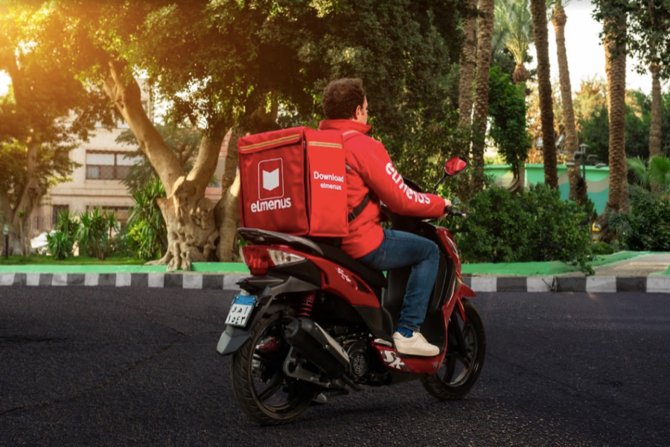
Uber’s Careem investing in Egyptian food delivery app elmenus

Careem, in a statement, as reported by Bloomberg, said the agreement with elmenus is a crucial step in launching its Super App across the region. Social media
Short Url
Updated 10 March 2022
Follow

Uber’s Careem investing in Egyptian food delivery app elmenus

RIYADH: Uber Inc.’s Careem is investing an undisclosed sum in elmenus, a leading Egyptian food delivery app, according to a Bloomberg report. 

Mudassir Sheikha, Careem co-founder and chief executive officer, said the partnership will help connect the company with more than 12,000 eateries in five Egyptian cities and their customers. 

Careem, in a statement, as reported by Bloomberg, said the agreement with elmenus is a crucial step in launching its Super App across the region. 

Uber bought Careem in 2019 for a whopping $3.1 billion. 

Now, Careem offers 11 services in UAE that include ride-hailing, food, and grocery delivery and payments. The food delivery service of elmenus is operational in countries such as Saudi Arabia, Jordan, Qatar, and Pakistan.


Saudi POS stays above $4bn as Ramadan spending lifts outlays on home goods

Updated 48 min 36 sec ago
Follow

Saudi POS stays above $4bn as Ramadan spending lifts outlays on home goods

RIYADH: Saudi point-of-sale transactions remained above $4 billion in the week ending Feb. 14, with spending on furniture and home supplies rising ahead of Ramadan, central bank data showed.

Overall POS activity totaled SR15.34 billion ($4.09 billion), representing a 4.8 percent week-on-week decrease, while the number of transactions dipped 1.6 percent to 252 million, according to the Saudi Central Bank. 

Spending on furniture and home supplies rose 5.9 percent to SR697.35 million, marking the strongest weekly increase among major retail categories. 

Expenditure on electronics increased 2.9 percent, while spending on construction and building materials rose 1.1 percent.

Sectors that saw declines includes freight transport and courier services, which posted a drop of 5 percent to SR64.86 million.

Pharmacy and medical supplies spending fell 8.2 percent to SR223.81 million, but outlays on medical services rose 5.7 percent to SR539.68 million. 

Food and beverage expenditure decreased 4.3 percent, but the total spend of SR2.57 billion meant it retained the largest share of POS activity.

Restaurants and cafes followed with SR1.73 billion, despite a 4.7 percent decline. Apparel and clothing outlays represented the third-largest share of POS spending during the monitored week, up 0.5 percent to SR1.38 billion.

The Kingdom’s major urban centers mirrored the mixed national changes. Riyadh, which accounted for the largest share of total POS spending, saw a 3.4 percent drop to SR5.32 billion. The number of transactions in the capital reached 80.7 million, down 0.8 percent week on week. 

In Jeddah, transaction values decreased 4.4 percent to SR2.12 billion, while Dammam reported a 3.3 percent decrease to SR746.29 million. 

POS data, tracked weekly by SAMA, provides an indicator of consumer spending trends and the ongoing growth of digital payments in Saudi Arabia.  

The data also highlights the expanding reach of POS infrastructure, extending beyond major retail hubs to smaller cities and service sectors, supporting broader digital inclusion initiatives.  

The growth of digital payment technologies aligns with Saudi Arabia’s Vision 2030 objectives, promoting electronic transactions and contributing to the Kingdom’s broader digital economy.