

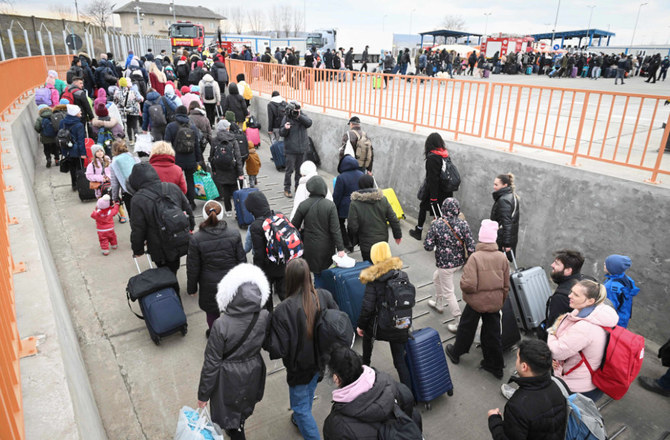
Thousands fleeing Ukraine queue at central Europe border crossings

People coming from Ukraine descend from a ferry boat to enter Romania after crossing the Danube river at the Isaccea-Orlivka border crossing between Romania and Ukraine on February 26, 2022. (AFP)
Short Url
Updated 28 February 2022
Follow

Thousands fleeing Ukraine queue at central Europe border crossings

  • The UN refugee agency, citing data provided by national authorities, said on Sunday about 368,000 people have fled abroad from the fighting

BEREGSURANY, Hungary: Thousands of people fleeing war in Ukraine crossed into central Europe on Sunday, with queues at border crossings stretching back for kilometers on the fourth day of a Russian invasion that has pushed nearly 400,000 people to seek safety abroad.
With men of conscription age prevented from leaving Ukraine, mostly women and children arrived at the border in eastern Poland, Slovakia and Hungary and in northern and northeastern Romania. Some pulled suitcases behind while others had only small duffel bags.
At Beregsurany in Hungary, Valeria, a 44-year-old ethnic Hungarian from Ukraine, fretted over leaving her brother and elderly mother behind in her home town of Berehove, 8 km (5 miles) from the border into the European Union.

“We would not go if we did not have to. If fate was not forcing us, we would not leave,” her husband Laszlo said. The couple declined to give their full names.


The exodus will require the EU to prepare for millions of Ukrainian refugees arriving in the bloc, EU Home Affairs Commissioner Ylva Johansson said.
Germany has warned against putting up bureaucratic hurdles, while France said EU countries will consider “in the next hours and days” if they need to put in place a resettlement program for Ukrainians fleeing the conflict.
The UN refugee agency, citing data provided by national authorities, said on Sunday about 368,000 people have fled abroad from the fighting.
Just under half have gone to Poland. At Poland’s Medyka crossing, where 40,000 people have crossed from Ukraine since Thursday, around one hundred women, children and teenagers stood in line waiting to be processed by Polish border guards.
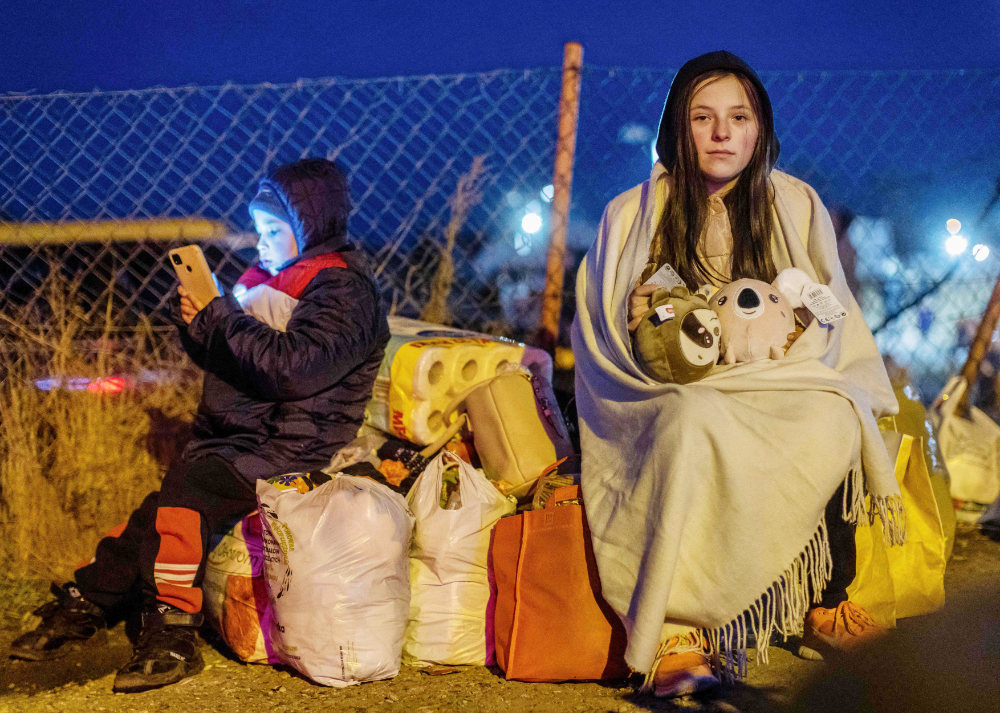


Helena (R) and her brother Bodia (L) from Lviv are seen at the Medyka pedestrian border crossing, in eastern Poland on February 26, 2022, following the Russian invasion of Ukraine. (AFP)

“My message will be very short: It can happen with you, in every home in Europe,” said Sofiia Kochmar-Tymoshenko after crossing into Poland. “Because nobody knows what Putin wants and where he will finish.”
On the Ukrainian side, a queue of cars and buses stretched back some 35 km to the town of Sudova Vyshnya.
Makeshift kitchens served hot meals alongside the road, and volunteers handed out snacks at a petrol station. Ukrainian police looked on as people walked with dogs on leashes and fathers carried children on their backs, everyone swaddled in winter clothes.
Piles of clothing lined the potholed road that cuts through fields and forests toward Lviv, as people sought to lighten their load.
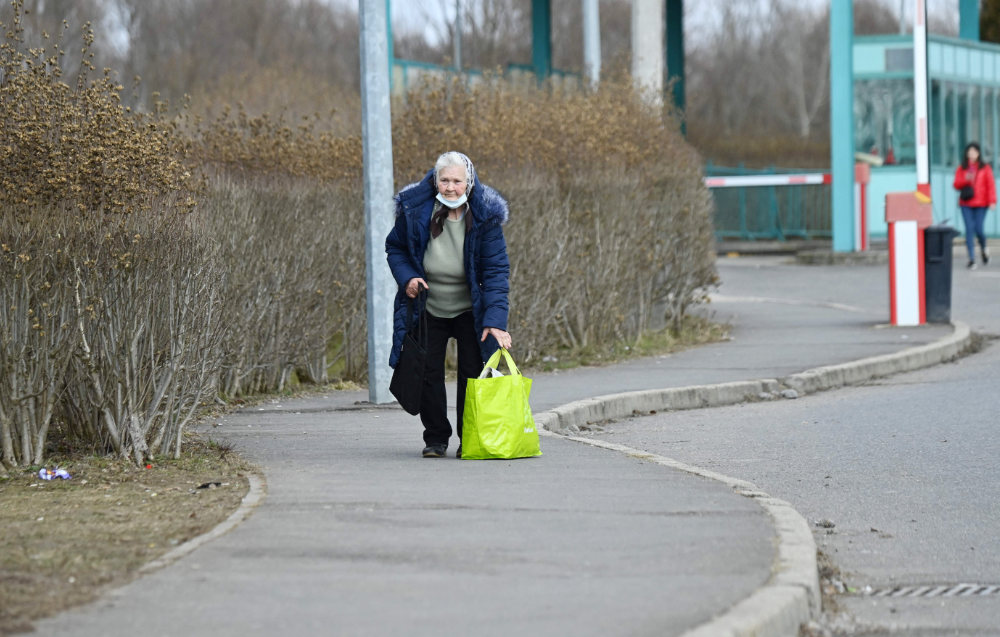


An elderly Ukrainian woman rests a few seconds on the pavement after she arrived at the Ukrainian-Hungarian border crossing in Tiszabecs, Hungary, on February 27, 2022. (AFP)

Once in Poland, newly arrived refugees sifted through boxes of donated sweets and toiletries, and collected fruit from makeshift stands. A trickle of cars and vans headed back for Ukraine packed with food supplies.
Kristina, a 27-year-old Ukrainian who said she left Lviv on Sunday, sat in front of a grocery store in Medyka with her dog.
“We call him Dog, just Dog. Now it’s a Wartime Dog,” she said as she waited for a group of acquaintances to pick her up and drive away from the border.

OUTPOURING OF SUPPORT
Across central Europe, authorities set up makeshift reception centers in tents where people could get medical aid and process asylum papers, while thousands of volunteers drove up to the borders with donations of collected food, blankets and clothes, offering transport services and shelter.
German railway operator Deutsche Bahn said on Sunday it would offer free of charge trips from Poland to Germany for refugees from Ukraine.


Police officers assists refugees fleeing conflict in Ukraine as they arrive, at the Medyka border crossing, in Poland, Sunday, Feb. 27, 2022. (AP)

Meanwhile, the International Committee of the Red Cross (ICRC) said it was receiving calls from people still in Ukraine pleading for food, money, hygiene items and blankets.
“We’re also receiving a growing number of calls from people in other countries, urgently seeking information on their families and friends inside,” the ICRC said on Twitter.
In Hungary, the immigration authority said only 10 people had applied for asylum so far, as an overwhelming majority of people who came over were ethnic Hungarians or already had the right to stay in the country. Thirty-five people have applied for asylum in Slovakia.
Romanian authorities said about half of those who had entered the country so far, or about 20,000 people, had already left for elsewhere in Europe.
The Czech government said a train with military aid for Ukraine had arrived in Poland, loaded with machine guns, sniper rifles, pistols and artillery ammunition.
Romania will send fuel, ammunition, bullet-proof vests, helmets, military equipment, food and water worth 3 million euros ($3.8 million) to Ukraine and has offered to care for the wounded in military and civilian hospitals, government spokesman Dan Carbunaru said on Sunday.
Speaking to reporters at the Slovak border crossing of Ubla, president Zuzana Caputova renewed calls by some in the EU for Ukraine to be admitted as a member.
“What Ukraine is fighting for now is not just Ukraine and its territorial integrity, but it is our European democratic values,” she said.


Agonizing wait as Switzerland works to identify New Year’s fire victims

Updated 12 min 45 sec ago
Follow

Agonizing wait as Switzerland works to identify New Year’s fire victims

  • Authorities begin moving bodies from burned-out bar in luxury ski resor Crans-Montana
  • At least 40 people were killed in one of Switzerland's worst tragedies

CRANS-MONTANA, Switzerland: Families endured an agonizing wait for news of their loved ones Friday as Swiss investigators rushed to identify victims of a ski resort fire at a New Year’s celebration that killed at least 40 people.
Authorities began moving bodies from the burned-out bar in the luxury ski resort town Crans-Montana late Friday morning, with the first silver-colored hearse rolling into the funeral center in nearby Sion shortly after 11:00 am (1000 GMT), AFP journalists saw.
Around 115 people were also injured in the fire, many of them critical condition.
As the scope of the tragedy — one of Switzerland’s worst — began to sink in, Crans-Montana appeared enveloped in a stunned silence.

Mathias Reynard, president of the Council of State of Valais Canton, with Italy's Foreign Minister Antonio Tajani outside "Le Constellation" bar in Crans-Montana where a fire and explosion on New Year's Eve killed more than 40 people. (Reuters)

“The atmosphere is heavy,” Dejan Bajic, a 56-year-old tourist from Geneva who has been coming to the resort since 1974, told AFP.
“It’s like a small village; everyone knows someone who knows someone who’s been affected,” he said.
It is not yet clear what set off the blaze at Le Constellation, a bar popular with young tourists, at around 1:30 am (0030 GMT) Thursday.
Bystanders described scenes of panic and chaos as people tried to break the windows to escape and others, covered in burns, poured into the street.

‘Screaming in pain’

Edmond Cocquyt, a Belgian tourist, told AFP he had seen “bodies lying here, ... covered with a white sheet,” and “young people, totally burned, who were still alive... Screaming in pain.”
The exact death toll was still being established.
And it could rise, with canton president Mathias Reynard telling the regional newspaper Wallizer Bote that at least 80 of the 115 injured were in critical condition.
Swiss authorities warned it could take days to identify everyone who perished, an agonizing wait for family and friends.
Condolences poured in from around the world, including from Pope Leo XIV, who offered “compassion and solidarity” to victims’ families.
Online, desperate appeals abound to find the missing.
“We’ve tried to reach our friends. We took loads of photos and posted them on Instagram, Facebook, all possible social networks to try to find them,” said Eleonore, 17. “But there’s nothing. No response.”

‘The apocalypse’

The exact number of people who were at the bar when it went up in flames remains unclear.
Le Constellation had a capacity of 300 people, plus another 40 people on its terrace, according to the Crans-Montana website.
Swiss President Guy Parmelin, who took office on Thursday, called the fire “a calamity of unprecedented, terrifying proportions” and announced that flags would be flown at half-mast for five days.
“We thought it was just a small fire — but when we got there, it was war,” Mathys, from the neighboring village of Chermignon-d’en-Bas, told AFP. “That’s the only word I can use to describe it: the apocalypse.”

Authorities have declined to speculate on what caused the tragedy, saying only that it was not an attack.
Several witness accounts, broadcast by various media, pointed to sparklers mounted on champagne bottles and held aloft by restaurant staff as part of a regular “show” for patrons.

‘Dramatic’

Pictures and videos shared on social media also showed sparklers on champagne bottles held into the air, as an orange glow began spreading across the ceiling.
One video showed the flames advancing quickly as revellers initially continued to dance.
One young man playfully attempted to extinguish the flames with a large white cloth, but the scene became panic-stricken as people scrambled and screamed in the dark against a backdrop of smoke and flames.
The canton’s chief prosecutor, Beatrice Pilloud, said investigators would examine whether the bar met safety standards.
Red and white caution tape, flowers and candles adorned the street outside, while police shielded the site with white screens.
Italian Foreign Minister Antonio Tajani, who said 13 Italians had been injured in the fire, and six remained missing, was among those to lay flowers at the site.
The French foreign ministry said nine French citizens figured among the injured, and eight others remained unaccounted for.
After emergency units at local hospitals filled, many of the injured were transported across Switzerland and beyond.
Patients are being treated in Italy, France and Germany, and Polish Prime Minister Donald Tusk said his country was ready to provide “specialized medical care to 14 injured.”
Multiple sources told AFP the bar owners were French nationals: a couple originally from Corsica who, according to a relative, are safe, but have been unreachable since the tragedy.