PASAMAN, Indonesia: A strong and shallow earthquake shook Indonesia’s Sumatra island on Friday, killing seven people and injuring 85, while causing panic on the island and in neighboring Malaysia and Singapore.
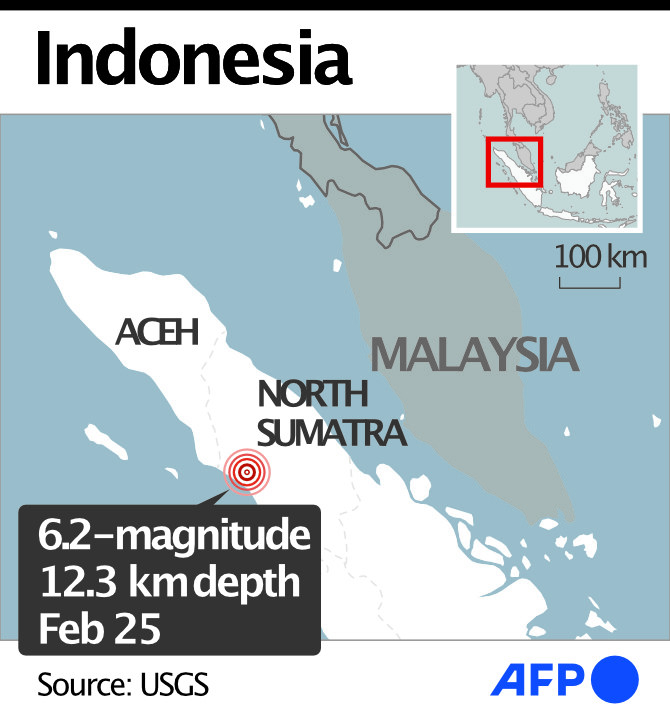
The magnitude 6.2 earthquake struck about 66 kilometers (41 miles) north-northwest of Bukittinggi, a hilly town in West Sumatra province, according to the US Geological Survey. It was centered about 12 kilometers (7.4 miles) below the Earth’s surface.
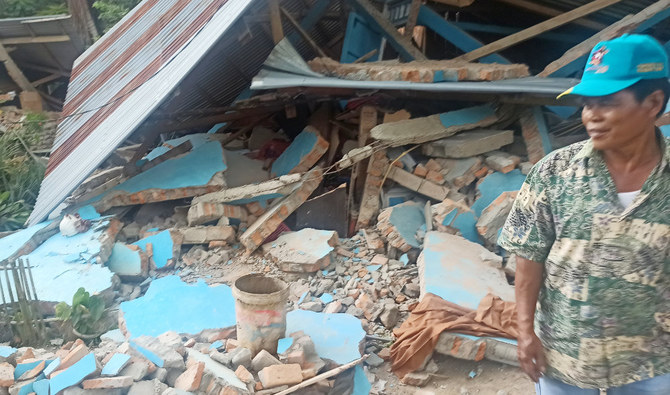
At least four people, including two children, were killed in Pasaman district and three people died in the neighboring district of West Pasaman. At least 410 houses and buildings were damaged, the National Disaster Mitigation Agency said.
More than 5,000 people fled their homes to temporary shelters, mostly in devastated areas of Pasaman and West Pasaman districts, agency spokesperson Abdul Muhari said in a statement.
“We are still focusing on search and rescue efforts for the victims,” Muhari said.
Authorities were still investigating the full extent of the damage.
People ran out of their houses looking for safer places when the earthquake struck, said Ahmad Nur, a resident of Talamau village in West Pasaman district. He said he was preparing to open his shop in a nearby market and returned home to check on his family. His house was damaged and his wife was in pain because her leg had been hit by debris, he said.
“Thank God ... my wife and our two kids managed to escape when the walls started to tumble,” Nur said. “The quake destroyed everything in my house, but I’m grateful that my wife and children are safe ... with only minor injuries.”
He said he and other survivors set up makeshift tents near the government office and were awaiting relief from the government or volunteers.
Dwikorita Karnawati, head of the Meteorology, Climatology and Geophysical Agency, said there was no danger of a tsunami but warned of possible aftershocks.
Television reports showed panicked people rushing into the streets in Padang, the capital of West Sumatra province, and patients in a hospital in West Pasaman being evacuated from the building. The reports also showed streams filled with mud from landslides triggered by the earthquake, and a mosque, a school and several houses that were flattened.
People in neighboring Malaysia and Singapore also felt the tremors. A video on social media showed residents gathering in the streets after high-rise buildings in Kuala Lumpur swayed for a few seconds. Witnesses said their doors and chairs shook and photos and paintings swayed on the walls.
Indonesia, a vast archipelago of more than 270 million people, is frequently struck by earthquakes, volcanic eruptions and tsunamis because of its location on the “Ring of Fire,” an arc of volcanoes and fault lines in the Pacific Basin.
In January 2021, a magnitude 6.2 earthquake killed at least 105 people and injured nearly 6,500 in West Sulawesi province.
A powerful Indian Ocean quake and tsunami in 2004 killed nearly 230,000 people in a dozen countries, most of them in Indonesia.


![]()
![]()

Magnitude 6.2 earthquake kills 7 on Indonesia’s Sumatra
Short Url
https://arab.news/ntrx8
Magnitude 6.2 earthquake kills 7 on Indonesia’s Sumatra


Latest updates





© 2026 SAUDI RESEARCH & PUBLISHING COMPANY, All Rights Reserved And subject to Terms of Use Agreement.