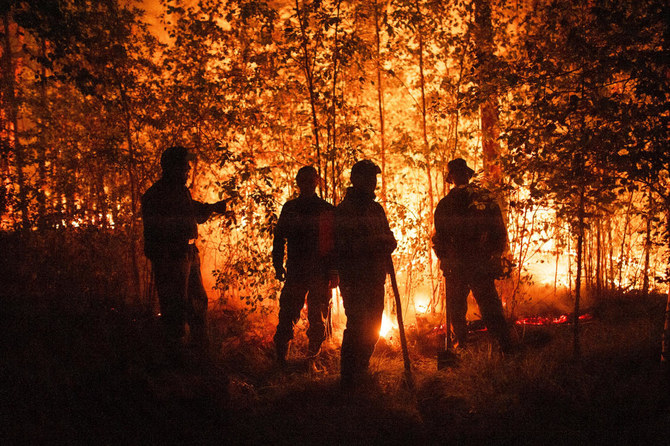
BILLINGS: A warming planet and changes to land use patterns mean more wildfires will scorch large parts of the globe in coming decades, causing spikes in unhealthy smoke pollution and other problems that governments are ill prepared to confront, according to a UN report released Wednesday.
The Western US, northern Siberia, central India, and eastern Australia already are seeing more blazes, and the likelihood of catastrophic wildfires globally could increase by a third by 2050 and more than 50 percent by the turn of the century, according to the report from the United Nations Environment Program.
Areas once considered safe from major fires won’t be immune, including the Arctic, which the report said was “very likely to experience a significant increase in burning.”
Tropical forests in Indonesia and the southern Amazon of South America also are likely to see increased wildfires, the report concluded.
“Uncontrollable and devastating wildfires are becoming an expected part of the seasonal calendars in many parts of the world,” said Andrew Sullivan, with the Commonwealth Scientific and Industrial Research Organization in Australia, one of the report’s authors.
The report describes a worsening cycle: Climate change brings more drought and higher temperatures that make it easy for fires to start and spread, and in turn those blazes release more climate-changing carbon into the atmosphere as they burn through forests and peatland.
Some areas including parts of Africa are seeing decreasing wildfires, in part because more land is being devoted to agriculture, said report co-author Glynis Humphrey from the University of Cape Town.
But UN researchers said many nations continue to spend too much time and money fighting fires and not enough trying to prevent them. Land use changes can make the fires worse, such as logging that leaves behind debris that can easily burn and forests that are intentionally ignited to clear land for farming, the report said.
Poor communities are often hit hardest by fires, which can degrade water quality, destroy crops and reduce land available to grow food.
“It impacts people’s jobs and the economic situation that people are in,” Humphrey said. “It’s integral that fire be in the same category of disaster management as floods and droughts. It’s absolutely essential.”
In the United States, officials recently unveiled a $50 billion effort to reduce fire risks over the next decade by more aggressively thinning forests around “hot spots” where nature and neighborhoods collide. Only some of that work has funding so far — about $3 billion over five years under the recently passed federal infrastructure bill, according to officials in President Joe Biden’s administration.
Critics of the administration’s plan say it continues to put too much emphasis on fighting some fires that can be useful to clear out underbrush when the flames remain relatively small and don’t threaten houses.
The UN researchers also called for more awareness of the dangers from wildfire smoke inhalation, which can affect tens of millions of people annually as plumes from major wildfires drift thousands of miles across international borders.


![]()

UN: Wildfires getting worse globally, governments unprepared
Short Url
https://arab.news/6a5st
UN: Wildfires getting worse globally, governments unprepared
- The Western U.S., northern Siberia, central India, and eastern Australia already are seeing more blazes
- Tropical forests in Indonesia and the southern Amazon of South America also are likely to see increased wildfires


Latest updates


© 2026 SAUDI RESEARCH & PUBLISHING COMPANY, All Rights Reserved And subject to Terms of Use Agreement.