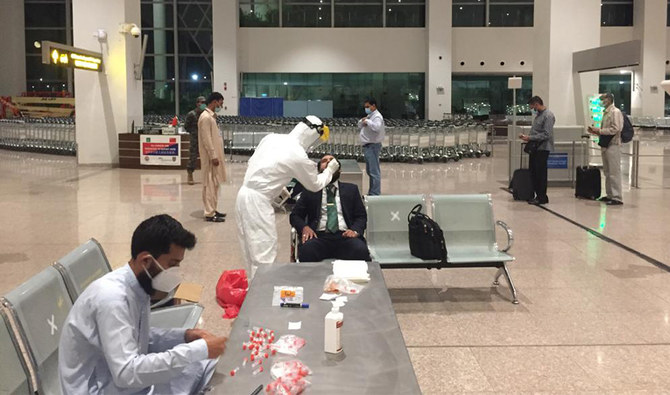
ISLAMABAD: Pakistan on Wednesday announced that passengers flying into the country would no longer be required to take a previously mandatory COVID-19 negative polymerase chain reaction (PCR) test.
After a omicron-fueled fifth wave of the coronavirus gained momentum in the South Asian nation early this year, last month Pakistan made PCR testing mandatory for all passengers above 6 years of age.
Last month, Pakistan reported over 7,000 COVID-19 cases in a single day, its highest daily number of infections since the pandemic began, with the government imposing new restrictions to curb the fast-spreading omicron variant.
“With effect from 24 Feb 22, requirement of negative PCR report for passengers traveling to Pakistan has been abolished (for fully vaccinated travelers),” the National Command and Operation Center (NCOC), which oversees the country’s pandemic response, said in a statement, adding that non-vaccinated individuals over 12 years would require a pre-boarding negative PCR.
“Passenger below 12 year of age are exempted from mandatory vaccination,” the NCOC statement read. “Passenger between 12-18 years of the age are allowed to travel without mandatory vaccination till 31st March 2022.”
The number of infections has been on the decline in the country for the past few weeks, with 1,232 new cases detected in the last 24 hours, and 43 deaths. The national positivity rate has also dropped to less than three percent.
Last week Pakistan eased COVID-19 restrictions for cities where the coronavirus positivity rate is below 10 percent.
Pakistan, with a population of 220 million, rolled out its vaccine campaign in February 2021, prioritizing health care workers and the elderly. It has since expanded its campaign to include the entire eligible population. Over 96 million Pakistanis were fully vaccinated as of Wednesday and over 1124 million had received a first dose of a COVID-19 vaccine.

Pakistan scraps mandatory COVID-19 testing for inbound passengers
https://arab.news/6fd89
Pakistan scraps mandatory COVID-19 testing for inbound passengers
- Passengers between 12-18 years allowed to travel without mandatory vaccination till March 31
- Last week Pakistan eased COVID-19 curbs in the country amid declining infection numbers
Pakistan, IFC review steps to unlock private investment, jobs
- Talks focus on public-private partnerships, mobilizing private capital
- Government flags IT, agriculture, mining, health care as priority sectors
KARACHI: Pakistan’s finance minister on Thursday reviewed ways to deepen cooperation with the International Finance Corporation (IFC) to mobilize private investment, expand public-private partnerships and support job creation, the finance ministry said in a statement.
Finance Minister Muhammad Aurangzeb met an IFC delegation led by Khawaja Aftab Ahmed, the lender’s director for the Middle East, Pakistan and Afghanistan, as Islamabad seeks to translate recent macroeconomic stabilization into sustained private-sector growth.
Pakistan has made progress under an International Monetary Fund–backed reform program, easing immediate default risks and restoring a measure of macroeconomic stability. But officials say the next phase hinges on reviving investment, expanding exports and creating jobs, particularly as fiscal space remains tight and development spending constrained.
“Both sides agreed on the need to align investment and advisory support with Pakistan’s medium-term development priorities, with a clear focus on job creation, sustainability, and export-oriented growth,” the finance ministry said.
According to the statement, the IFC briefed the minister on its expanding engagement in Pakistan across investment and advisory operations, including local-currency financing, private-sector investments and sustainability-oriented initiatives. Particular emphasis was placed on the IFC’s role in strengthening public-private partnership frameworks, including projects aimed at improving urban services, infrastructure performance and resource efficiency.
Aurangzeb outlined the government’s strategy of creating enabling ecosystems rather than direct state intervention, identifying priority areas such as the digital and information technology economy, agriculture and agri-value chains, minerals and mining, health care and skills-based human capital exports.
Both sides also discussed closer coordination within the World Bank Group to deploy advisory, financing and risk-mitigation instruments more effectively, while stressing the importance of timely execution of approved transactions to maintain investor confidence.
Pakistan’s engagement with the International Finance Corporation is part of a broader long-term partnership aimed at catalyzing private sector-led growth. Since its early involvement in the country, IFC has deployed a range of equity and loan investments across sectors including renewable energy, infrastructure, manufacturing and agribusiness, with cumulative investments reaching an estimated $13 billion over several decades.
In recent years, IFC has boosted financing for strategic initiatives such as Pakistan’s first sustainable aviation fuel facility in Punjab, where it is providing up to $35 million in equity and debt capital to generate jobs, support exports and reduce carbon emissions.


