

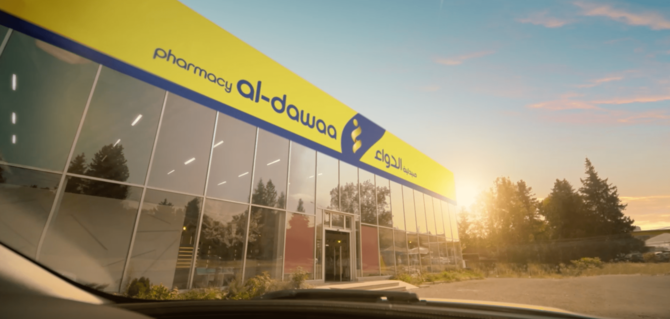
Saudi pharma chain Al-Dawaa raises $27bn in IPO from institutional investors

Short Url
Updated 23 February 2022
Follow

Saudi pharma chain Al-Dawaa raises $27bn in IPO from institutional investors

  • Individual subscriptions will be invited between Feb. 27 and March 1

RIYADH: Saudi pharmacy chain Al-Dawaa raised SR100 billion ($27 billion) in equity from institutional investors after its first sale of shares to the public.

With the order book 53.8 times oversubscribed, the final offer price has been set at SR73 per share, according to a bourse filing.

This translates into a market value of as much as $1.6 billion, the pharma chain operator said in a statement.

Individual subscriptions will be invited between Feb. 27 and March 1, offering a maximum of 2.55 million shares.

“Following a successful book-building process which saw strong demand from institutional investors, the final offer price is testament to the strength of our investment proposition,” said the company’s CEO, Mohammed Al-Farraj.

Listing represents a chance to “strengthen Al-Dawaa’s brand presence and future growth potential as well as reinforce our commitment to the highest standards of corporate governance,” Al-Dawaa commercial director, Fahad Al-Farraj, told Arab News earlier.

Proceeds from the offering will be used to feed that strategy and enhance automation across the company’s supply chain, he said.


Islamic banks’ market share in Turkiye rises to 9.2%: Fitch Ratings

Updated 18 February 2026
Follow

Islamic banks’ market share in Turkiye rises to 9.2%: Fitch Ratings

RIYADH: Islamic banks in Turkiye lifted their asset market share to 9.2 percent in 2025 from 8.1 percent a year earlier, as financing and deposits outpaced the broader banking sector, a new analysis showed. 

In its latest report, Fitch Ratings said financing and deposit market shares rose to 7.9 percent and 10.4 percent, respectively, by the end of 2025, compared with 7.3 percent and 9.4 percent in 2024.

The agency noted that new digital Islamic banks are emerging in the country, with investment from Gulf Cooperation Council countries expected to continue. 

Turkiye’s strong ties with Islamic countries across the Balkans, Africa and the Middle East support the development of its Islamic banking sector, attracting investors and contributing to the industry’s growth.

In its latest report, Fitch stated: “Three recently established private Islamic banks (two digital) grew rapidly in the first nine months of 2025. Investment in digital participation banking from the Gulf Cooperation Council countries underscores the potential for further investment from the region.” 

It added: “Planned establishment of new participation banks, and rapid growth of recently established banks – albeit from small bases – means that the segment landscape may be reshaped in 2026.” 

Dubai Islamic Bank PJSC’s investment in digital bank TOM underscores the potential for further GCC investment. 

Turkish regulators have approved the establishment of Halk Katilim Bankasi A.S. and Adil Katilim Bankasi A.S. (digital), while BIM Birlesik Magazalar A.S.’s application is pending. 

Fitch added that state-owned participation banks may merge or pursue initial public offerings, potentially reshaping the banking landscape. 

The report predicts Islamic banks’ market share will rise further in 2026, supported by strong internal capital generation and growth appetite. However, the non-performing financing ratio may increase moderately due to high inflows. 

“The segment’s non-performing financings ratio deteriorated to 2 percent at end-2025 compared to 1.2 percent in 2024 but remained below the sector average of 2.5 percent,” said Fitch. 

It added: “We expect pressure to persist given still-high financing rates, high but declining inflation, and the sensitivity of unsecured retail (lower share than conventional banks) and SME segments to economic cycles. We forecast a moderate increase in the segment NPF ratio in 2026.”