

Red Sea Farms sees tie-up with American university as a gateway to global market, says CEO

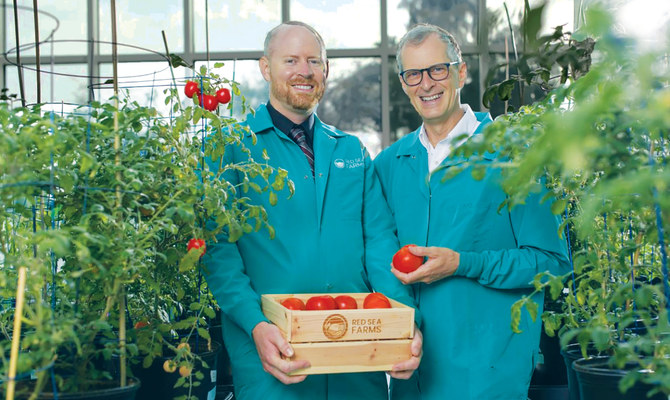
Red Sea Farms was established in 2018 with a vision to reduce food insecurity, carbon and freshwater use in the global and Gulf food sectors. (Supplied)
Short Url
Updated 22 February 2022
Follow

Red Sea Farms sees tie-up with American university as a gateway to global market, says CEO

  • The Saudi startup uses saltwater to cool greenhouses and irrigate crops, such as tomatoes

DUBAI: Saudi startup Red Sea Farms is preparing for a global launch of its saltwater farming technology — after a key partnership with the University of Arizona — that may open doors to North America’s massive agriculture market and beyond, said one of its founders.

The startup, spun out of the King Abdullah University of Science and Technology in 2018 by engineer Ryan Lefers and plant scientist Mark Tester, has invented a technology that grows crops without using freshwater in humidity-controlled greenhouses.

Although the technology is already being used in the Kingdom and other parts of the Middle East, CEO Lefers said the firm is looking to bring its system to other parts of the world where water is scarce. 
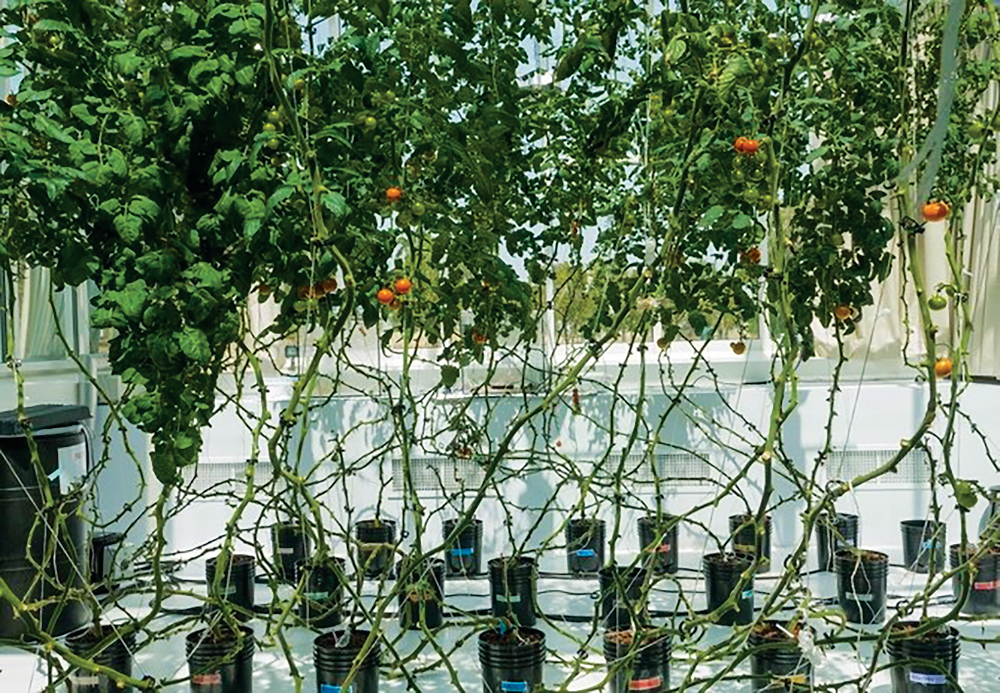


Red Sea Farms is also working to sell this method of farming to growers around the world. (An photo by Huda Bashatah)

The firm uses saltwater to cool greenhouses and irrigate crops, such as tomatoes, that it, or its partner farms, sell into the market. It also provides technical advice to other firms on how to grow crops in arid climates.

“Initial deployment is already happening in the Middle East, but we are looking at the US as a pathway into North America, and then globally,” he told Arab News.

Last month, Red Sea Farms announced a partnership with the University of Arizona’s College of Life and Sciences’ Controlled Environment Agriculture Center.

Under the deal, the Arizona center will combine Red Farms’ technology with its existing farming programs in a yearlong study to assess the results before deciding on a further rollout.

FASTFACTS

• Last month, Red Sea Farms announced a partnership with the University of Arizona’s College of Life and Sciences’ Controlled Environment Agriculture Center.

• Under the deal, the Arizona center will combine Red Farms’ technology with its existing farming programs in a yearlong study to assess the results before deciding on a further rollout.

• The controlled-environment agriculture market is projected to jump from $74.5 billion (SR279.5 billion) to $172.1 billion by 2025.

“We have a four-phase plan for our deployment, and right now we’re in phase three, which is around commercial-scale testing,” Lefers said, adding they expect to reach actual deployment by the end of 2022.

Aside from solving long-standing agricultural issues in parts of the US, the move is also seen to take advantage of a growing demand for greenhouse technologies in the country to boost food security.

The controlled-environment agriculture market is projected to jump from $74.5 billion (SR279.5 billion) to $172.1 billion by 2025, Lefers said, citing their market research. But he said profits are still out of the question as the startup continues to discuss the pricing of its system. “We’re still working on our pricing models around the technology and what price gets charged to the end consumer,” Lefers noted, adding this will also come by the end of the year.

Global rollout

Red Sea Farms is also working to sell this method of farming to growers around the world.

“We have a strong interest in Southeast Asia. We see that as a growing global market with a lot of demand, and with a lot of the challenges that we see on the coast of the Red Sea,” Lefers said.

“We are also looking at South Europe, North Africa — there’s a lot of agriculture in the Mediterranean zone that happens to fall in arid regions,” Lefers said.

The partnership with the University of Arizona comes after a $16 million funding round last August from Wa’ed, Aramco’s entrepreneurship arm, as well as US investors AppHarvest and Bonaventure Capital.

Lefers said future investors will play a crucial role in scaling the technology globally — not just in cash, but through business “connections and synergies.”

He noted: “Our ideal investor at this stage of the company is really around an investor who is not ‘just money,’ but someone who has connections, or those who we see strong synergy with from a business perspective.” The Saudi startup is expected to close a Series A round funding in the second half of this year, and Lefers said they are already receiving expressions of interest for participation in the next important step of this young firm’s growth.


First EU–Saudi roundtable on critical raw materials reflects shared policy commitment

Updated 16 January 2026
Follow

First EU–Saudi roundtable on critical raw materials reflects shared policy commitment

RIYADH: The EU–Saudi Arabia Business and Investment Dialogue on Advancing Critical Raw Materials Value Chains, held in Riyadh as part of the Future Minerals Forum, brought together senior policymakers, industry leaders, and investors to advance strategic cooperation across critical raw materials value chains.

Organized under a Team Europe approach by the EU–GCC Cooperation on Green Transition Project, in coordination with the EU Delegation to Saudi Arabia, the European Chamber of Commerce in the Kingdom and in close cooperation with FMF, the dialogue provided a high-level platform to explore European actions under the EU Critical Raw Materials Act and ResourceEU alongside the Kingdom’s aspirations for minerals, industrial, and investment priorities.

This is in line with Saudi Vision 2030 and broader regional ambitions across the GCC, MENA, and Africa.

ResourceEU is the EU’s new strategic action plan, launched in late 2025, to secure a reliable supply of critical raw materials like lithium, rare earths, and cobalt, reducing dependency on single suppliers, such as China, by boosting domestic extraction, processing, recycling, stockpiling, and strategic partnerships with resource-rich nations.

The first ever EU–Saudi roundtable on critical raw materials was opened by the bloc’s Ambassador to the Kingdom, Christophe Farnaud, together with Saudi Deputy Minister for Mining Development Turki Al-Babtain, turning policy alignment into concrete cooperation.

Farnaud underlined the central role of international cooperation in the implementation of the EU’s critical raw materials policy framework.

“As the European Union advances the implementation of its Critical Raw Materials policy, international cooperation is indispensable to building secure, diversified, and sustainable value chains. Saudi Arabia is a key partner in this effort. This dialogue reflects our shared commitment to translate policy alignment into concrete business and investment cooperation that supports the green and digital transitions,” said the ambassador.

Discussions focused on strengthening resilient, diversified, and responsible CRM supply chains that are essential to the green and digital transitions.

Participants explored concrete opportunities for EU–Saudi cooperation across the full value chain, including exploration, mining, and processing and refining, as well as recycling, downstream manufacturing, and the mobilization of private investment and sustainable finance, underpinned by high environmental, social, and governance standards.

From the Saudi side, the dialogue was framed as a key contribution to the Kingdom’s industrial transformation and long-term economic diversification agenda under Vision 2030, with a strong focus on responsible resource development and global market integration.

“Developing globally competitive mineral hubs and sustainable value chains is a central pillar of Saudi Vision 2030 and the Kingdom’s industrial transformation. Our engagement with the European Union through this dialogue to strengthen upstream and downstream integration, attract high-quality investment, and advance responsible mining and processing. Enhanced cooperation with the EU, capitalizing on the demand dynamics of the EU Critical Raw Materials Act, will be key to delivering long-term value for both sides,” said Al-Babtain.

Valere Moutarlier, deputy director-general for European industry decarbonization, and directorate-general for the internal market, industry, entrepreneurship and SMEs at European Commission, said the EU Critical Raw Materials Act and ResourceEU provided a clear framework to strengthen Europe’s resilience while deepening its cooperation with international partners.

“Cooperation with Saudi Arabia is essential to advancing secure, sustainable, and diversified critical raw materials value chains. Dialogues such as this play a key role in translating policy ambitions into concrete industrial and investment cooperation,” she added.